The White Sox are spending $52.5 million over three years on a pitcher with a power arsenal, a top prospect pedigree and a record full of interruptions. Their agreement with right-hander Dustin May is a clear bet on what he might still become. The contract, which the team has yet to announce officially, also reflects how much uncertainty Chicago is willing to absorb in the middle of its rotation.
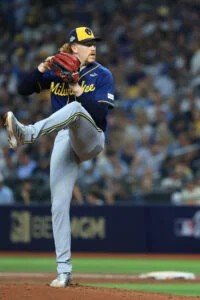
May will pitch next season at 29. His fastball and sinker averaged 96.9 mph and 96.6 mph, respectively, in 2026, and he also throws a 93.3 mph cutter, an 86 mph slider and a changeup in the low 90s. Those are enticing tools for a pitcher once regarded as one of baseball’s leading pitching prospects. Chicago’s challenge is turning that raw stuff into more consistent results and keeping him on the mound.
Velocity against the recent record
May’s latest season showed both the appeal and the risk. He began 2026 on a one-year, $12.5 million contract with St. Louis, then moved to Milwaukee at the trade deadline alongside reliever JoJo Romero. May struggled with the Brewers, allowing a 5.65 ERA in 10 starts and 36 2/3 innings. His postseason work was also difficult.
Across the regular season, he posted a 4.70 ERA in a career-high 145 2/3 innings. Including the playoffs, he finished with a 4.77 ERA in 156 2/3 innings. That workload is a positive sign for availability, but it doesn’t erase the uneven performance: over the past two seasons, May has a combined 4.82 ERA in 278 innings. His 22.2% strikeout rate, 8.8% walk rate and 42% ground-ball rate over that span are all around league-average territory.
There is a longer-running concern behind those numbers. May’s 2025 and 2026 campaigns are the only seasons in which he has thrown more than 56 major league innings. Tommy John surgery in 2021 kept him out until late in 2022. A torn flexor tendon ended his 2023 season, and surgery to repair that injury, followed by surgery for an esophageal tear, wiped out all of 2024.
His swing-and-miss numbers also cooled after an early glimpse of his ceiling. In 53 innings across 2021 and 2022, May struck out 29.1% of hitters and generated a 13.4% swinging-strike rate. In the three seasons he has pitched since, those figures fell to 21.6% and 8.7%. The White Sox are paying for the possibility that his velocity and mix can again produce more missed bats, even though that hasn’t been the recent pattern.
Why Chicago sees a fit
Some underlying measures view May’s recent results more favorably than his ERA does. He recorded a 4.08 FIP and a 4.22 SIERA across 2025 and 2026; in 2026 alone, those figures were 3.63 and 3.99. That gap gives Chicago a case for expecting better outcomes, though it doesn’t settle the question of whether May can sustain the workload or improve his strikeout rate.
The comparison with Jack Flaherty, who became a free agent at 29, helps frame the choice. Flaherty had better results and a stronger durability record at that stage, while May brings higher-end velocity. Chicago appears to be paying for that difference and for the chance that May’s former prospect reputation still points to something more than a back-end starter. The risk is that the deal resembles the expensive bet on a young former prospect that Taijuan Walker represented.
May joins a staff with several plausible options but little certainty. Sean Burke, Grant Taylor, Luis Castillo, Davis Martin and Anthony Kay are among the other candidates. Taylor is moving from relief into a starting role. Young left-hander Noah Schultz, right-handers David Sandlin and Tanner McDougal, and former top prospect Drew Thorpe offer further depth. Thorpe is expected to be healthy for his first full season back from UCL surgery.
There are also unresolved questions around Shane Smith. He opened 2026 as Chicago’s starter on Opening Day after a strong rookie season in 2025, but three rough starts totaling 8 1/3 innings led to an option to Triple-A Charlotte. He struggled there and didn’t return to the major league club that season.
A rotation still needs a stabilizer
General manager Chris Getz has called starting pitching his “top priority” this winter. May adds upside to the middle of the rotation, but he is not a proven workhorse. That distinction matters for a White Sox team that reached the playoffs as a Wild Card in 2026 after entering the season with expectations well below that outcome.
Chicago’s lineup is in better shape. The club has a young group of position players under control, with Munetaka Murakami at first base, Chase Meidroth at second, Colson Montgomery at shortstop and Miguel Vargas at third. The outfield and catcher group includes Sam Antonacci, Tristan Peters, Braden Montgomery and Kyle Teel. There may be room to add a hitter at first base, designated hitter or right field, potentially reducing playing time for Andrew Benintendi or Montgomery.
Before the May agreement, Chicago’s projected payroll stood at $108 million, including estimated arbitration raises for several key players. That exceeded the $98.93 million payroll at the end of 2026, though it remained well below the franchise-record $193 million figure from 2022. May will add to the total, but the available figures don’t suggest that the rotation is finished.
May gives the White Sox a high-velocity arm with a plausible path to outperforming his ERA. The club still needs a steadier source of innings around him. How Chicago fills that gap will determine whether this contract anchors a stronger staff or simply adds another question mark to it.


