Two matchups on this week's card come down to what happens after the snap. That's a broader point than it sounds, because most games that get argued about afterward turn on the same two things: who gets the ball downfield, and who gets hit before the throw. Detroit gives up big plays at a worrying rate. San Francisco's offensive line is doing something few units manage: blocking every assignment on the same play. Here's the thing: those two facts sit at opposite ends of the same question.
Patriots' deep passing hits Detroit's weak spot
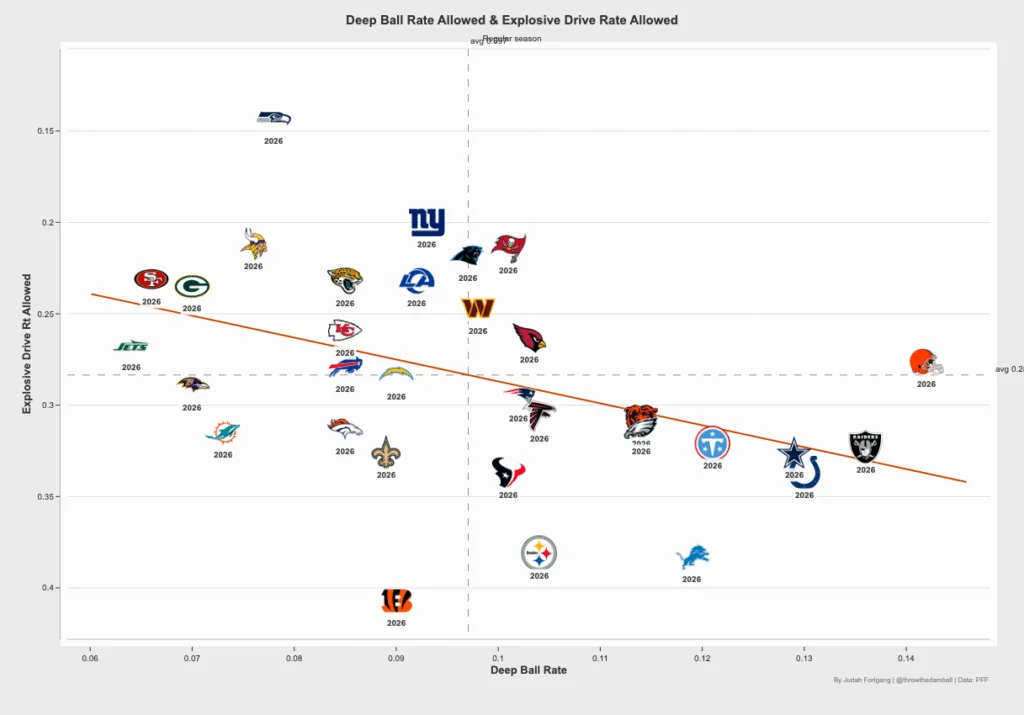
Explosive plays drive offensive success, and PFF's 2022 study on that point still frames how I look at this slate. The Lions haven't stopped them. Nearly 40% of opposing drives have produced at least one explosive gain, and Detroit ranks among the bottom five in explosive pass-play rate allowed. Only one team gives up explosive plays per drive at a higher rate. What makes this more than a stat line is how the damage gets done. A single long completion can erase a string of stalled possessions, which means a defense can allow few yards per play and still get burned repeatedly. That's the pattern to watch here, because it's the kind of weakness that doesn't show up in a team's average performance.
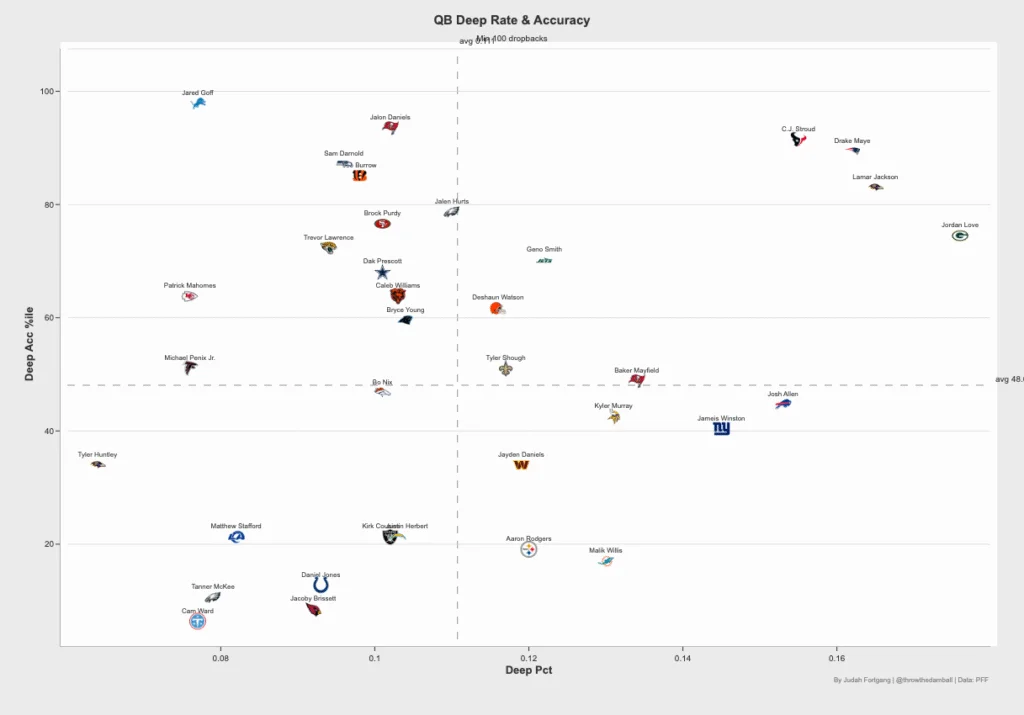
Now add Drake Maye. He throws deep at the third-highest rate in the NFL and ranks among the league's most accurate deep passers. It's no surprise the Patriots rank third in explosive play rate. This is an offense built for chunk gains, and chunk gains are what keep drives alive and turn field position into points. I'd argue this is the center of the matchup. Volume on deep throws is easy to chase, but accuracy on those throws is harder to sustain, and the fact that Maye ranks among the league's best there is what separates a team that takes shots from a team that actually hits them.
Detroit should move the ball too, and that's the part that makes this interesting. Offenses that take big shots tend to produce faster drives, and faster drives mean more possessions for both sides. If New England connects on its deep throws consistently, the pace picks up and scoring chances pile up quickly. Mistakes compound in a game like that, so one blown coverage can turn into a short field and a quick score. My read is that the total is where the market may be underpricing that scenario, though I'd want to see how the early possessions go before I trusted the number.
Betting angles: The over in Patriots-Lions is the primary target, with same-game parlays built around a New England win driven by the passing attack and explosive plays. Those are my framing of the matchup, not guarantees. Totals and parlay prices move with injury news and line adjustments, and any projection built on explosive-play rates is only as stable as the sample behind it.
Perfect blocks give the 49ers an edge against Dallas
I've spent a lot of time looking at offenses as either weak-link or strong-link systems. An offensive line is a weak-link unit: one player missing his assignment can open a lane for pressure and wreck an entire play. That's why a perfect block is such a clean test. It asks a single question. Did everyone on the line do his job? When the answer is yes, the quarterback gets time, the receivers get to their routes, and the play gets to develop the way the coordinator drew it up.
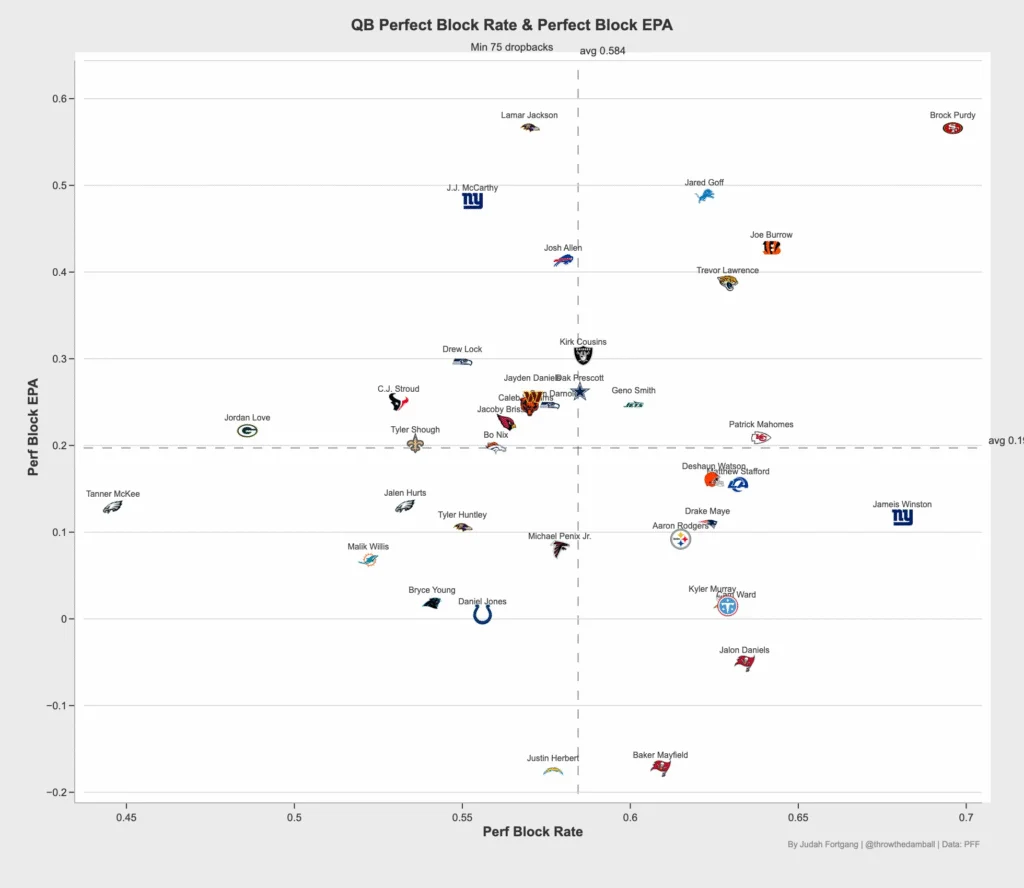
The gap is large. The average offense produces nearly 0.2 expected points per dropback on perfectly blocked plays, and the separation is widest in San Francisco. The 49ers lead the NFL in perfect-block rate, and Brock Purdy and the offense are nearly four times as productive when those blocks happen. That's a rare combination of frequency and payoff. Plenty of lines can block well on a given Sunday. Far fewer can do it often enough that the offense builds its whole identity around it.
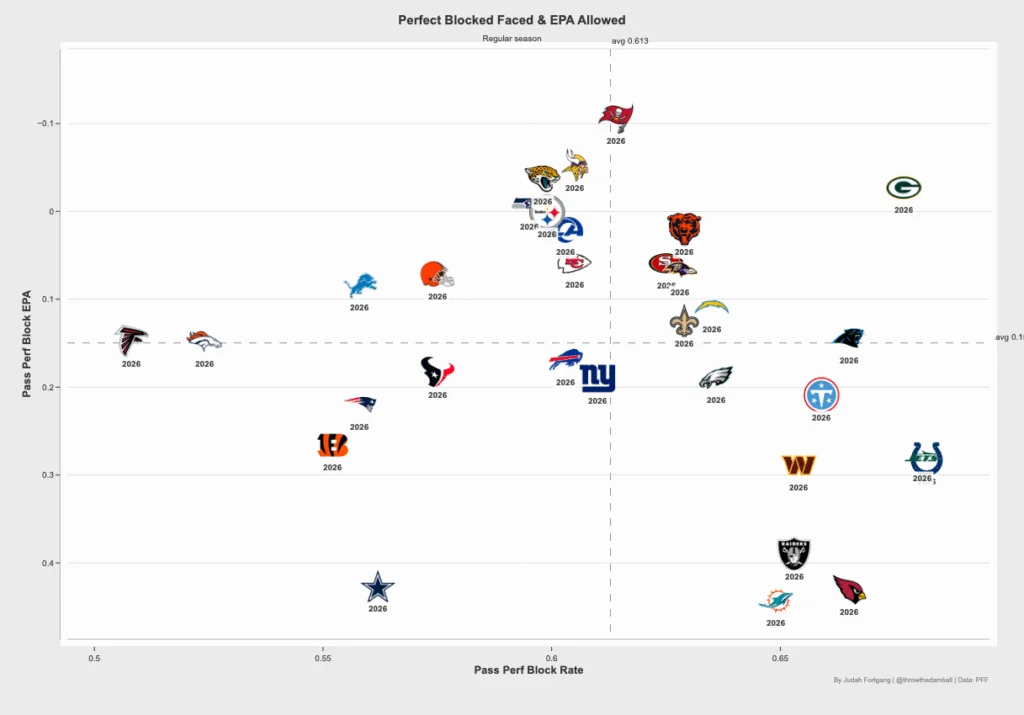
Now they face a Cowboys defense that forces plenty of blocking mistakes but falls apart when the offensive line holds up. Dallas has faced perfect blocks on roughly 57% of dropbacks and allowed nearly 0.45 expected points per play in those situations. That's the number that stands out to me. A defense that generates pressure through breakdowns in protection is only as good as those breakdowns, and if San Francisco's line keeps its shape, the pressure Dallas depends on may never arrive.
San Francisco hasn't posted a perfect-block rate below 60% in any game this season. That consistency matters more than any single strong week. A line that's reliable every Sunday gives the offense a floor, and it lets the game plan stay aggressive without fear of the protection collapsing. That consistency suggests Purdy should get plenty of clean dropbacks to attack a secondary that struggles once the pocket holds. That's the core of the case.
Betting angles: The focus is on 49ers spreads, team total overs against Dallas, and same-game parlays built around an efficient passing performance from San Francisco. Read those as the logic behind the matchup, not as a recommendation. Spreads and team totals respond quickly to injuries and to sharp money, and a line that looks mispriced on Tuesday can look fair by kickoff.
What this slate says about how games get decided
Taken together, these two matchups point to the same lesson. Games are rarely decided by the average play. They're decided by the handful of snaps where a deep throw connects or a protection holds, and the teams that repeat those outcomes tend to win more often than their season totals suggest. Detroit's problem is that it gives those snaps away. San Francisco's strength is that it rarely does.
If you're working in this space, whether you're scouting, writing, or just following the games closely, the useful habit is to look past the yardage column. Ask how the damage happens. Is a defense getting beaten by one long play, or by a steady drip of small gains? Is an offense winning because it's explosive, or because its line gives the quarterback enough time to find the open man? Those questions don't always have clean answers, but they're the ones that separate a read from a guess.
What comes next depends on whether these patterns hold. Explosive-play rates and perfect-block rates are useful, but they're samples, and samples can drift when injuries hit or when opposing coaches adjust. The real test is whether Maye keeps finding receivers downfield and whether San Francisco's line keeps its shape against a Dallas front that wants to make things messy. Consistency, not peaks, is what I'll be watching.
The early drives will tell the story. If Purdy gets clean pockets from the first series, the real question becomes whether Dallas can generate the mistakes it needs to stay in the game. That's a lot to ask of a defense that has struggled to create pressure without help from its opponent. And yet, if Dallas does force a couple of early breakdowns, the matchup looks very different.


