The Panthers' edge in this matchup isn't a dramatic one on paper. It shows up in how each team's weaknesses line up with the other's strengths, and that's where this game could tilt. Here's the thing: matchups like this rarely get decided by a single headline stat. They tend to turn on a few specific mismatches that a box score won't surface until after the final whistle.
Where the efficiency numbers land
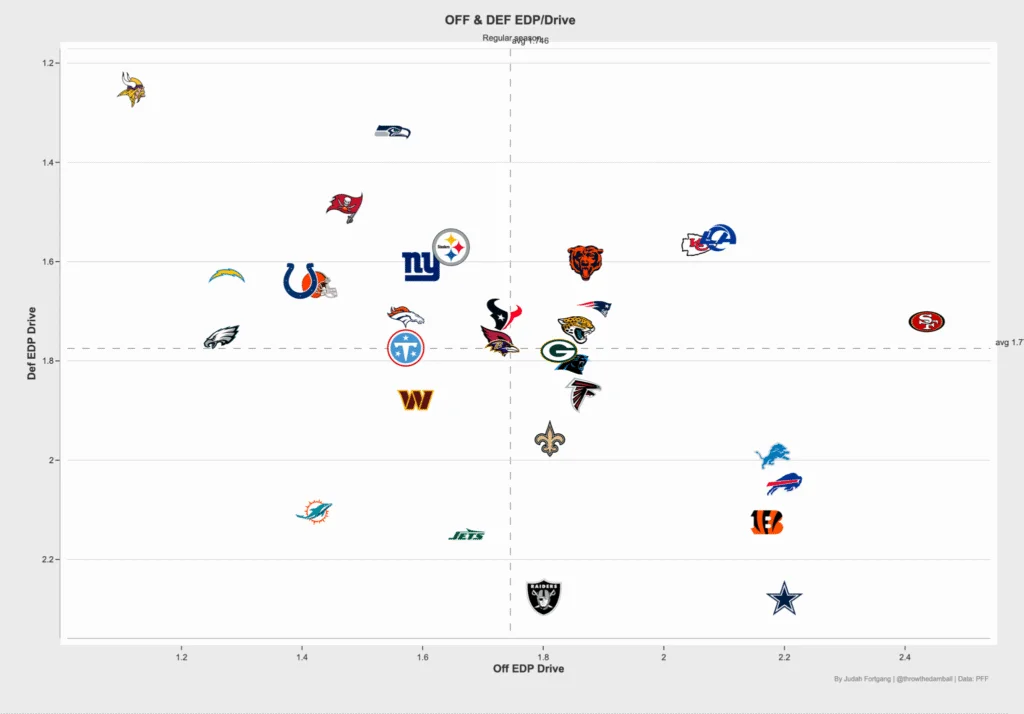
Start with Earned Drive Points, which measures how repeatable and sustainable a drive's success is on a points-per-drive basis. Both offenses look similar here. Carolina's defense grades slightly better. That's the kind of gap you'd expect between two units that have traded blows all year without either one pulling clearly ahead. If you're trying to judge which side has the stronger case, a metric like this helps because it looks past the one big play that can inflate a team's record.
EPA per play tells the same story. Switch to your preferred efficiency metric and you'll mostly see Carolina edging a Saints team it doesn't clearly outclass. That's a narrow advantage, not a blowout. I'd be wary of anyone selling this as a mismatch. Efficiency metrics agree with each other more often than fans expect, and when they all point the same modest way, the signal is real but thin.
The Panthers' defense is getting healthier
Markets still list New Orleans as a slight favorite, and home-field advantage is being treated as the tiebreaker. That's a fair read on the raw numbers. But it ignores the personnel picture on the other side. Home-field edges are real, but they're usually modest, and they don't patch over a defense missing its best players. (And this is the part most people overlook: a betting line reflects what's already known, not what the depth chart will look like on game day.)
Carolina's best pass rusher, Jaelan Phillips, is expected back. Cornerback Will Lee III might return too. After several weeks of patchwork coverage and pressure, that's a meaningful upgrade for a unit that has been short-handed. Depth matters as much as stars in this kind of game. A returning cornerback doesn't just fill a hole; it lets the defensive staff call the aggressive looks it's been holding back. Pass rush and coverage feed each other, so getting one back often helps the other.
Blitzing a Saints offense that can't handle it
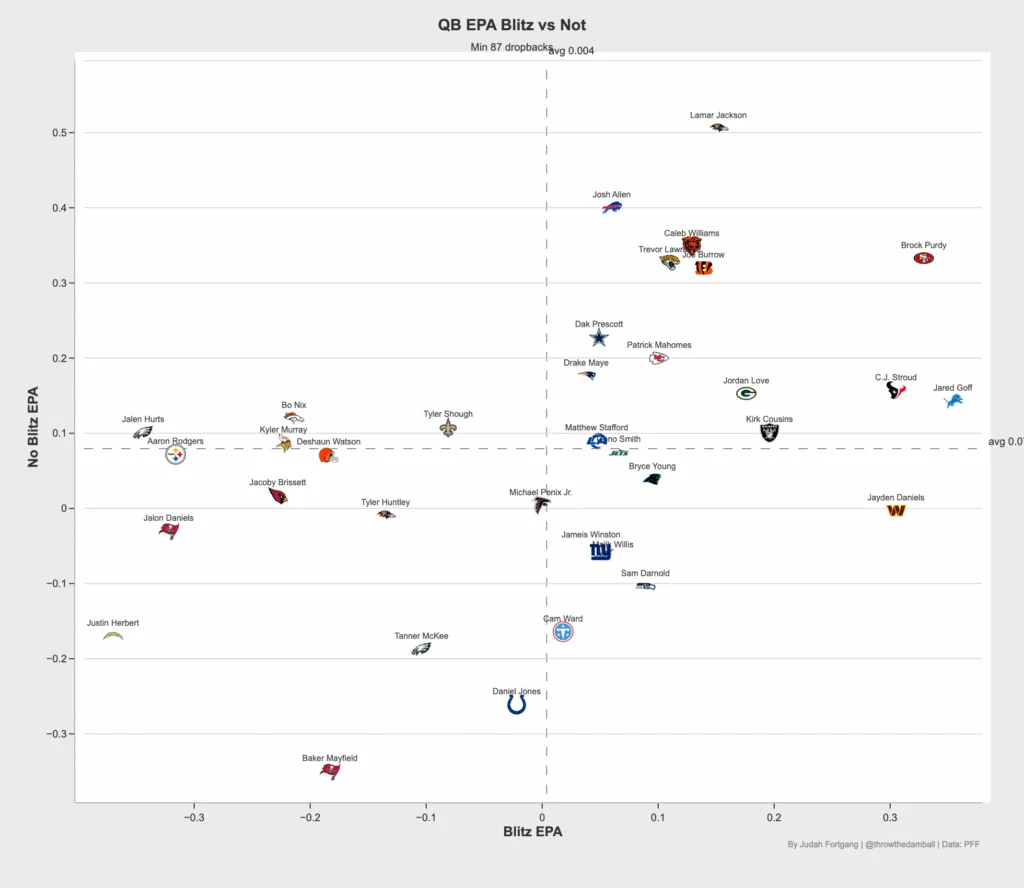
Carolina has been one of the most blitz-heavy teams in the league, and New Orleans has struggled against exactly that look. Blitzing is a bet on timing and disguise, and quarterbacks who read it well usually see the rush coming. When that read breaks down, the damage is immediate. The gap is stark. Tyler Shough is solid in EPA when the defense doesn't send extra rushers, but that number drops by roughly 0.20 points per play once the blitz arrives.
The running game offers no escape hatch. New Orleans ranks last in rushing success and fourth-worst in EPA over the last month, and it's now without its starting center. Losing a center hits hardest up the middle, where a run play depends on five linemen moving as one. That leaves the Saints living on third-and-long and intermediate throws on early downs. Those aren't the situations where this offense is at its best, and they're the ones a blitz-heavy defense is built to force.
Carolina's defense has also been stingy with explosive plays over the last month. Explosive plays are often what keep a struggling offense alive, because a single long gain can erase a string of short, failed drives. Take those away and New Orleans has to grind. It may not get many cheap chunks to bail itself out.
Bryce Young's best matchup
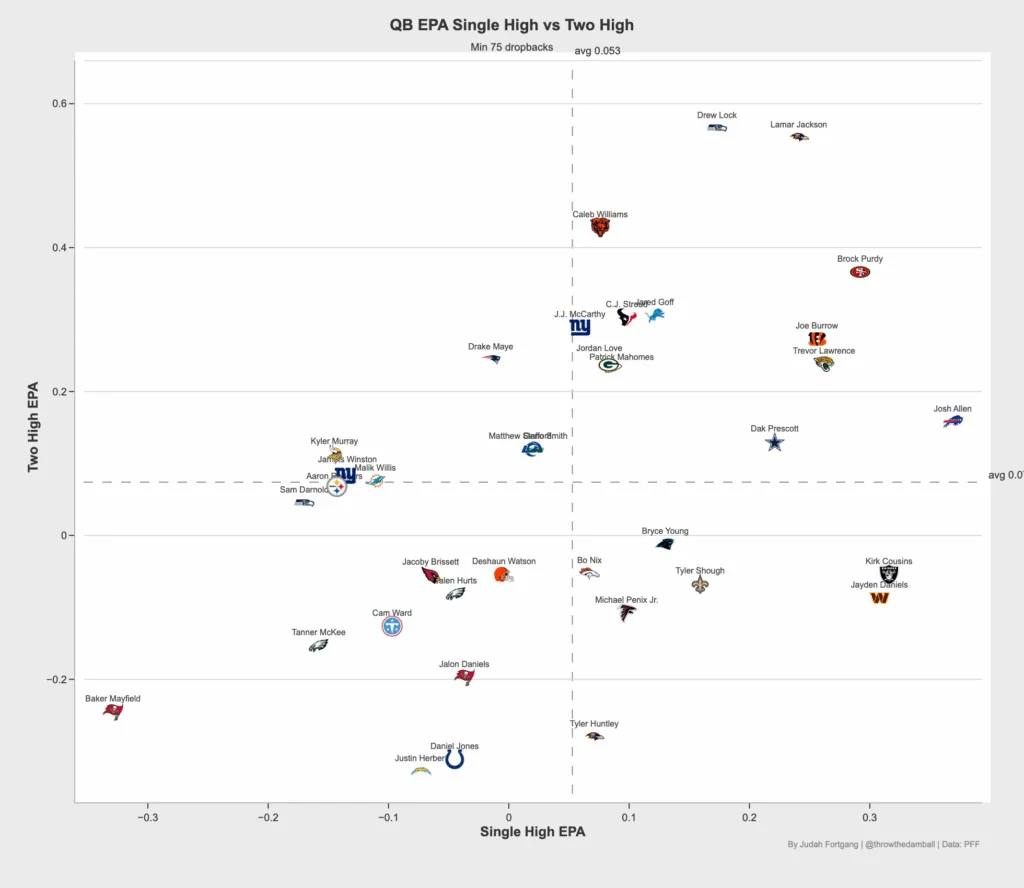
Bryce Young has been far more effective against single-high coverage than two-high looks. The Saints run single-high at the third-highest rate in the league, so Young should see the coverage he handles best. That's a useful pattern to track. Single-high looks leave more grass open behind the safety, which is exactly where a quarterback who trusts his arm can attack.
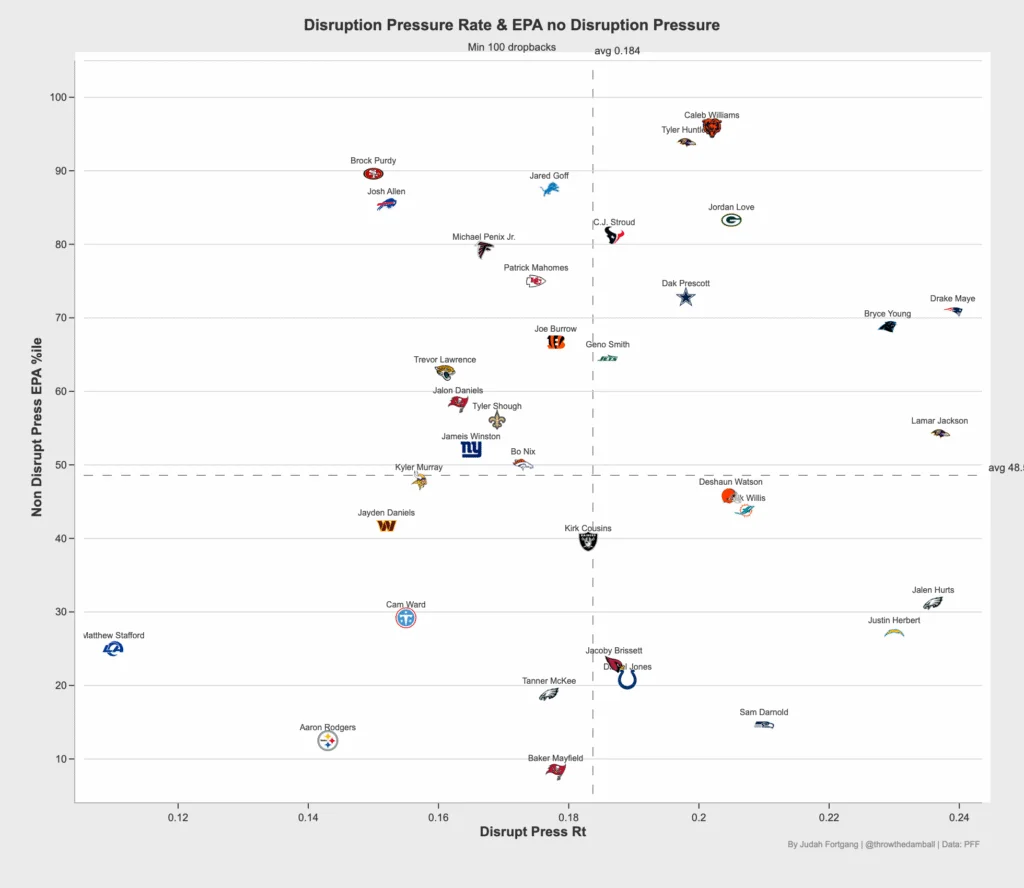
Pressure is the other half of this. New Orleans ranks 30th in pressure rate and near the bottom in both quick and disruption pressure. That matters because Young has faced disruption pressure close to 22% of the time, one of the highest rates in the NFL. If the Saints can't get home, Young gets more clean drops. On those plays, he has been excellent, sitting in the 70th percentile for EPA per play. Here's what that means for you as a viewer: watch the pocket, not just the stat sheet. The quarterback's comfort is the variable most likely to change this game.
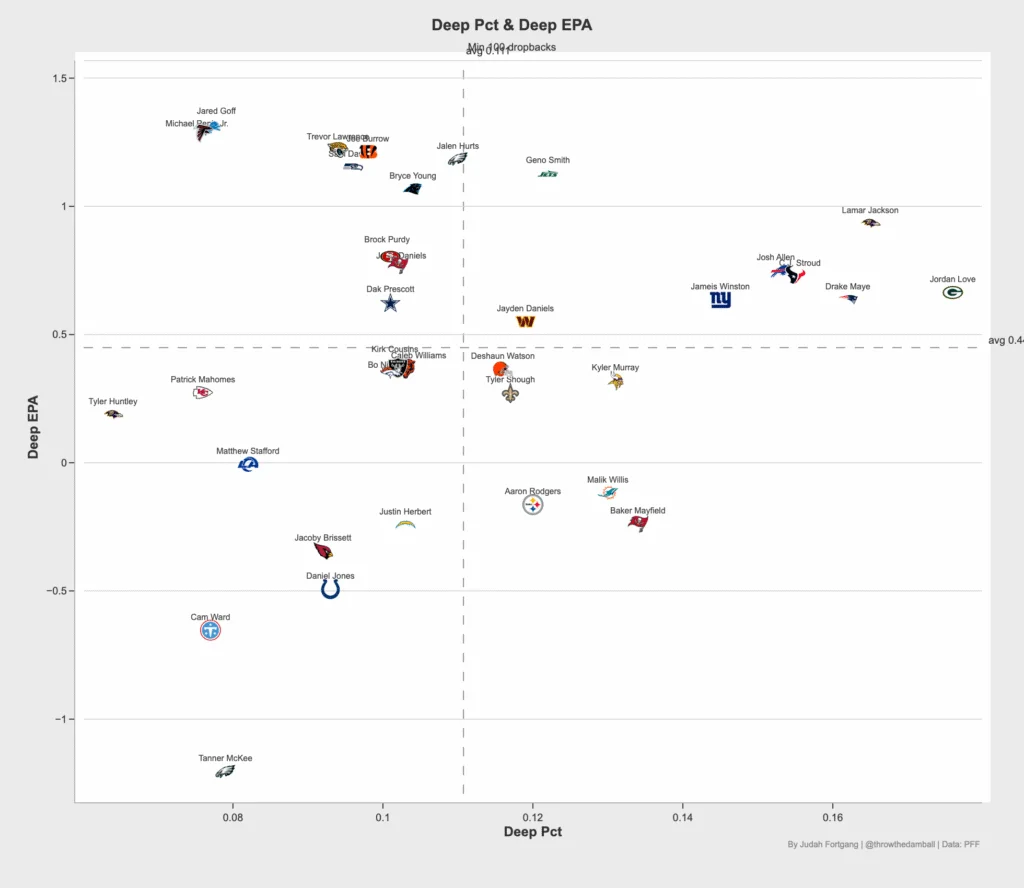
The deep ball is where Young has been strongest, and it's where New Orleans has been weakest. The Saints own the second-worst EPA on deep passes and allow explosive plays at the fourth-worst rate in the league. That's a pairing that favors a quarterback who can push the ball downfield. Deep throws also carry more variance than short ones, so they're the swing plays most likely to decide a close game one way or the other.
What to watch
The numbers don't make Carolina a lock. They describe a Panthers team that is slightly better on paper, healthier on defense and set up to attack the exact areas where New Orleans is thinnest. That's a real edge, but it's one that depends on execution, not just on the spreadsheet. Watch whether the Saints can keep Shough upright against the blitz, and whether Phillips' return changes how often Young faces pressure. Those two variables will likely decide how this game unfolds.
What this matchup says beyond one game
Games like this one are useful because they expose how a team handles specific stress, not just how good it is on average. A quarterback who struggles against the blitz or a defense that depends on one pass rusher tends to show those tendencies again and again. That's why a single matchup can say more about a roster than a full season of averages. The Saints' trouble with pressure and the Panthers' reliance on their rush are worth tracking beyond Sunday, because they're the patterns most likely to carry into the rest of the schedule. I'd keep an eye on whichever team adjusts first, since that's usually the one that's learned something real.


