Why the Rankings Ignore Money
This free-agent class won't have a star at the top, and that's fine. The fun in a market like this is in the margins, where a team with a specific need can find value nobody else bothered to price. Top-of-market names get the headlines and the big-money speculation, but they rarely decide whether a club's bullpen or rotation actually works. Depth players usually do.
Our rankings deliberately ignore money. We don't care what players earn or how much owners are stretching to cover payroll. Each spot reflects how much a player should contribute in the short term, which also tells you how much reason a casual fan has to adopt a new face and buy a jersey. It's a narrow lens, and the coming months will test it.
That's a deliberate trade-off, and you should push on it. A list built purely on expected production answers a different question than a front office does. You'll notice the gap whenever a player who ranks high here gets priced out by a team with a bigger budget. The reverse is true too. A player who ranks low on this list might still be exactly what a contender needs for one October.
The Window and the Lockout
The signing window opened a week ago. Talk of an impending lockout suggested teams would rush to act early, and that hasn't really happened. Moves could still land before the full list is out, but the rankings are set. They're a forecast of 2027 production, not a verdict on whose agent has the best pitch.
That gap between expectation and reality is worth sitting with. Lockout talk tends to create urgency, because a club that signs before a work stoppage can lock in roster certainty while everyone else waits. When the rush doesn't come, it usually means teams are either waiting for prices to soften or don't see a deal they like yet. Neither is guaranteed. I'd be wary of reading too much into a slow first week.
Only eight players received a qualifying offer this offseason. Eight is a small number, and it's worth asking why it's small. A qualifying offer typically costs a club a draft pick when the player signs elsewhere, so it can make a player's price tag harder to move. We don't much care how that changes their markets, but it could shift where a few of them end up.
Every list needs a baseline, and ours is Randy, the Random Number Generator. Randy is a useful humbling device. Projection systems are built on historical data and aging curves, and they miss things, which is exactly why a random number generator makes a fair benchmark. PECOTA may have soured on the Brewers, but Randy seems to have fallen for the Angels. We don't pretend to understand either process. The goal is simply to beat Randy at least once.
No. 50: Jojo Romero, RP
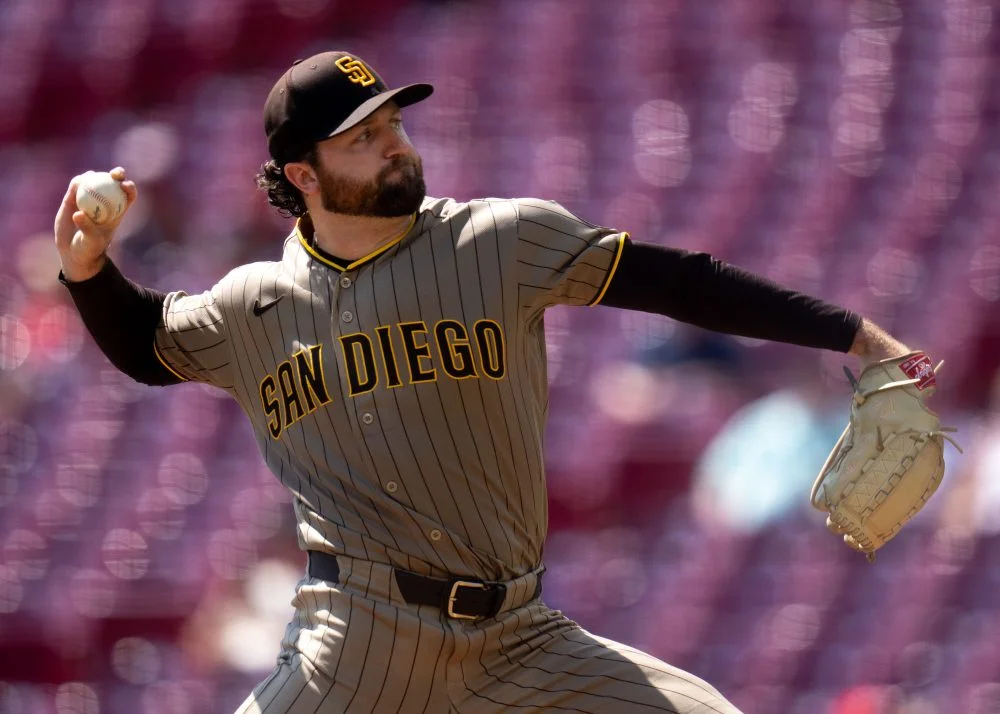
Jojo Romero posted a 3.36 ERA and 1.22 WHIP over 56.3 innings with the Brewers in 2026, with a 0.8 WARP and an 80 DRA-. PECOTA projects a 21.9% strikeout rate, a 9% walk rate, a 2.1% home run rate and an 89 DRA- for 2027.
| IP | ERA | WHIP | DRA- | WARP |
|---|---|---|---|---|
| 56.3 | 3.36 | 1.22 | 80 | 0.8 |
| K% | BB% | HR% | DRA- |
|---|---|---|---|
| 21.9 | 9 | 2.1 | 89 |
Read the two tables together. The first one is what happened. The second is what the model expects, and the gap between them is where most of the debate lives. The DRA- is the number to focus on, since it tries to strip out some of the noise that ERA carries. An 80 last season and an 89 projected means the model expects a step back, and a modest one, but a step back all the same.
If you're evaluating a reliever like this for your own club, the projected rates tell a clear story. A strikeout rate near a fifth of batters faced and a walk rate of 9% describe a pitcher who misses bats and gives out a few free passes. That profile works well when the defense behind him does its job and the ball stays in the yard. It works less well when neither happens.
Reasons for optimism: The playoffs, mostly. Romero spent several seasons as a dependable second lefty in St. Louis, then moved to Milwaukee's bullpen, where a groundball profile and a strong defense behind him made obvious sense. The second half of the regular season wasn't special, but October was. Over eight critical innings, he raised his walk and strikeout rates and allowed one run.
This is more significant than it looks. A reliever's usage in the biggest games tells you how a manager really trusts him, and that trust is hard to fake. His track record covers several seasons of effectiveness. Yes, he looked more homer-prone after the move, but his postseason work makes that risk easier to accept. Everything points to a reliable short-term arm.
That's a strong statement, and I think it's slightly ahead of the evidence. Eight innings is a small sample, and postseason numbers are noisy in ways regular-season numbers aren't. Still, a manager doesn't hand the ball to a pitcher in close games for no reason, and that's worth something.
Reasons for pessimism: Romero pitches to contact, which works fine when the ball stays on the ground. It's a problem when fly balls leave the park at a high rate. His late-season run is the flip side of his postseason: his velocity tailed off, he missed fewer bats, and more balls went over the fence. If that decline continues, he could slide from very good second lefty to something closer to third lefty.
And yet, the pessimism case isn't a footnote. Contact pitchers live and die by batted-ball outcomes, and a few hard-hit fly balls can turn a good month into a bad one. The late-season trend is what worries me. One hot October doesn't reverse a fading fastball, and velocity is the kind of signal that's easy to miss in a box score but hard to explain away in a scouting report. Velocity. That's the whole debate.
Predictions: Patrick has him in Texas, Bryan sends him to New York, and Randy picks Miami. Three picks, three destinations, and none of them is obviously wrong. Randy's pick, at least, is random by design. The number to watch this winter is his velocity. It will decide whether he's the steady short-term reliever his October suggested, or a useful arm whose best days are a little behind him.
What This Class Says About the Market
Stepping back from the individual names, this class reflects a pattern that shows up in most offseasons. Teams often spend their attention on the headline players, while the mid-tier arms who fill out a bullpen get less scrutiny until the moment a club needs one. That's where the real opportunity sits, and it's also where the mistakes tend to happen. A reliever who looks fine on paper can be a disaster in the wrong role, and a reliever with a shaky surface line can be an asset in the right one.
If you're a fan of a club with a bullpen hole, the practical takeaway is to watch for fit rather than fame. Look at how a pitcher's profile matches the park, the defense, and the way the manager uses relievers. A strikeout-and-walk profile tells you something, but a groundball profile behind a strong infield tells you more. Here's the thing: those details rarely make the highlight reel, and that's exactly why they matter.
Lockout uncertainty adds another layer. Slow markets can reward patient teams, but they can also leave good players waiting longer than they'd like. How that plays out will depend on factors that go beyond any single list, and I'd rather admit that than pretend to know the outcome. What I'm confident about is narrower: the margins of this class are where the interesting decisions live, and the rankings are only a starting point for the argument.


