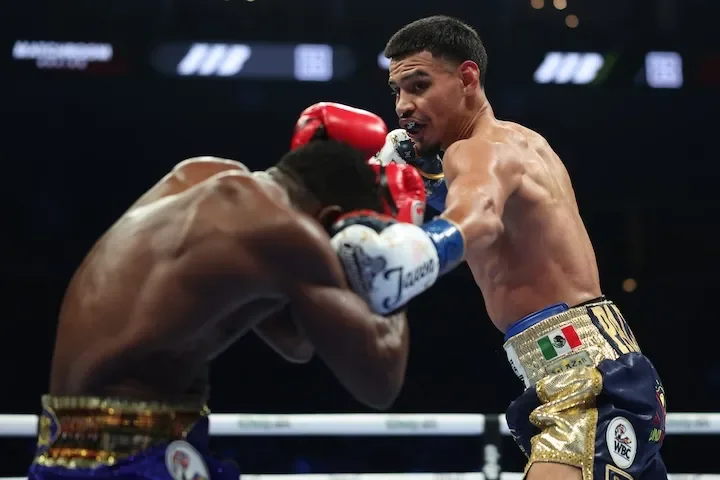
Diego Pacheco’s best route to the top of the super middleweight division may be the punch that asks for patience: his jab. At 25, the unbeaten Los Angeles fighter is building his game around controlling range and choosing when to open up. His next test is Darius Fulghum, a dangerous opponent with power of his own, in Saturday’s main event at Dignity Health Sports Park in Carson, California.
Pacheco, 26-0 with 19 knockouts, is 6 feet 4 inches tall and has a 79-inch reach. Those dimensions make the jab a natural advantage, but trainer Buddy McGirt’s work is about turning that advantage into a plan. A jab can score, disrupt an opponent’s approach and create opportunities for other punches. Pacheco says he and McGirt have been varying the shot and building combinations behind it.
“The jab’s one of my best punches, and we’re throwing it different ways, setting stuff up behind it,” Pacheco said. “It’s a key.”
A measured approach to a high-stakes fight
McGirt, a Hall of Fame former fighter, has been pressing the value of the jab even when a crowd might prefer a more aggressive display. His point is practical: a fighter who can manage distance makes an opponent solve problems before he can attack. And if that opponent does get inside, McGirt says, Pacheco can work there too.
“The jab can get you out of trouble, and if you don’t use it, it can get you in trouble,” McGirt said. He cited Larry Holmes, whose jab helped define a heavyweight championship reign that lasted 7½ years. For McGirt, the lesson is that an effective jab can do more than set up a knockout. It can dictate the pace and keep a fighter in control.
That approach matters against Fulghum, who enters at 15-1-1 with 13 knockouts. The WBA’s No. 4 contender has had a difficult stretch: he lost to top contender Bektemirt Mulikuziev and has a draw among his past three bouts. Fulghum believes his own jab can match Pacheco’s, and he has reason to treat the meeting as a must-win opportunity.
Pacheco isn’t treating it as a stepping stone. “Darius is a great fighter, dangerous and hungry as I am,” he said. “Without a win, we can forget about it.” The stakes are immediate: another victory would strengthen his case for larger fights, while a misstep would interrupt the momentum he has built.
Patience learned early
Pacheco’s preference for patience reaches back beyond the gym. He grew up in South Central Los Angeles, raised by immigrant parents who came to the United States as teenagers with little support. As a child, he watched friends get new shoes and sports gear and understood that asking for the same things could make life harder for his parents.
“I knew I would only make my parents feel bad if I asked them for it,” he said. “So in my mind, I knew that one day I’d be able to buy it myself and do all the things I wanted to do. It was just about being patient, waiting for my time.”
His parents also helped him frame boxing as a long effort. Pacheco says his father urged him to stay consistent when other children doubted him. That support carried a real cost: his parents took on debt to pay for travel and entry fees at amateur tournaments. Pacheco won eight national tournaments and lost just five fights as an amateur, four by split decision.
He has described that investment as pressure to deliver, but also as a source of resolve. His parents believed he could succeed, and he says he didn’t want their sacrifices to end in defeat. Those years may help explain why McGirt is comfortable asking a young fighter to win with discipline, even when the crowd wants a finish.
Rankings and the next step at 168 pounds
Pacheco is ranked No. 2 by the WBO and No. 5 by the WBA. At the WBO, he is waiting on the outcome of the title fight between Janibek Alimkhanuly and Jacob Bank. In the WBA picture, Jaime Munguia’s mandatory defense against Mulikuziev sits ahead of him. The division’s leading names offer a demanding target, but Pacheco is younger than many of the established contenders, several of whom are in their 30s.
McGirt has praised Pacheco’s jab against the standard set by top fighters and titleholders at 168 pounds, including Canelo Alvarez, Lester Martinez, Alimkhanuly and Munguia. That’s a bold comparison, and the Fulghum fight offers a more immediate measure: Pacheco must show that his tools work against a strong, motivated opponent who believes he can win the same contest at long range.
Pacheco’s last outing brought a statement finish. He stopped Immanuwel Aleem in the 11th round, one fight after unbeaten Lester Martinez went the distance with Aleem. Pacheco sees Martinez as a potential opponent and wants that fight in Los Angeles. He said he had spoken briefly with promoter Eddie Hearn, who viewed a matchup at Crypto.com Arena as an appealing possibility. Whether it happens depends on both sides, but Pacheco has made clear that the local rivalry interests him.
McGirt, who previously trained Alimkhanuly, has said he would favor Pacheco if the two met. Pacheco himself argues that he has time to reach the division’s leading fighters, pointing out that their résumés at age 25 did not include the opponents he has already faced. His stated ambition goes beyond earning a place among them: he wants to arrive and remain at the top.
Los Angeles as home base
Pacheco’s return to Los Angeles is part of that ambition. He spent five years training in Renton, Washington, before deciding he wanted to be closer to his parents as they grew older. He says the move has helped him become more independent and build his name where he grew up.
The surroundings around his downtown gym may look rough to an outsider; the article describes him navigating potholed streets in a new Mercedes SUV. For Pacheco, though, the setting connects his current success to the work and family support that made it possible. He says being back in the city reminds him what he has put in.
Saturday’s bout gives him a chance to turn that personal history into a professional result. Beating Fulghum would keep Pacheco’s rise on track and sharpen the argument for a higher-profile fight. The clearest sign of progress may not be a dramatic knockout. It may be whether his jab lets him set the terms, stay composed and leave Carson with the win.


