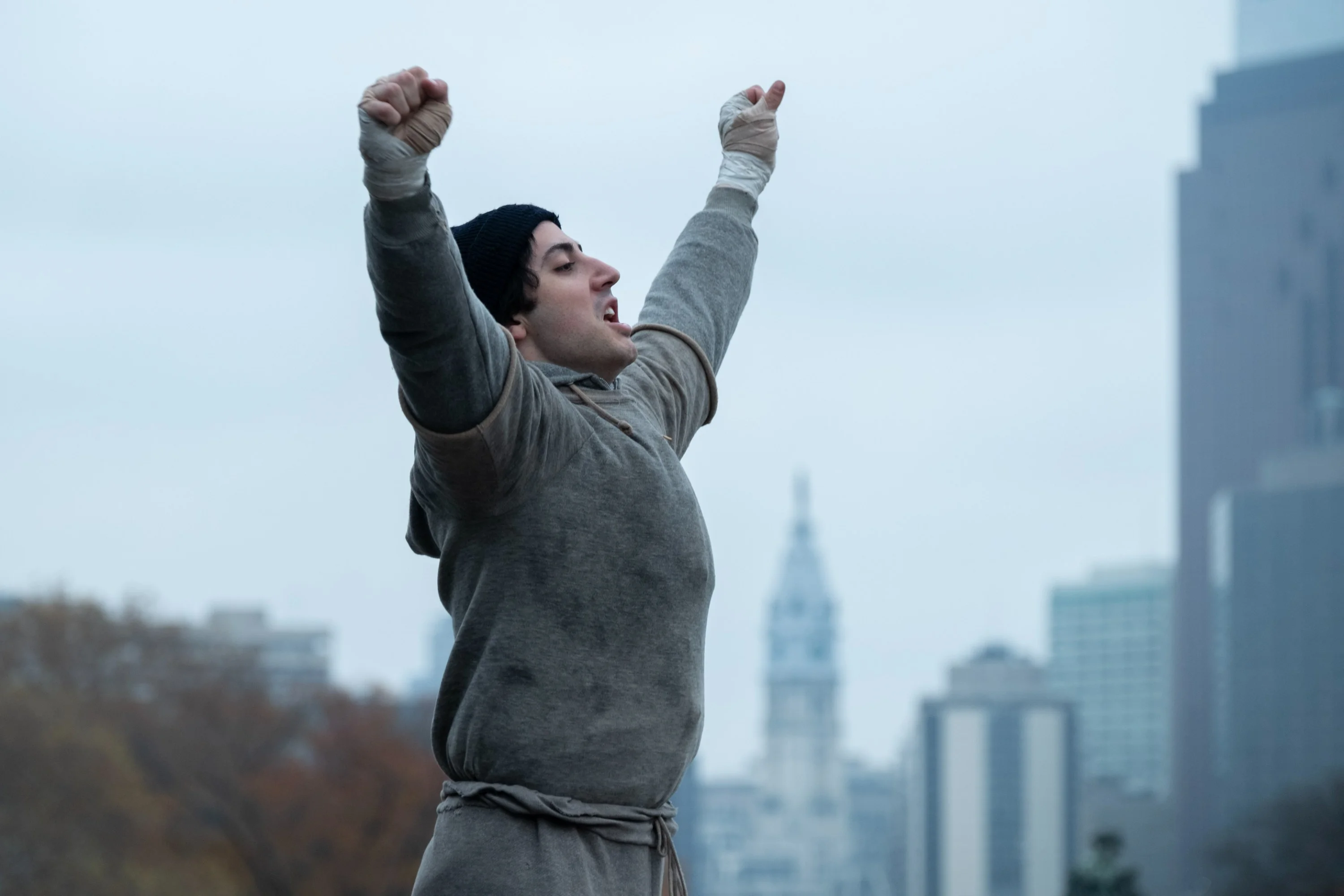
What makes Rocky endure may be that boxing is only part of the fight. Peter Farrelly’s new film, I Play Rocky, revisits the making of the 1976 hit and raises a useful question: is the franchise’s defining film really a boxing movie, or is boxing the route through which its story about a struggling man finds its force?
Farrelly’s answer is both. At a recent media roundtable, the director said Rocky is “a boxing movie, definitely — it’s the boxing movie,” but also “a character piece.” He sees I Play Rocky as less of a boxing film. Its subject is the uphill effort to get the original movie made, with Sylvester Stallone fighting for the chance to play Rocky Balboa.
Boxing gives Rocky its shape, not its only meaning
The distinction surfaces in a scene in I Play Rocky, set during discussions over who should direct the film. John G. Avildsen, played by Jay Duplass, is considering the job with Stallone, portrayed by Anthony Ippolito, and producers Irwin Winkler and Robert Chartoff, played by P.J. Byrne and Toby Kebbell. Avildsen’s view, as dramatized here, is that the project shouldn’t be treated first and foremost as a boxing movie.
That idea may sound surprising when the story opens and closes with fights and includes the gyms and training that have become part of its visual vocabulary. But Avildsen’s point is about emphasis. The ring supplies the opportunity; the emotional center is Rocky, a decent but damaged man trying to make something of himself when the odds are stacked against him.
That frame leaves room for several kinds of movie at once. Rocky is a sports story, a romance, a Philadelphia story, and a portrait of a particular American moment. It’s also a boxing film in the most direct sense. The categories don’t cancel each other out; they explain why the movie can reach viewers who aren’t drawn to the sport itself.
For a film about the film’s creation, that debate adds a layer of self-reference. I Play Rocky depicts people deciding what Rocky should be, while its own director considers how to describe the finished movie. Farrelly hadn’t, by his account, been asked the question before. His answer keeps the sport at the center without reducing the original to its bouts.
A familiar ending, with a fresh underdog story
The outcome of I Play Rocky is hardly a mystery to most viewers. Stallone plays Rocky; the film gets made; audiences embrace it, and the story continues through sequels. The challenge is creating tension when viewers know where the production story leads. Farrelly’s film instead draws its energy from the effort required to reach that destination.
Ippolito called the project “a love letter to what [Stallone] was able to achieve.” Screenwriter Peter Gamble built that story, and Farrelly had a personal reason to take it on: he remembers seeing Rocky at 19 in 1976, after reading a review in Newsweek.
Farrelly recalled that the film didn’t open huge in its first weekend. Word of mouth gathered over the following weeks. He left the theater feeling “pumped up,” though he couldn’t say exactly what he felt inspired to do. He went home and urged his friends to see it. The experience, he said, made a deeper impression on him than Star Wars or other major films of the period.
That memory helps explain the appeal of making a movie about the original’s long odds. Stallone wasn’t simply cast in an already established role; his determination to play the title character was central to the story being told. I Play Rocky turns that persistence into its own underdog narrative, one whose audience knows the finish but can still be drawn into the struggle.
Ippolito’s transformation anchors the cast
Ippolito, born in 1999, comes to the role from a different generation than Farrelly’s. His childhood memory of seeing Rocky Balboa in a theater at age seven offers a glimpse of how far the original’s reach extends. He had also played a young Al Pacino in the 2022 Paramount+ series The Offer, about the making of The Godfather.
Farrelly said Ippolito’s audition made the casting feel immediate. He described the decision as “100 percent guaranteed,” then recalled that he didn’t realize for months that Ippolito had already played Pacino in The Offer. Even after working with him, Farrelly said he struggled to connect the actor with that earlier performance. The ability to disappear into a role, in his view, served him well as Stallone.
The physical work proved demanding. Ippolito said Stallone was the harder of the two actors to portray, largely because he had to add size after playing Pacino. Farrelly compared the transformation to Robert De Niro’s physical preparation for Raging Bull. Ippolito and Stephan James, who plays Carl Weathers, also trained at Gleason’s Gym in Brooklyn. Their task was to look credible as boxers while capturing the fact that the real Stallone was himself learning the sport decades earlier.
The cast’s resemblance to its real-life counterparts is one of the film’s clear strengths. Robert Morgan plays Burgess Meredith, Scot Teller plays Burt Young, and Kiko Seto plays Talia Shire. Duplass fits Avildsen, while AnnaSophia Robb brings charm to the role of Stallone’s first wife, Sasha. Tracy Letts makes an impression as Sandy Maddox, a fictional studio executive combining traits of several people who wanted someone else in the title role. Matt Dillon, despite being the film’s best-known actor, plays Stallone’s father and can nearly disappear among the supporting cast.
Where the film works—and where it strains
I Play Rocky has some rough edges. It adds a few invented turns for dramatic effect, and at least one may prompt an eye roll. A flattering reference to Stallone’s anatomy feels especially calculated, as if the film wants to ensure its real-life subject stays on board.
There’s also a built-in limit to the suspense: viewers already know the film got made and became a hit. The production story can’t surprise them with its destination, so it has to make the setbacks and choices along the way compelling. Gamble’s script, Farrelly’s direction, and the cast give the story enough momentum to work despite that constraint.
The strongest measure of its success may be what it sends viewers back to do. Farrelly remembered leaving the original inspired, even before he knew how to channel that feeling. I Play Rocky aims for a similar effect, with a more concrete invitation: watch the original again and see the drama around the sport with fresh eyes.
A Rocky story, even outside the ring
The original’s Best Picture win remains debated, particularly against films such as Taxi Driver and All the President’s Men. Its lasting place in film culture is less contested. The sequels have their advocates, but each has a flaw that fans tend to acknowledge: the camp of Rocky III and Rocky IV, the slower stretches of Rocky II, or the uneven shift in the second half of Rocky Balboa.
That leaves room for an unexpected ranking. I Play Rocky may be the strongest film in the franchise since the original, depending on what counts as a Rocky movie. It has no claim to being a boxing film, and Farrelly readily places it behind Rocky on that score. But its story of persistence, rejection, and a chance seized against the odds belongs to the same family.
Maybe the cleanest description is that Rocky is both a boxing movie and a character drama, while I Play Rocky is more interested in the fight to make one. The distinction matters less than the shared idea: the work can be worth watching even when you already know who gets to the other side.


