How much are these players really worth?
Steve Adams and Darragh McDonald opened their MLB Trade Rumors chat by inviting questions about the site’s Top 50 Free Agent list and predictions. The first challenge was the gap between projections for Brandon Lowe. MLB Trade Rumors forecast three years and $69 million. Tim Britton of The Athletic landed at three years and $63 million; Ben Clemens of FanGraphs at two years and $38 million; and Kiley McDaniel of ESPN at four years and $80 million. Keith Law, also of The Athletic, stood apart with five years and $150 million. Adams called Law’s figure closer to a personal valuation than a prediction of what a team would pay. Lowe will turn 33 next July and has a history of injuries, making five years at $30 million annually a difficult sell. McDonald said the other forecasts clustered around a three-year deal worth roughly $20 million per season. That’s a useful distinction for anyone reading these lists: a player’s perceived value and his likely market price aren’t the same thing. The chat also pushed back on the idea that the Top 50 was packed with extravagant contracts. Adams said the list had only about five deals above $100 million, most just over that mark, with Tarik Skubal a clear exception. Many of the other forecasts were for one- or two-year contracts. McDonald agreed that free agency is often an inefficient way to spend, but said teams still have to take that risk when they need to fill holes. He singled out Jazz Chisholm Jr. as a potential bargain at the projected price. Adams put it more bluntly: free agency is an auction, and a winning bid often means paying more than the other 29 teams are comfortable with.Thin tiers and risky bargains
The list’s weak middle tier came up in a discussion about Trevor Rogers. One fan called him the worst No. 2 free agent in recent memory; Adams and McDonald didn’t dispute the complaint. A projection of five years and $115 million would usually put a player around 10th, McDonald said. This year, it puts Rogers second. For comparison, the same five-year, $115 million forecast placed Ranger Suárez 10th on the prior year’s list. Adams said other free agents, including Freddy and Teruaki Sato, could out-earn Rogers. If Rogers falls short of five years, Suzuki and Randy Arozarena might pass him as well. The comparison captures the problem: the ranking reflects the market’s thin supply as much as it reflects any one player’s quality. The chat’s bargain candidates came with familiar caveats. Adams named Kris Bubic, who could offer No. 3 starter upside without requiring a multiyear commitment, along with reliever Evan Phillips and first baseman Jake Bauers, whose age, health histories or limited track records could keep their prices down. McDonald pointed to Chisholm and Luis Robert Jr. Robert is a high-risk bet: a $14 million investment might buy a borderline MVP-level player, and potentially a qualifying-offer draft pick at season’s end, but he has often been ineffective, injured or both. That risk runs through the whole market. McDonald said teams can find value in free agency, but the wins don’t come with guarantees.Why Jeffers could command a longer deal
Ryan Jeffers drew a wide range of contract projections, from two years and $15.5 million to four years and $75 million. The questioner wondered why MLB Trade Rumors expected four years, especially given the way catchers often wear down in their early 30s. Adams said the low estimate already looked dated: the Twins had offered Jeffers $23.15 million for one year. The case for a longer contract rests on his offense. From 2023 onward, Jeffers hit .254/.342/.440 in 1,632 plate appearances. Willson Contreras had a similar .249/.349/.467 line in 1,604 plate appearances over the four seasons before his free agency, then signed for five years and $87.5 million despite defensive concerns and a qualifying offer. MLB Trade Rumors projected Jeffers below Contreras’ deal but above the $73 million Yasmani Grandal received in 2019. McDonald said the comparison helps explain the forecast, though it’s still hard to identify which team would actually pay that much. The numbers support the argument; the market’s willingness to act on them is less certain.Age, role and the cost of projection
Adams said the projection for reliever Morejon—five years and $80 million—didn’t depend on whether a signing team planned to try him as a starter. The panel viewed him as one of the sport’s five to 10 best relievers. At 27, with the Padres having made him a qualifying offer, he could command a premium if teams aren’t concerned about his shoulder. McDonald said the forecast put him above Tanner Scott’s four-year, $72 million contract, which included deferrals. Other players’ roles make longer guarantees harder to justify. Tyrone Taylor asked whether two years and $14 million was realistic. Adams said the panel had considered two years but saw Taylor as a part-time, glove-first center fielder, a profile that rarely earns that kind of commitment. McDonald compared him to Michael A. Taylor, who had a strong glove and occasional offense but never received more than a one-year, $4 million free-agent deal; he did sign a two-year, $9 million extension. Adams added that Harrison Bader had repeatedly taken one-year contracts despite being more of a regular. For relievers who missed the Top 50, the panel generally expected deals below the list’s No. 50 projection of one year and $12 million. But there were close calls. McDonald said Gregory Soto and Kevin Ginkel had been discussed for contracts around two years and $20 million before landing outside the consensus list. Adams said Ginkel could still get two years, citing a quietly solid track record and decent rate statistics. He also thought Alec Bohm might get two years, though he wouldn’t make that offer himself. McDonald said Anthony was preparing a Front Office subscribers’ post on players who just missed the list, and Adams guessed that Anthony would make the case for Sean Newcomb.Team fits are possibilities, not promises
The chat’s team predictions prompted skepticism from a Tigers fan who didn’t want Jazz Chisholm Jr. or Luis Arraez. McDonald argued that this winter offered few better offensive investments than Chisholm: Detroit has a second-base opening, and Chisholm could add speed. The panel had projected a short-term contract with an opt-out, a structure the Tigers favor. Adams saw a plausible case for Arraez, too. Detroit has emphasized improving its contact skills, and he questioned why the club hadn’t called up prospect Max Anderson late in the season, while cautioning that the decision didn’t prove the Tigers had given up on him or planned to trade him. Adams also noted that short-term deals might rule out pricier bats such as Seiya Suzuki, who could seek four or five years. Brandon Lowe could be a compromise, and a trade remains another option. McDonald stressed that team assignments on the list were low-confidence guesses. The panel tries to make each scenario fit, but expects to get only about 10 of its 50 team picks right. That’s the right way to read them: as coherent possibilities, not firm predictions. A Giants fan asked whether San Francisco should pursue Shota Imanaga, Itoh and Taira. Adams said Imanaga’s home-run issues make a large ballpark a sensible fit, though he joked that the homer-prone Emilio Pagán continues to pitch in Cincinnati’s hitter-friendly park. Itoh or Taira could also fit the Giants, who need substantial pitching help. McDonald said that if the club wants to win in the short term, it should spend like a big-market team now that its territory includes the whole Bay Area.Qualifying offers change the calculation
Bauers prompted two related questions: what another team would need to offer to keep him from accepting a qualifying offer, and what his market might look like if he turned it down. Adams personally expected Bauers to get more than $50 million over three years, even with the qualifying offer attached, but said the rest of the group—including Tim Dierkes—leaned toward him accepting it. McDonald thought a multiyear offer near $20 million annually would probably be worth taking for the security, though he was skeptical a team would make one. He compared Bauers to Jurickson Profar, a talented player who bounced around before breaking out in his early 30s; Profar received three years and $42 million without a qualifying offer. Adams said Bauers might still earn more on the open market, but understood the appeal of taking a $23 million-plus offer from the reigning World Series champion after once thinking his career might be over. The panel’s contract contest offered a lighter note. Adams claimed last year’s win with 11 correct picks, ahead of McDonald’s nine and Anthony’s five, then asked readers not to revisit earlier offseasons. Read moreLong-term bets, short-term leverage
The debate over Tarik Skubal’s next contract comes down to how much he’d charge for flexibility. One reader floated four years and $200 million, with no deferrals and an opt-out after every season, predicting Skubal would accept. Steve Adams and Darragh McDonald both think that annual price would need to be higher. MLBTR’s projection was $47 million a year over nine years; McDonald pointed to Kyle Tucker’s $60 million annual rate last winter as evidence that a star can choose a short deal, but suggested Skubal would want more than $50 million a year to do it.
That uncertainty is even sharper with Japanese star Sao Sato. Asked whether his projected contract reflected doubts about his ability to stay at third base, Adams said the bigger problem is how little teams know when NPB stars are posted. Sato could get $200 million, he said, or a market that passes on him could leave him with $40 million. Scouts have praised his bat speed and exit velocity, but his defensive position remains unsettled: some favor developing him at third, while others would move him to right field immediately. Different clubs may reach very different conclusions.
Adams acknowledged the projection might be low, but said MLBTR was cautious after predicting nearly $200 million for Munetaka Murakami the previous year and seeing the market reject that estimate. That’s a useful reminder: scouting reports can inform a forecast, but they can’t tell you how 30 front offices will price unfamiliar players.
Why Miami is absent from the predictions
Marlins fans asked why the club wasn’t projected to sign a top-50 free agent. The short answer is its recent record. Since taking over, general manager Peter Bendix hasn’t spent more than $13 million on a free agent, and the team’s spending before his tenure was limited too. Adams said Miami could plausibly pursue a short-term starter or a two-year reliever near the bottom of the list, but Bendix has leaned heavily on trades for prominent additions. McDonald put it more bluntly: the Marlins have room to spend, but their recent behavior makes “I’ll believe it when I see it” a fair position.
Owner Bruce Sherman’s biggest free-agent commitments have been Avisail Garcia at $53 million, Jorge Soler at $36 million and Pete Fairbanks at $13 million. Adams said the Garcia and Fairbanks deals had burned the club, especially the Garcia contract. That history helps explain why Miami was hard to place in a prediction exercise whose participants were trying to make plausible picks, even while conceding that team forecasts are low-confidence guesses.
Relievers can still cash in after a qualifying offer
Steve Adams expects both Adrián Morejón and David Bednar to reject qualifying offers and land in the $60 million to $80 million range. He called Morejón a “monster” and described Bednar as one of the most consistently excellent relievers in the game, despite one awful season. Adams said Darragh McDonald’s argument helped push him toward the higher estimate: elite relievers such as Josh Hader and Edwin Díaz have also had rough seasons, while Tanner Scott secured $72 million with a shorter track record. This year’s playoffs, he added, again showed how much teams value dominant bullpens.
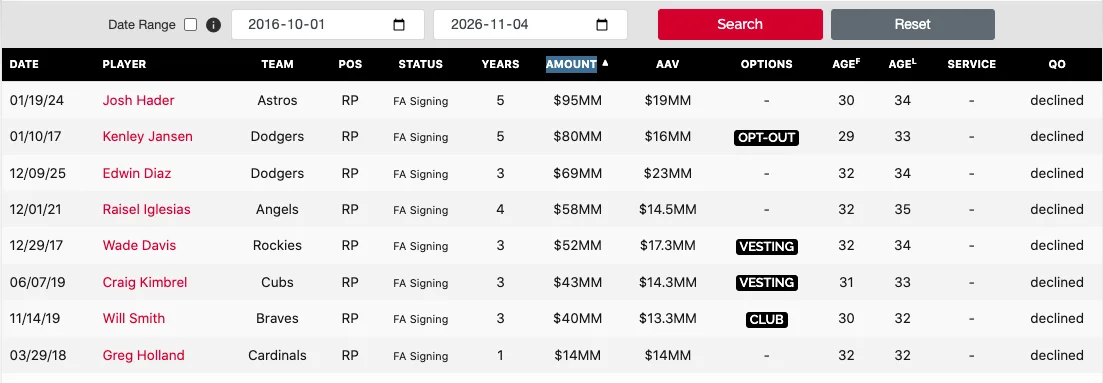
McDonald pointed to the Contract Tracker’s examples of strong relievers turning down qualifying offers and still earning major deals. The broader point is straightforward: a qualifying offer doesn’t necessarily erase demand for a reliever with a strong body of work.
A thin market won’t automatically inflate every price
Could Rafael Devers’ contract value rise because he would be the clear No. 2 free agent in a weak class of hitters? Adams doesn’t think so. He said teams have become too analytical to overpay simply because the alternatives are scarce. MLBTR tried to account for a weak hitting market when projecting Cody Bellinger above $200 million, but clubs didn’t follow. They were willing to trade for alternatives or rely on players already in the organization rather than pay more for a hitter they didn’t value at that level. Adams doesn’t expect a shortage of bats to add $40 million to Randy Arozarena’s price, as it might have 15 years ago.
McDonald sees a possible effect elsewhere. If teams rate Devers around the level of Pete Alonso—or better—the roughly $210 million he still has to be paid could compare favorably with Alonso’s reported $150 million to $160 million deal with the Orioles. Teams may hold to their own valuation of Devers, McDonald agreed, but the lack of comparable free-agent options could make a trade more appealing. In a deeper market, a club might simply wait for a similar player to become available.
Most teams are treating the CBA as business as usual
Asked whether uncertainty around the next collective bargaining agreement made the Top 50 predictions harder, Adams said the panel largely treated this as a normal offseason. The last lockout didn’t prevent most players from getting deals near expectations, and he still expects games to be played. McDonald said the looming CBA came up in specific cases, including a possibility that Josh Bauer might be more inclined to accept a qualifying offer, but it wasn’t a major influence on the projections.
A related question was whether clubs might prefer one-year deals to avoid uncertainty around a possible salary cap or stronger penalties after 2027. Adams said some teams could take that approach, though it wasn’t a pattern in the 2021–22 offseason. Kevin Gausman might accept a one-year deal to return to Toronto, where he likes playing, but Adams thinks Gausman could get two years if that’s what he wants.
Team fits still depend on playing time and payroll habits
Kansas City left-hander Kris Bubic could be drawn to Pittsburgh, one reader argued, citing the park and the club’s history with left-handed starters such as J.A. Happ, José Quintana, Francisco Liriano and Tyler Anderson. Adams agreed the park could suit Bubic, but questioned whether Pittsburgh offers the rotation opportunity a pitcher trying to rebuild his value would want. Paul Skenes, Braxton Ashcraft, Jared Jones, Mitch Keller and Bubba Chandler already occupy much of the team’s rotation picture. McDonald instead projected Bubic to Tampa Bay, where he thinks the Rays do a good job helping players reach their ceilings.
Max Scherzer didn’t make the Top 50 because the panel didn’t seriously consider him. Adams said the list ranks players by their perceived earning power, and Scherzer is in his 40s, signed for one year and $3 million last winter, then had another season marred by injuries and poor performance. Adams said he hopes Scherzer keeps pitching, but didn’t see a case for including him on that basis.
For the Angels, new ownership could mean more spending, but the panel was wary of expecting an instant turnaround. McDonald said owner Stan Kroenke has the money to spend, yet fixing the club likely requires years of work in scouting, player development and analytics. He floated a rebuild aimed at contention around 2030, while stressing that the outcome is uncertain. Adams expects the Angels to fill some holes, but not necessarily chase the biggest names. A higher payroll—even one that eventually reached $300 million—would be difficult to put in place in one offseason.
There’s a terminology wrinkle here: Adams said the Angels could shop in the “six-year free agent” market, meaning players who reach free agency through service time, not players seeking six-year contracts. That could mean pursuing players outside the top tier, such as Skubal, Arozarena or Freddy Peralta.
The Minnesota Twins reunion pitch for Luis Arraez got a qualified yes from Adams. Arraez could play second base, where he wants to play, with Kody Clemens moving to first. Still, Adams thinks Minnesota is more likely to seek power: the lineup needs home runs and had one of the lower walk rates in the league.
Skubal’s price may involve the owners directly
Steve Adams doesn’t expect Mets president of baseball operations David Stearns to pursue Skubal at $400 million or more. He does think owner Steve Cohen might. The distinction matters: Adams doubts a general manager or baseball operations chief will be eager to authorize a deal in the $300 million to $400 million-plus range, and expects agent Scott Boras to negotiate directly with owners.
McDonald said Stearns’ history points toward avoiding long contracts, but Boras has shown he can reach Cohen. When the Giants’ deal with Carlos Correa collapsed over concerns about Correa’s ankle, McDonald recalled, Boras called Cohen in Hawaii. Cohen agreed to a deal worth more than $300 million; Adams remembered the figure as $315 million. For Skubal, the question may be less whether a front office wants to pay that price than whether an owner will.
Trevor Rogers’ projection is a real disagreement
MLBTR’s five-year, $115 million estimate for Trevor Rogers is well above several other projections: Tim Britton had him at four years and $84 million for The Athletic; Keith Law put him at three years and $75 million for The Athletic; Ben Clemens projected four years and $104 million for FanGraphs; and Kiley McDaniel forecast four years and $76 million for ESPN.
Adams said he feels good about Rogers getting five years. The former top-15 pick and Rookie of the Year runner-up has endured injury-plagued seasons, but has posted a 3.16 ERA, 23.2% strikeout rate, 6.1% walk rate and 41.1% ground-ball rate across his past 48 starts. Adams described him as healthy and very good; he also noted that Rogers will pitch next season at age 29, which helps his case. McDonald acknowledged MLBTR may be high, but compared Rogers with Ranger Suárez, who signed for five years and $130 million. Whether the higher forecast holds up is uncertain. The case for it is that Rogers’ recent performance and age could make him a more attractive bet than the lower estimates suggest.
Milwaukee has options, but few urgent needs
Darragh McDonald briefly considered projecting Milwaukee to sign Foster Griffin. The Brewers have plenty of good pitching, but injuries and workload concerns after a World Series run could make a dependable innings-eater useful for protecting younger arms.
Adams said Milwaukee doesn’t need to go big in free agency. Its pitching depth is strong, its young hitters are already good, and another wave is coming. He wouldn’t object to adding a steady starter for a year or two. He also said he’s not especially high on Garrett Mitchell, but the Brewers have enough outfielders that they don’t need to force a center-field signing in a weak class.
There is one bolder possibility: Milwaukee could chase Luis Robert Jr. and bet on his upside. Adams said the Brewers are well positioned to take that risk. Robert could lift the team’s ceiling, while Milwaukee’s existing foundation gives it room to absorb another injury-plagued season.


