Miguel Vargas delivered the sort of season that changes how fantasy managers value a player: 33 home runs, 22 stolen bases, 93 RBIs and 106 runs after an average draft position of 278.5. His dollar-value ranking was 17. For the Chicago White Sox, he became a central contributor during an unexpected run to October in 2026. The numbers point to a compelling blend of power, speed and contact, though his .250 batting average also sets a clear limit on the profile.
A late pick with a new level of production
Vargas arrived in Chicago from the Dodgers at the 2024 trade deadline with a reputation as one of the more polished bats in the Minors. He had hit .308/.396/.493, walked in 12% of his plate appearances and struck out 16.1% of the time. That skill set took longer to appear in the majors. Across his first three seasons, covering 591 plate appearances, he batted .175/.273/.312. His walk rate held at 11%, but his strikeout rate rose to 22.2%.
His first full season with the White Sox, in 2025, offered a more encouraging read. Vargas posted a 101 wRC+, hit 16 home runs and 32 doubles, and recorded a 40.5% hard-hit rate. His 9.4% barrel rate and 89.7 mph average exit velocity sat around league average or a little higher. The strongest stretch came after the All-Star break, when he hit .267/.354/.436. His strikeout rate for the season was 17.6%, a sign that his minor-league contact skills were beginning to translate.
That finish wasn’t enough to make Vargas a priority in fantasy drafts the following spring. His ADP of 278.5 shows how far down the board he went. By June 9, though, he had already matched his previous season’s home-run total and set a new career high in steals, with nine successful attempts and just one caught stealing. He finished with 22 steals, a total that made his power production especially valuable.
Power and speed in rare company
At least 30 home runs and 20 steals is a useful shorthand for Vargas’ season. Only four other players in the cited group joined him at that mark, and his 33 home runs and 22 steals put him alongside some of baseball’s most productive power-speed threats.
Players with at least 30 HR and 20 SB
| Name | HR | SB |
| Pete Crow-Armstrong | 45 | 41 |
| CJ Abrams | 33 | 34 |
| Elly De La Cruz | 30 | 30 |
| Miguel Vargas | 33 | 22 |
| James Wood | 30 | 21 |
Vargas had the lowest strikeout rate in this group, at 17.6%. CJ Abrams was next at 24.2%. Yet Vargas’ .250 average was also the lowest, just below Abrams’ .261. That pairing makes sense for a hitter whose game leans heavily toward fly balls: the swing can produce substantial power, but it tends to leave fewer balls in play that turn into hits.
Fly balls help explain the batting average
Over his two full major-league seasons, Vargas has hit fly balls at a 35.3% rate, the 14th-highest mark among 333 qualified hitters. His rate of fly balls pulled to his natural side is 25.9%, ranking 31st. That figure climbed to 28.4% in 2026, good for 19th. The pull-side air contact helps explain how Vargas reached 33 home runs, while the overall fly-ball profile helps explain why his batting average hasn’t climbed with his power.
His batting average on balls in play (BABIP) has been .261 in each of the past two seasons, against a .243 career mark. Those are low results, but they fit a hitter who sends a large share of his contact into the air. A major change in batting average would likely require a meaningful shift in his batted-ball profile. That isn’t an obvious goal: Vargas appears to have found a useful balance between better contact quality and the plate discipline that marked his minor-league work.
That balance matters for evaluating the season ahead. Vargas’ strikeout rate gives him a foundation that many power hitters lack, but it hasn’t erased the average cost of his approach. If he repeats a .250 average, that would still have been six points above the league average in 2026. His fantasy value will depend more on the combined effect of power, runs, RBIs and steals than on a batting-average rebound.
A wide range of pitches, with few easy answers
Vargas’ production wasn’t tied to one broad pitch category. He recorded a .374 wOBA and .382 expected wOBA against fastballs, a .335 wOBA and .361 expected wOBA against breaking pitches, and a .348 wOBA with a .398 expected wOBA against off-speed pitches. The expected figures suggest that his results against breaking balls could have been stronger, while his contact against off-speed offerings had particularly encouraging underlying quality.
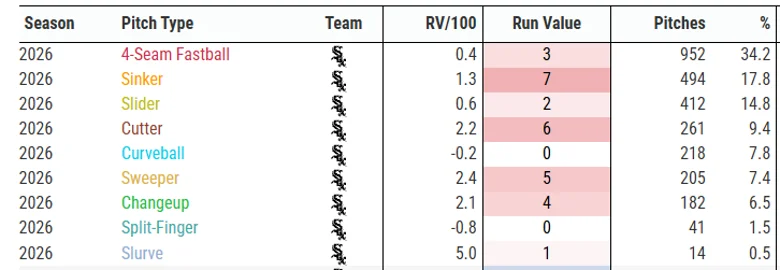

Baseball Savant breaks pitches into nine types, and Vargas had positive run value against each one in 2026. The two pitch types against which he was neutral made up just 9.3% of the pitches he saw. His lowest expected wOBA among the three broad categories was .361 against breaking pitches. For context, a .361 overall xwOBA would have ranked 25th across baseball. That’s a difficult mix of results for opposing pitchers to attack: Vargas produced against a broad range of offerings, even if his average and expected results weren’t equally strong in every category.
The speed is part of the package
Vargas exceeding 20 steals may have been the biggest surprise of his season, but his past record gives the result some context. He was never a standout base-stealing prospect, though he reached double digits three times in the Minors and combined for 17 steals across the majors and Minors in 2022. He was efficient when he ran: his success rate in the Minors was 79%, and it stands at 88% in the majors.
He also has the foot speed to support a larger role on the bases. Vargas ranked in the 82nd percentile for sprint speed in 2026, ahead of Oneil Cruz. Speed alone doesn’t guarantee another 22-steal season, but it makes the total less mysterious. His efficiency, athleticism and opportunity combined to turn a modest part of his minor-league record into a real source of fantasy value.
What to expect next
Vargas will turn 27 during the 2027 season and is positioned in the middle of a White Sox lineup that’s on the rise. There are reasonable grounds to expect him to remain productive: the contact rate is strong, the ball is leaving the yard, and the stolen bases came with a high success rate. The main constraint is still his batting average. His fly-ball tendencies make a sharp improvement difficult to assume, even with the rest of his offensive game moving in the right direction.
My read is that Vargas’ 2026 season looks more like a useful blueprint than a fluke. A .250 average paired with another substantial contribution in home runs and steals would still make him valuable, especially after he returned a top-20 dollar-value ranking from a late draft slot. The next test is whether he can keep combining contact quality, plate discipline and running efficiency as opponents adjust. If that mix holds, Vargas has a clear path to another strong season without needing a dramatic jump in batting average.
The post Revelación de valor ’26: Miguel Vargas appeared first on Baseball Prospectus.


