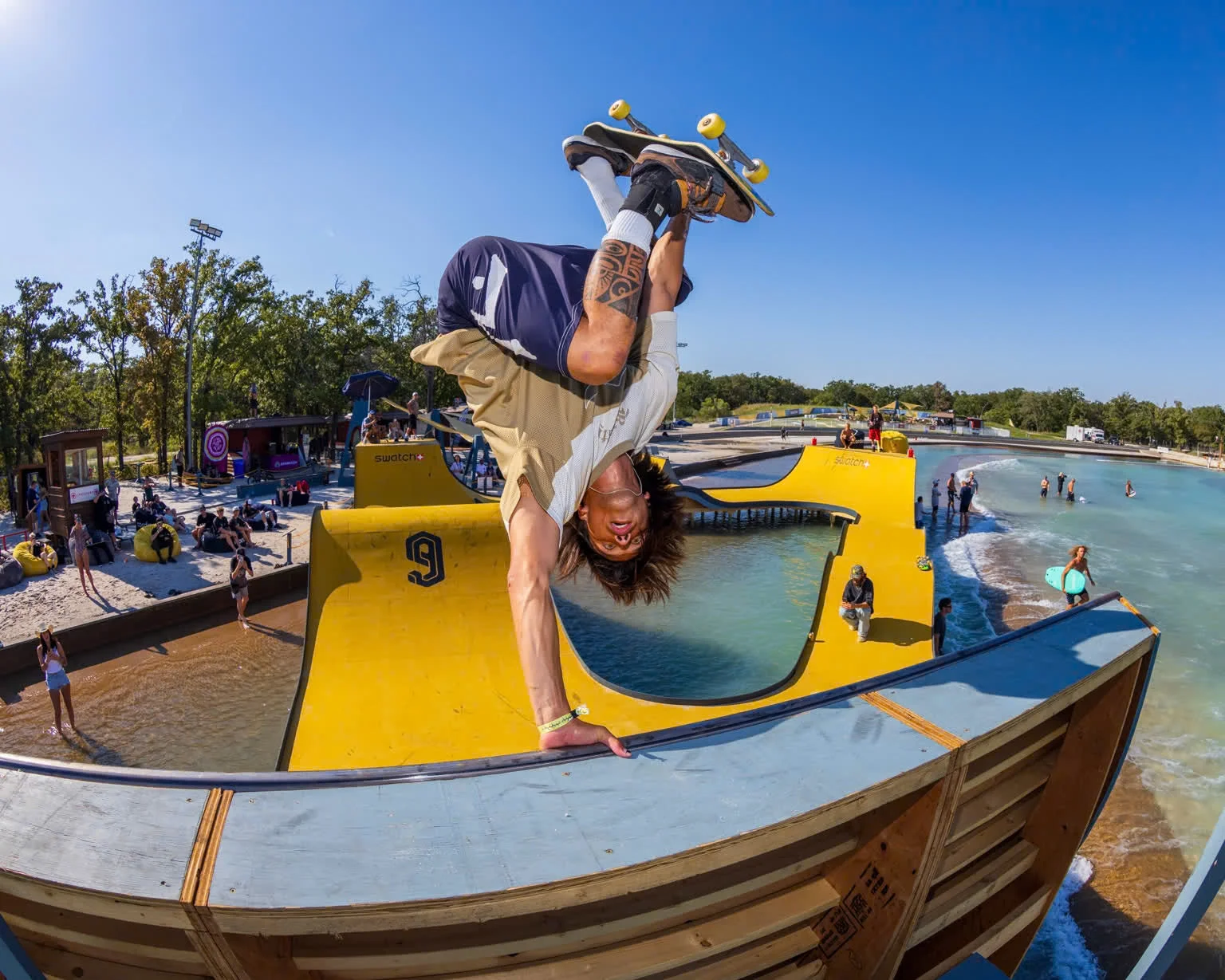
Three sports, one shared course
Swatch Nines’ third year at Waco Surf showed what happens when a course is designed for interaction rather than a single discipline. Over three days, surfers, skateboarders and BMX riders shared custom features that encouraged experimentation, with the wave pool and surrounding builds linking the sports in unexpected ways. The format changes what a course can ask of its athletes: instead of repeating a familiar line built for one sport, riders can respond to features shaped by another.
That shared setting is the event’s central idea, and it’s more significant than it looks. A feature that makes sense to a skater might become a launch point or visual marker for a surfer, while the pool itself gives the course a moving backdrop and a physical boundary. There’s no guarantee that every crossover will produce a new trick, of course. But the arrangement gives athletes room to test possibilities that a conventional, single-sport setup might never invite.
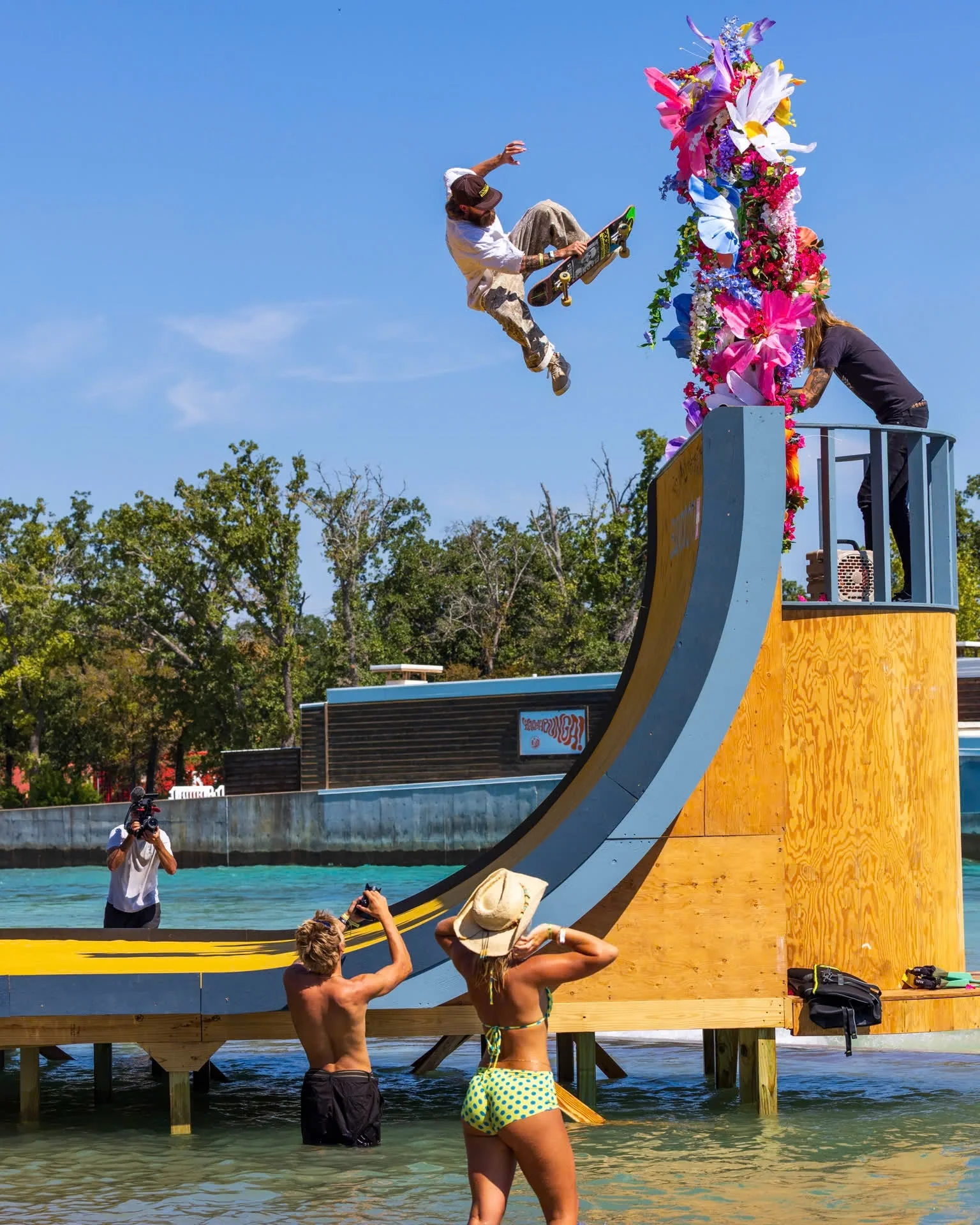
A flowing course over the water
The skate setup has grown from a pipe at the event’s first edition into its largest skate presence yet: a connected course built above the water. Spines, quarterpipes, hips and rollers gave riders room to link sections and choose their own routes. That kind of layout rewards judgment as much as execution: athletes have to read the available transitions, decide where to carry speed and work out whether a feature belongs in a longer line or stands on its own.
The Flying O returned, while the mirror feature put flat-ground tricks in front of a reflection as surfers rode beneath it. The visual effect is part of the point, but the design also makes the course feel less like a collection of separate obstacles. Skateboarding happens above the pool; surfing continues below. The two activities occupy the same frame, even when their lines don’t physically cross.
Several riders used the course to test ambitious lines. Dalton Dern landed a 540 on Thursday, then aired over the pool’s shallow section and rode away. Adam Hopkins also landed a 540, on the vert quarterpipe, and Yurin Fujii kickflipped Indy over a roller. Those performances show how different riders could draw distinct challenges from one connected layout: a feature’s height, transition or position might define the trick, while the next section asks for a different kind of control.
Shane Borland made an impression with his ramp lines; Gustavo Ribeiro connected a route through the reception area; and Alex Midler landed a kickflip backside tailslide over the steps. Ribeiro’s route is a useful example of the event’s broader premise: the course doesn’t have to end where a purpose-built skate feature ends. It can extend into the surrounding space, provided the rider can turn that space into a coherent line. First-time Nines riders Curren Caples and Brandon Valjalo added to a deep skate roster, bringing more approaches to a setup that’s designed to be interpreted rather than followed in one prescribed way.
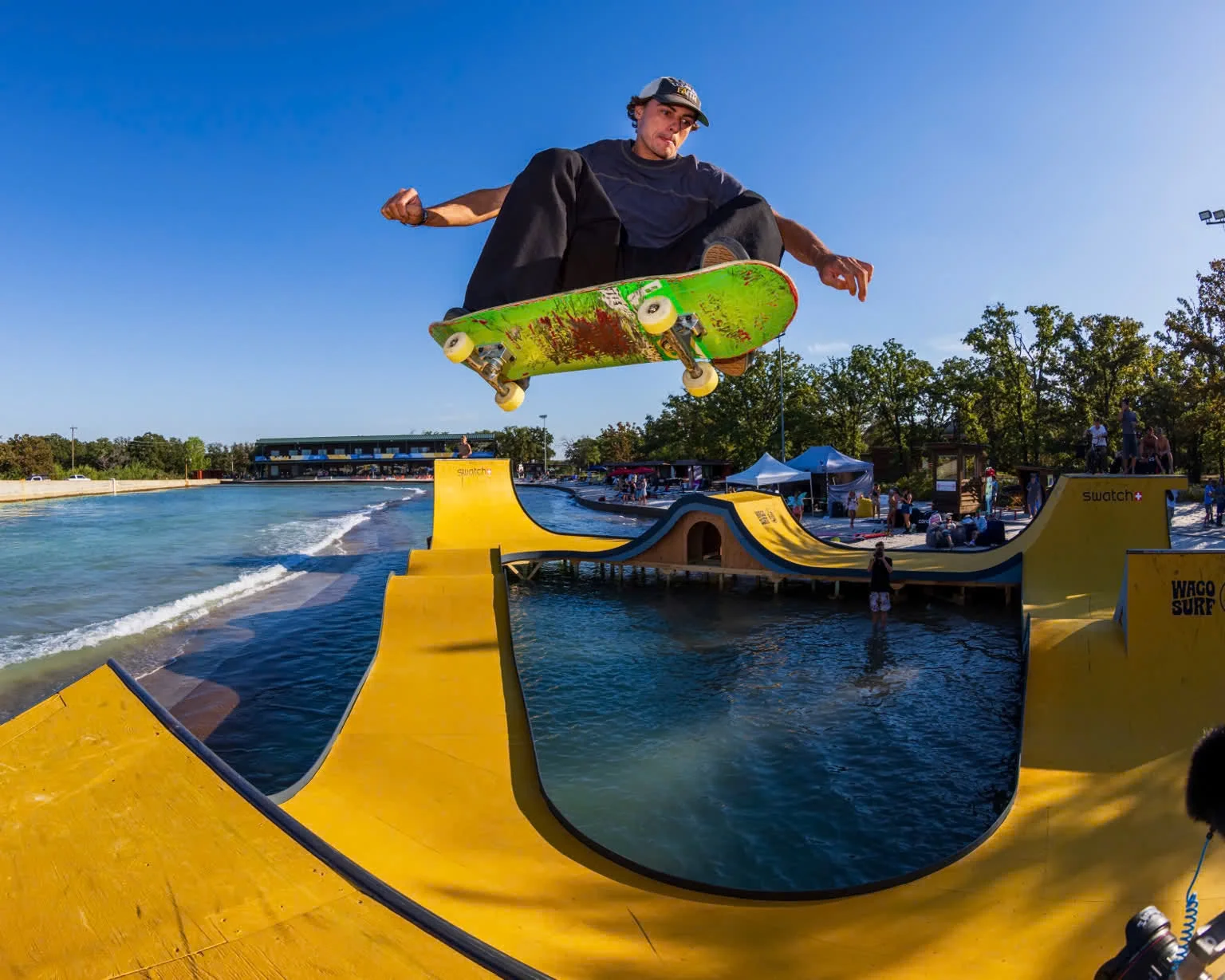
Blair Alley
“The Waco setup is insane. There’s nothing like surfing and skating all in one zone,” said Midler. He said having top athletes from different sports together creates pressure to push further, as riders see peers attempt tricks they once thought out of reach. That pressure can be productive, but it also depends on athletes being willing to learn from one another rather than simply perform side by side.
Here’s the thing: shared space doesn’t automatically mean shared ideas. The course has to offer enough options for athletes to make their own choices, and the riders have to treat those choices as an invitation to experiment. At Waco, the reported lines suggest that some did. A 540, a kickflip Indy and a route through a reception area are different kinds of achievement, but each reflects an athlete deciding how to use the available terrain.
The builds also carried ideas from last winter’s Creative Cabin workshop into the event. The Zenga Bros turned athlete concepts into features that worked with the course, creating a shared space where surf, skate and BMX could shape one another’s lines. That design process matters because a multi-sport event can easily become a set of adjacent attractions. Bringing athlete ideas into the build gives riders a hand in defining what the space can do.
And that’s the part most people overlook: the course is not just a backdrop for highlight clips. Its design determines which experiments are possible, how athletes move between features and whether the different sports feel connected in practice. The result won’t be every rider finding a common line. Sometimes the value is simply that the same structure presents different questions to different athletes.
Public day and rider awards
More than 300 fans came to Waco Surf’s beach on Saturday afternoon for Public Day. They could get close to the custom builds, watch the athletes ride and meet participants. For an event built around unusual course design, that access gives visitors a chance to understand the setup as a physical place, not just as a sequence of edited action shots.
Some visitors joined Nines riders on Waco’s new Shredmill. That offered a more direct way to engage with the event, even for people who weren’t there to attempt the athletes’ lines. If you’re working in this space, the public day is a reminder that a live sports event can make its design part of the audience experience: people can see how the features fit together, watch riders make choices and then try a piece of the setup themselves.
Swatch Nines isn’t a contest, but riders gathered on the final night to recognize notable performances and creative contributions. The awards add a point of focus to a format that doesn’t rank everyone through a single competitive result. They also reflect the event’s range, with categories for tricks, standout performances and new participants. Still, awards can only capture some of what happens on a course where exploration is part of the brief.
The 2026 award winners were:
- New Nine: Makana Franzmann
- Best Skater – Female: Yurin Fujii
- Best Trick Skate – Male: Clay Kreiner
- Special Skate Award: Andy Anderson
- Best Trick Surf – Female: Milla Coco Brown
- Best Trick Surf – Male: Noah Beschen
- MVP – Female: Yurin Fujii
- MVP – Male: Shane Borland
Event footage is available at YouTube.com/@SwatchNines, with a full highlight video scheduled for early this week. Updates are posted at @thenines.cc on Instagram. The Couch Surfing Show aired October 8 and 9 on YouTube, where viewers can also watch event coverage with rider commentary.
Those channels give audiences a way to follow the action after leaving Waco, and rider commentary can add context to what a clip alone shows: how a line was chosen, what made a feature difficult or why a particular attempt stood out. The scheduled highlight video may bring the event’s different sports together in one edit. Whether that captures the feel of sharing a course is another question; footage can show the tricks, while the event’s defining quality is the space and choices around them.
What the format puts in play
Waco’s setup points to a clear opportunity for action-sports events: design the environment so athletes can interpret it in their own ways, then let those interpretations sit alongside one another. That approach can produce variety without requiring a single scoring system to explain every performance. It also places more weight on course design and on the creative work that happens before the athletes arrive.
There are limits to what can be inferred from one event. A shared course won’t erase the differences between surfing, skateboarding and BMX, and a memorable feature doesn’t by itself prove that the format will work everywhere. But Waco offers a practical demonstration of the idea: custom builds can give athletes room to borrow inspiration across disciplines while still pursuing the demands of their own sport.
For audiences, that means there’s more to watch than a list of tricks. The most compelling question is how each athlete reads the same space differently. A useful course invites that question; a successful event gives viewers enough access, footage and commentary to follow the answer.