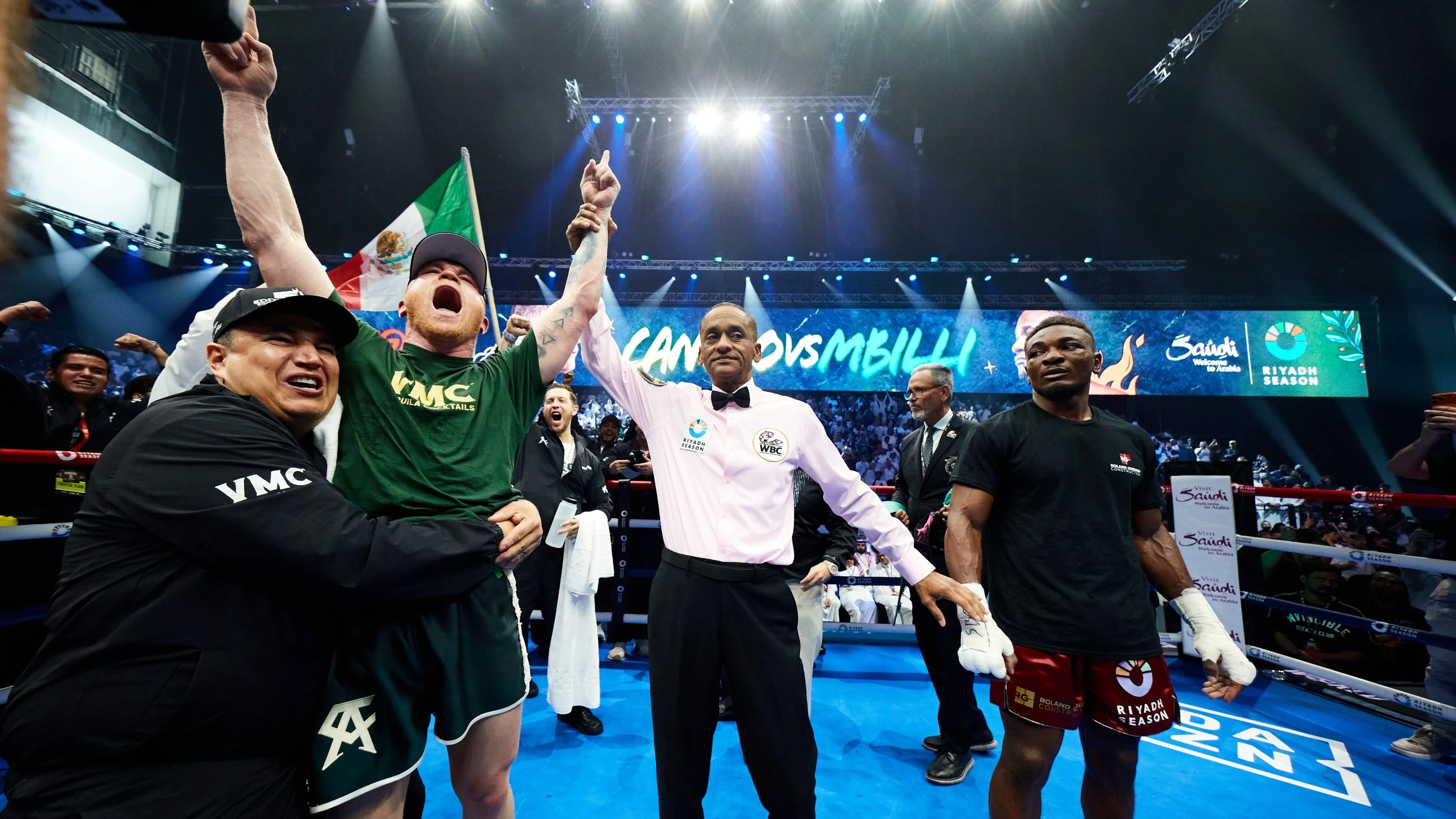
A title regained through timing
Canelo Alvarez’s return to the championship tier came through a familiar adjustment: absorb pressure, make the opponent pay for entering range, then take over. The 36-year-old Mexican beat Christian Mbilli by unanimous decision in Riyadh to claim the WBC super middleweight title, one of the four belts he lost to Terence Crawford in September last year. The result gives Alvarez a belt back, but the route matters as much as the prize: he had to read a younger opponent’s pace and change the shape of the fight rather than simply impose his own from the opening bell.
The judges scored it 115-112, 116-111 and 117-110 for Alvarez. The result moves him to 64-3-2, with 39 knockouts; Mbilli, 31, falls to 29-1-1, with 24 knockouts. Alvarez had been out for 413 days after the Crawford defeat and elbow surgery, making the performance a pointed answer to questions about his ability to compete at the top level. A scorecard can show the margin, but it can’t capture the tactical problem he faced early: Mbilli was forcing exchanges before Alvarez had settled into his preferred rhythm.
Mbilli’s pace tested Alvarez early
Mbilli set a high tempo from the opening bell, steering Alvarez toward the ropes and firing in combinations. Alvarez gave ground, watched for openings and looked to counter, while Mbilli’s greater punch volume made the opening rounds demanding. A right hand narrowly missed in the second, and the Frenchman continued to attack in the third as Alvarez slipped and weaved along the ropes. That early movement was defensive work, but it also gave Alvarez time to study how Mbilli entered and where he left himself exposed.
The pressure wasn’t especially tidy, but it kept Alvarez occupied. In boxing, a forward fighter doesn’t need every punch to land cleanly to affect the opponent’s choices; sustained activity can make it harder to set a pace or choose when to engage. Alvarez answered by inviting Mbilli forward, then meeting him with a heavy counter right as the champion stepped in. In the fifth, Alvarez began to advance himself, threading his lead left around Mbilli’s guard before following with his right and visibly catching him.
That shift changed the terms of the fight. Alvarez’s left hook began landing more often, and Mbilli’s instinct to answer at close range gave the Mexican opportunities to counter in combination. The adjustment wasn’t a sudden transformation so much as a change in who was dictating the exchanges: Alvarez was now drawing the attacks he wanted and punishing the entries. When Mbilli rushed forward in the seventh, Alvarez met him with a clean right uppercut that rocked him.
Alvarez owns the second half
As the rounds wore on, Alvarez’s punches found their mark with increasing regularity and Mbilli’s output ebbed. The Frenchman seemed less willing to commit, with Alvarez’s left hook making each entry risky. That doesn’t mean Mbilli stopped trying; it means the cost of pressing forward had become clearer. Alvarez’s counters made him hesitate, and hesitation gave the veteran more room to choose the next exchange.
By the 10th round, Alvarez was dictating the action: he worked behind his jab, mixed attacks to the head and body, then brought the hook around Mbilli’s guard. Those choices made the offense harder to anticipate. A jab could set up a heavier shot, while a body attack could make the opponent think twice about charging in. Here’s the thing: Alvarez’s experience mattered most when it helped him make Mbilli’s aggression predictable.
Mbilli tried to lift the pace in the closing rounds. In the 12th, he unleashed a flurry while Alvarez rested against the ropes, but Alvarez again found the timing, landing a sharp uppercut that buckled Mbilli’s legs. The late burst didn’t erase the control Alvarez had built across the second half. It did, however, underline that Mbilli remained dangerous enough to demand attention until the final bell.
“It feels like my first title,” Alvarez said after the fight, describing the result as “perfect.” He noted that he had been a professional for 21 years and had won his first title 16 years ago. He said he would rest for a couple of weeks, keep learning and then return. The comments frame the win as a personal milestone, but the fight itself offers a more useful measure: Alvarez could still adjust under pressure and sustain that adjustment over the later rounds.
A meaningful answer at 168 pounds
Fight-week attention had also turned to safety concerns after missile and drone strikes targeted Riyadh in recent weeks. Organisers SELA and Turki Alalshikh faced criticism for proceeding with the event. On fight night, the action stayed inside the ring, where Alvarez had to solve a younger, aggressive champion who began with urgency. That sporting result doesn’t resolve the questions raised around the event’s setting, but it does explain why the bout drew attention beyond the title at stake.
Alvarez may no longer resemble the fighter at his peak, but this was among his most convincing performances in recent years. He didn’t simply survive Mbilli’s pressure; he gradually made that pressure work against him. This is more significant than it looks: after a long absence and a loss to Crawford, Alvarez needed to show that he could still respond to an opponent who forced him to work early. He did so by changing his approach as the fight developed, not by relying on a single dramatic moment.
What the win says about Alvarez’s next chapter
The victory puts Alvarez back in the title picture at 168 pounds, but one result can’t settle every question about his future. It shows that his timing, counterpunching and ability to manage distance remain effective against this opponent. It doesn’t tell us how those strengths will hold up against different styles, or how quickly Alvarez can return after his planned rest. Those answers will depend on the next fight, which he hasn’t specified here.
If you’re working in this space, the useful signal is the method: Alvarez allowed Mbilli to spend energy pressing, then narrowed the openings as the challenger’s attacks became easier to read. Similar contests often turn on whether the fighter under pressure can keep seeing the incoming shots clearly enough to counter. Alvarez managed that transition. And yet, the opening rounds also showed the margin for error: Mbilli’s activity kept him busy and forced him backward before the veteran established control.
The numbers tell part of the story; the changing balance of risk tells the rest. Alvarez’s title win is a strong answer to doubts raised by his layoff and previous defeat, though it isn’t proof that he has returned to his earlier peak. For now, the clearest takeaway is narrower and more credible: he can still make an aggressive opponent pay for rushing in. A title regained. A question answered, at least for one night.


