Velocity tells several different stories in baseball. Mason Miller brought the season’s fastest average four-seam fastball, Jacob Misiorowski delivered its fastest individual pitch, and Chris Bassitt’s curveball moved at a pace that barely seemed to belong in the same game. Those extremes make for a more revealing snapshot of 2026 pitching than a single leaderboard can offer.

This first installment of the 2026 pitching superlatives looks at velocity, from the year’s slowest offerings to the hardest fastballs and the biggest speed gap between a pitcher’s fastball and changeup. A pitch qualified if it was thrown at least 152 times during the regular season. That cutoff also left room for a comic exception: A’s outfielder Carlos Cortes pitched in nine games and threw 151 eephuses.
That was enough for Cortes to earn the unofficial title of sloppiest pitcher of the year. The pitch below, from a 23-2 game against the Nationals, makes a persuasive case for making the designation official. It missed the general vicinity of home plate, struck a Circa Sports sign after three bounces, then took a sharp carom back toward the field. The pitcher, catcher, batter and umpire all seemed to miss the ball’s strange trip. Statcast’s marker for where the pitch supposedly crossed the plate appears well behind Jacob Young, adding an accidental punchline to the sequence.

The slowest individual pitch came from James McCann. On April 28, in a Diamondbacks-Brewers game, McCann tossed a 30.3-mph eephus to start the bottom of the eighth. The Brewers’ broadcast was still airing a group-ticket promotion when he released it. By the time the broadcast returned to the field, the ball had climbed out of view.
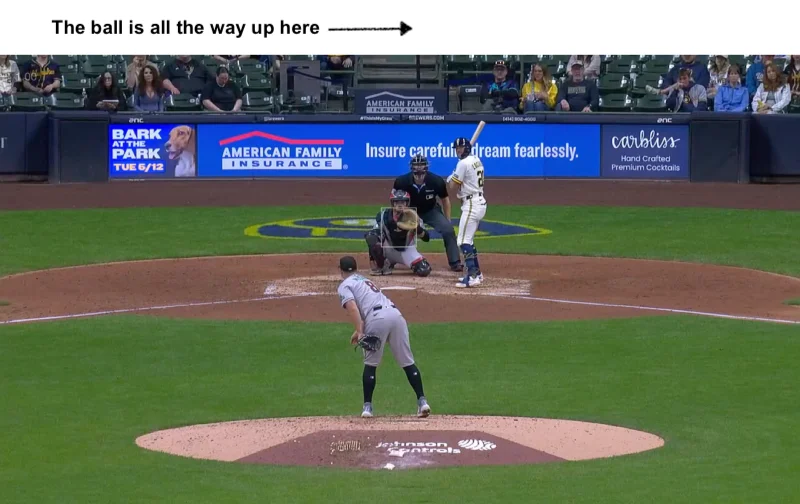
The game was already a 13-2 blowout, and the long, looping delivery briefly made it look as though the teams might be finishing the contest by pantomime. The pitch eventually reached its target, and the clip captures the full arc:
Misiorowski’s peak speed, Miller’s season-long pace
Jacob Misiorowski owns the fastest individual pitch of the season: a 105.5-mph four-seamer to Pete Crow-Armstrong on June 26. Crow-Armstrong fouled it off, making contact with the third-fastest pitch recorded in the Statcast era. Misiorowski’s fastball averaged 100.6 mph, the highest average for a starting pitcher in the season and a mark described as a historical high for starters.
Misiorowski also led the league in volume for a single pitch type. He threw his four-seamer 1,677 times, more than any other pitch in baseball. His former teammate and World Series opponent, Freddy Peralta, ranked second with 1,568 four-seamers. By the article’s deliberately strict nickname rules, that leaves “Fastball Freddy” available only to Misiorowski.

The most fastball-dependent pitcher was Phillies left-hander José Alvarado. A four-seamer, sinker or cutter accounted for 97.4% of his pitches. His curveball made up the remaining 2.6%, yet it may be his most effective offering: Stuff+ gave it a 152 grade, and the cited Statcast measures also favored it over his more frequently used pitches.
That rare curve can produce a called strike even when it appears well away from the top of the strike zone. It’s a striking contrast for a pitcher whose repertoire is otherwise dominated by fastballs.
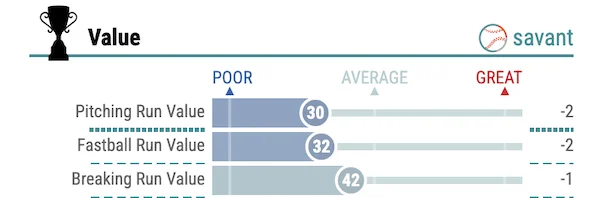
For average fastball velocity, the award goes to Mason Miller. His four-seamer averaged 101.4 mph, up from 101.2 mph in 2025, when he won the same distinction. Ben Joyce, the 2024 winner, followed at 101 mph. Edgardo Henriquez placed third and fourth with sinkers averaging 100.9 and 100.7 mph.
Miller’s fastest pitch reached 104 mph against Hunter Goodman. Goodman let it go by for a ball, a useful reminder that velocity alone doesn’t guarantee a swing.
Bassitt slows the game down
The season’s slowest regular pitch was a curveball, not a changeup. Chris Bassitt’s curve averaged 71.3 mph. It has ranked as baseball’s slowest or second-slowest pitch in each of the past four seasons, after also placing in the top 10 in 2021 and 2022. His slowest curve of 2026 wasn’t otherwise remarkable, but its speed keeps the pitch in a category of its own.
Gaddis creates the widest changeup gap
The final velocity distinction measures separation: the difference between a pitcher’s four-seam fastball and changeup. Dylan Cease and Hunter Gaddis tied with a 15.4-mph gap. Gaddis takes the title because his changeup was slower, averaging 79.7 mph to Cease’s 81.4.
Gaddis’ slowest changeup of the season came against the Twins on July 23. Though the broadcast labeled it a splitter, it was a traditional changeup, floated well inside to Luke Keaschall. Keaschall fouled it off the knob of his bat, sending it away at 50.3 mph. He had already done the same thing against another Gaddis changeup on May 9. The season’s slowest changeup overall belonged to Brent Suter at 76.6 mph, though that mark didn’t win this category.
The season’s velocity leaders show how varied a pitcher’s advantage can be: a fastball that overwhelms over a full season, a single pitch at historic speed, or a changeup that disrupts a hitter’s timing by arriving far slower than the fastball. The next set of superlatives turns from speed to other kinds of pitching extremes.


