Detroit’s roster choices point to two different priorities: keeping a versatile arm who could help fill rotation innings, while leaving the closer spot open. The Tigers exercised Drew Anderson’s $10 million option and declined Kenley Jansen’s $12 million option, paying the veteran closer a $2 million buyout instead.
The moves also required room on the 40-man roster. Detroit re-signed right-hander Jacob Waguespack to a one-year deal with a $1.3 million guarantee and up to $200,000 in performance bonuses. Four players were removed from the roster to accommodate the transactions.
Anderson brings rotation flexibility
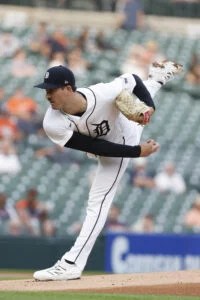
Anderson, 32, will enter spring training competing for a starting role in his second season with Detroit. The Tigers signed him for $7 million after four years pitching in Asia, initially expecting him to contend for a rotation job. Later additions Framber Valdez and Justin Verlander pushed him toward long relief.
His first season had a split character. Anderson opened unevenly and didn’t establish himself as a late-inning reliever, though he received some high-leverage work alongside Will Vest, Kyle Finnegan and Brant Hurter. After Tarik Skubal and Casey Mize were traded at the deadline, Detroit used Anderson in the rotation. He started his final nine appearances and posted a 2.84 ERA over 44⅓ innings.
The underlying numbers temper that finish. Anderson struck out 20% of batters and walked 11% during that stretch, while allowing home runs at an above-average rate. He also had limited success when facing hitters a third time: opponents went 9-for-22, with two doubles and two home runs.
There’s a stronger case for retaining him when his entire season is considered. Anderson threw 108 innings with a 3.67 ERA and struck out nearly 27% of batters as a reliever; his overall strikeout rate was 25%. His fastball averaged 95 mph, and his curveball and kick-changeup generated swings and misses. He developed that changeup while pitching for the SSG Landers in Korea, and it helped him handle left-handed hitters.
Detroit’s rotation depth chart currently starts with Valdez, Troy Melton and Jackson Jobe. Anderson joins Keider Montero and River Ryan as candidates for the remaining spots or for relief work. Reese Olson could also factor in, depending on his recovery from shoulder surgery. With the rotation still taking shape, Anderson’s ability to start or work out of the bullpen gives the Tigers a practical option for camp.
Jansen’s departure leaves a bullpen question
Declining Jansen’s option gives Detroit $10 million in payroll flexibility compared with exercising it, while leaving open the possibility of another deal. The Tigers had five days to decide whether to retain him on those terms. They chose not to commit that early to a closer who had a mixed season.
Jansen converted 22 of 28 save chances and finished with a 3.20 ERA in 45 innings. His 28.3% strikeout rate remained strong, and he closed September with 9⅓ scoreless innings. But walks and home runs made his work less dependable, even as he held the closer’s job throughout the season.
The rest of the late-inning group offers little certainty. Vest and Finnegan are coming off difficult seasons, and Hurter’s larger bullpen role ended after a back injury in late May. Detroit will need to add multiple high-leverage relievers, whether Jansen returns or the club turns to other options such as David Bednar, Adrian Morejon, Raisel Iglesias or Emilio Pagán.
Jansen may prefer to sign somewhere with a clear path to closing. He’ll enter his age-39 season with 498 career saves, third-most all time, and could reach 500 early next year. His track record and September finish give him a case for another opportunity, though Detroit’s decision shows it wasn’t ready to pay $12 million to secure that role before seeing how the market develops.
Waguespack returns after a strong stretch
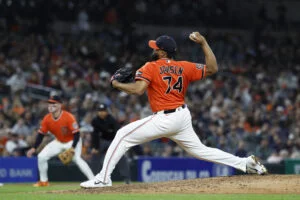
Waguespack’s new deal includes $25,000 bonuses at 45 and 50 innings, followed by $50,000 bonuses at 55, 60 and 65 innings. The right-hander qualified to negotiate with Detroit during the five-day window for clubs to retain their own free agents.
Detroit acquired Waguespack from Milwaukee in mid-June, while he was pitching in Triple-A. He appeared in 35 games for the Tigers and delivered a 2.49 ERA across 47 innings, mostly in low- and medium-leverage situations. His 19.1% strikeout rate was modest, but he produced ground balls on 48% of balls in play.
Waguespack, who turns 33 this week, has a strong chance to make the bullpen. A release clause in his contract gives him the right to elect free agency after each season, despite his not being close to six years of major league service. He’s also out of options, so Detroit would have to expose him to waivers to send him to Triple-A.
Four roster spots open
Detroit placed pitchers Bailey Horn and Sawyer Gipson-Long on release waivers, designated reliever Yilber Díaz for assignment and outrighted outfielder Corey Julks. Julks cleared waivers and elected free agency, according to the team.
Gipson-Long’s removal stands out after a brief but impressive rookie run in 2023. He underwent internal brace surgery the following April, then spent all of the past season on optional assignment. Across 109⅔ minor league innings, he posted a 5.50 ERA. He continued to miss bats at around a league-average rate, but too many walks and a 91–92 mph fastball left him outside the rotation picture.
Horn had Tommy John surgery around the All-Star break and is expected to miss most of next season. Díaz arrived as a waiver claim from Arizona in late June. His arm strength is appealing, but he walked 15% of Triple-A opponents and will be out of options next season.
Julks held a roster spot from mid-August and recorded seven major league plate appearances. His Triple-A season was more productive: a .262/.337/.447 line with 18 home runs. He’ll seek another minor league contract as Detroit reshapes its depth.
The Tigers have preserved flexibility in the rotation and bullpen, but the roster decisions also make the next steps clear. Anderson will compete for innings, Waguespack has a credible path to a middle-relief role, and Detroit still needs reliable arms for the back end of its bullpen.
Respective images via Brian Bradshaw Sevald, Rick Osentoski, and Denny Medley — Imagn Images.


