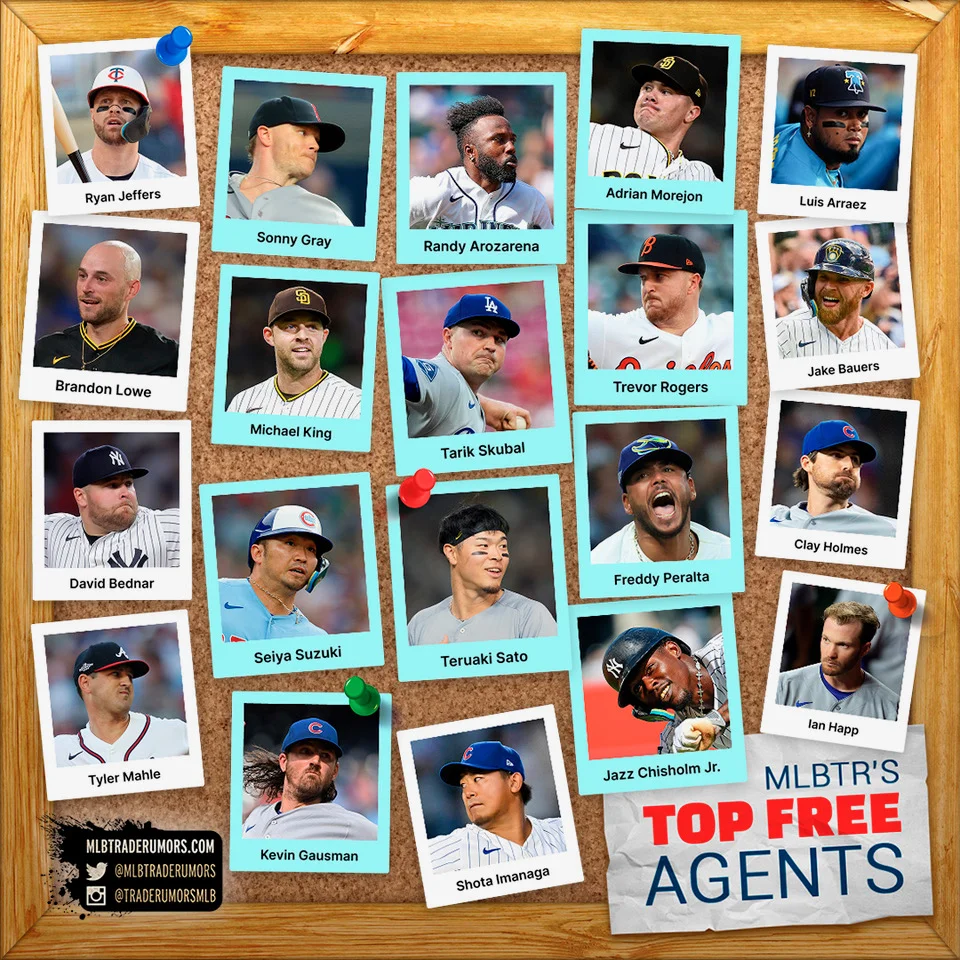
The 2026–27 free-agent market opens under two competing pressures: clubs are sizing up an unusually strong group of players, while a looming labor fight could bring baseball transactions to a halt. That makes this year’s market more than a list of contract guesses. Timing may matter almost as much as talent.
MLB Trade Rumors is publishing its 21st annual Top 50 Free Agent list, ranking players by their expected earning power and predicting a contract and destination for each. The full free-agent pool is here. The site has also previewed the market by position: catcher, first base, second base, shortstop, corner outfield, center field, designated hitter, starting pitchers, right-handed relievers and left-handed relievers.
How the predictions were made
These rankings and player reports took shape over more than a month of discussion among Steve Adams, Anthony Franco and Darragh McDonald, with contributions from MLBTR founder and owner Tim Dierkes. For players who have starred overseas but haven’t appeared in the majors, the group also draws on scouts and industry contacts. The writers reach a shared contract prediction for every player on the list, though their own estimates can differ from that consensus. The destination picks are made independently, which means overlap is expected and occasional unanimity happens.
Each writer’s team predictions will go into MLBTR’s annual Free Agent Prediction Contest. Readers can enter for free, compare their calls with the staff’s and compete for cash prizes, free subscriptions and other rewards. The contest is expected to be posted Tuesday.
A team’s absence from the picks shouldn’t be read as a forecast that it will sit out. The list covers 50 players, even though dozens more will sign major-league contracts, and each writer has to name just one destination for each player. The accompanying reports discuss a broader set of plausible fits based on roster needs and budget. Front offices also have another route to reshape a roster: MLBTR’s top 40 trade candidates.
A market facing a labor deadline
The central uncertainty is the collective bargaining agreement, which expires Dec. 1. MLB and the MLB Players Association have been in what the source describes as nominal negotiations, with no substantive progress so far. The league is pushing more aggressively for a salary cap; the union is focused on blocking one and wants rules that press low-payroll clubs to spend the revenue-sharing funds they already receive on their rosters.
The last CBA expired in December 2021. Owners then imposed a 99-day lockout, freezing transactions until the sides reached a deal. Nobody can say how long a new stoppage would last. The union has always rejected a salary cap, and if MLB insists on one, games could be missed in 2027. That outcome remains uncertain, but the approaching deadline is likely to concentrate activity into a few weeks while the current agreement still applies.
The 2021 deadline produced a rush of deals before the lockout, followed by another burst of transactions in March after the new CBA was settled. A similar pattern could bracket this winter. The less disruptive option is obvious: the parties reach an agreement before baseball shuts down for months. Whether they can do that is the question hanging over every contract projection.
Following MLBTR through the offseason
MLB Trade Rumors says it has operated independently for two decades and appreciates readers choosing it among larger media companies. Readers can support the site with a Trade Rumors Front Office subscription. Membership includes ad-free browsing, the contract tracker research tool, the Offseason Outlook series covering all 30 clubs, an agency database, weekly staff articles, a weekly mailbag and live chats with Anthony Franco and Steve Adams. The subscription includes a 100% money-back guarantee.
The free Trade Rumors app offers article reading and comments, plus custom feeds and alerts for teams and players. It also connects with the site’s sister publications covering the NBA, NFL and NHL: Hoops Rumors, Pro Football Rumors and Pro Hockey Rumors.
1. Tarik Skubal, LHP — nine years, $425 million
Tarik Skubal is the clear No. 1 free agent in this group. He has won the American League Cy Young Award in both 2024 and 2025, and he’ll reach the market shortly before turning 30. Over each of the past four seasons, he has kept his ERA below 3.00, struck out at least 30% of batters and walked fewer than 5%.
Since 2023, Blake Snell has the best ERA in baseball at 2.46, just ahead of Skubal’s 2.47. The workload makes that comparison more favorable to Skubal: he has done it over 626⅓ innings, nearly twice Snell’s 388.
Skubal’s value comes from the whole package. At 6-foot-3 and 240 pounds, he routinely throws his four-seamer and sinker at 96 mph or faster, and he holds that velocity deep into games. Since breaking out in 2023, he has averaged more than six innings per start. Batters have also struggled to adjust as a game goes on: his career opponent line rises from .201/.247/.347 the first time through the order to .221/.272/.361 the second time and .235/.291/.366 the third.
Across the past four seasons, Skubal’s 26.7% strikeout-minus-walk rate leads the majors. Only Chris Sale at 25.6% and Garrett Crochet at 25.5% have topped 25% in that span. Skubal’s 15.5% swinging-strike rate ranks third; his 31.1% strikeout rate since 2023 ranks fifth, while his 4.5% walk rate ranks third-lowest.
Detroit found him in the ninth round of the 2018 draft, selecting the former Seattle University left-hander with the first pick of that round. Another 254 players had already been chosen. Within two years, Skubal was widely regarded as one of the sport’s top 50 prospects.
Health is the main complication in an otherwise exceptional profile. Skubal had arthroscopic surgery in May to remove a loose body from his left elbow. He underwent a newer, experimental procedure called “NanoNeedle” and returned to a major-league mound 43 days later. His medical history also includes Tommy John surgery in college and a 2022 operation to repair the flexor tendon in his left arm.
Even with those concerns, his recent availability is strong: after returning from the flexor repair in 2023, the elbow procedure was his only missed time. He threw 158⅔ regular-season innings, then added 11 postseason innings with a 2.45 ERA during the Dodgers’ run after a trade from Detroit to Los Angeles on Aug. 1. That trade also made him ineligible for a qualifying offer, removing one potential obstacle in free agency.
The proposed nine-year, $425 million deal would put Skubal in the conversation for the largest pitcher contract ever. Gerrit Cole signed for nine years and $324 million with the Yankees, setting the previous record for a pitcher, excluding two-way star Shohei Ohtani. Yoshinobu Yamamoto later nominally surpassed that guarantee at $325 million after being posted. Skubal’s agent, Scott Boras, will have a chance to reset the benchmark, and the projection here is that he clears it by a substantial margin.
Long contracts carry more risk for clubs than they once did. Skubal nevertheless has an unusually strong case: two Cy Young Awards, four dominant seasons, an age that keeps him in his prime and no qualifying offer attached. His 2025 season may not have been baseball’s best individual campaign, but his sustained excellence since 2023 supports calling him the sport’s best pitcher.
Plenty of teams will want him. Far fewer can comfortably contemplate a price above $300 million, potentially $400 million. The Dodgers, his current club, have a deep rotation, which could temper their urgency without taking them out of the bidding. There’s also uncertainty around owner Mark Walter amid an ongoing federal fraud probe. Dodgers president of baseball operations Andrew Friedman has said he expects “business as usual” this offseason.
The Mets have the financial capacity to compete with Los Angeles and a more pressing need for rotation help. The Yankees have high-end starters already, but can’t be dismissed. The Padres regularly pursue major free agents; the Phillies are also aggressive, and the Blue Jays have spent years chasing top-tier talent. Chicago’s Cubs have a glaring rotation need among big-market contenders, though their franchise-high contract remains Jason Heyward’s $184 million deal. The Rangers need pitching while cutting payroll, with only one guaranteed year left on both Jacob deGrom and Nathan Eovaldi. Boston doesn’t have an urgent rotation need, but chief baseball officer Craig Breslow, a former big-league pitcher, has built around pitching and defense.
Don’t be surprised if an unexpected bidder appears. Detroit has little long-term money committed beyond Kevin McGonigle’s extension. The White Sox have a talented young core under cost control and no guaranteed salary beyond 2027. San Francisco could also consider adding another major long-term commitment.
The likeliest outcome is a deal with one of the richest clubs, but the structure is hard to call. Some teams may favor a shorter contract with a huge annual salary, as the Dodgers did with Kyle Tucker; others may stretch the payments over more years to manage luxury-tax costs. Either way, Skubal is positioned to challenge the pitcher records for average annual value and total guarantee. The current AAV mark is $43.33 million, shared by Max Scherzer and Justin Verlander.
Steve’s pick: Mets | Anthony’s pick: Dodgers | Darragh’s pick: Mets
2. Trevor Rogers, LHP — five years, $115 million
Trevor Rogers is next on the list, with a projected five-year contract worth $115 million.
Injuries obscured what Miami thought it had in Trevor Rogers. Once healthy, he’s looked like a reliable mid-rotation starter again—and that recovery is the point teams will weigh most heavily as he reaches free agency.
Rogers was a top-10 draft pick and finished runner-up for National League Rookie of the Year in 2021. Back spasms, a lat strain and a biceps strain then restricted him to 125 innings across 2022 and 2023. He posted a 5.26 ERA in that span as his fastball lost velocity. Miami traded him to Baltimore in 2024 for Kyle Stowers and Connor Norby, but his first Orioles stint went poorly enough that he was sent to Triple-A after four starts. A knee dislocation in spring training 2025 delayed his recovery further. Since returning, though, he’s spent most of two seasons pitching much closer to his rookie form.
The results since May 2025 make a strong case: 48 starts, a 3.16 ERA, a 23.2% strikeout rate, a 6.1% walk rate and a 41.1% ground-ball rate. That’s a little better than average at missing bats, excellent control and a ground-ball rate just below the norm. His fastball hasn’t regained its 94.6 mph peak, but it has climbed from 91.9 mph in 2024 to 93.8 mph this season. It was even livelier late, averaging 94.3 mph over the final two months.
Here’s the thing: Rogers has shown No. 2 or No. 3 starter quality whenever he’s been healthy. In 2021, he logged 133 innings with a 2.64 ERA, a 28.5% strikeout rate and an 8.4% walk rate. Since finding his form in Baltimore, he’s added 279 1/3 innings with an ERA just above 3.00. His career ERA remains 3.88 despite the injury-riddled seasons. He walked only 4.4% of hitters over his final 127 innings this year. He isn’t a dominant ace, but the mix of command, strikeouts and grounders gives a team plenty to trust.
At 28, Rogers is younger than most pitchers entering the market; he turns 29 later this month. His draft and prospect pedigree still carries some weight, and the recent trend is encouraging. The Orioles were obvious candidates to extend him a qualifying offer. He should decline the $23.15 million offer, with a deal of at least four years in reach, five quite plausible and six a longer shot.
His recent numbers compare well with those Ranger Suarez brought into free agency last winter before signing a five-year, $130 million contract with Boston. Rogers hasn’t matched Suarez’s durability, but he’ll reach the market a year younger. He could become the leading option for teams that need rotation help but balk at the expected record-setting price for Skubal. The Blue Jays, Cubs, Giants, White Sox, Mets, Braves, Twins, Padres and Orioles all have reason to look.
Steve’s pick: White Sox | Anthony’s pick: Cubs | Darragh’s pick: Blue Jays
3. Freddy Peralta, RHP: Five years, $110MM
Freddy Peralta’s season swung so wildly that it’s hard to price him from the final line alone. He went from a promising start, to the worst stretch of his career, to a convincing late-season recovery. The question for clubs is how much to trust that last turn.
The Brewers traded Peralta, the only organization he’d known, to the Mets in late January. He arrived with extension and free-agent stakes hanging over the season, but no long-term deal came together before Opening Day. Through nine starts, he had a 3.10 ERA and carried a 3.63 mark into June. His fastball averaged 93.9 mph, down from 94.8 the year before, while his strikeout rate slipped from 28.2% to 23.9%. Those were signs of decline, but hardly a crisis.
Then June arrived. Peralta gave up six runs in six innings on June 9, followed less than two weeks later by a career-worst 10-run outing against Philadelphia. More rough starts followed. Over a 13-start stretch, he posted an ERA above 7.00, struck out just 18.8% of hitters and allowed nearly two home runs per nine innings. His 3.63 ERA after a quality start on June 3 ballooned to 5.33 over the next nine weeks. The Mets sent him to Tampa Bay at the deadline for a respectable return, though nowhere near what his spring outlook might have suggested.
Peralta’s Rays stint changed the picture again. He started to recover velocity late in the season and, like many Tampa Bay pitchers, leaned more heavily on his changeup. The home runs stopped coming, and he finished with a 3.25 ERA in 10 regular-season starts. That includes a seven-run loss at Coors Field in his first outing after the trade. Over his final nine starts, he had a 2.26 ERA; in his last 34 innings, he allowed only three runs.
He carried that form into the playoffs, allowing two runs over his first 16 2/3 innings, though his 12-to-7 strikeout-to-walk ratio was less reassuring. His former Brewers teammates finally got to him for five runs in 4 2/3 innings in World Series Game 3. Defensive mistakes and a bullpen unable to strand the runners contributed to that damage.
Even counting the Coors Field blowup and the World Series loss, Peralta’s ERA since the trade is 3.17 over 76 2/3 innings. His fastball, which averaged 93.9 mph early in the year, has been close to 97 mph in the playoffs. The 19.1% strikeout rate he posted as a Ray is below average, but he cut his walk rate to 8% and generated chases more than six percentage points above his previous career high. His swinging-strike rate was around average. The renewed velocity and improved command give him a path back to more strikeouts, though that outcome isn’t guaranteed.
The midseason collapse likely cost Peralta money. There’s no point pretending otherwise. His representatives can still make a credible case that he has been among baseball’s most consistent starters since 2021, with one badly timed slump in a contract year followed by a strong rebound. A weak Mets defense didn’t help, and Peralta isn’t the only pitcher on this list whose results improved after leaving New York.
Some teams may try to offer a short deal with a high annual salary, perhaps including an early opt-out. Peralta can decide whether that structure suits him, but his track record and late recovery should support a multiyear contract as he enters his age-31 season. Tampa Bay is unlikely to keep him at this price. The Giants, Padres, Blue Jays, White Sox, Orioles, Red Sox and Cubs are sensible fits; Chicago’s manager, Craig Counsell, previously managed Peralta in Milwaukee.
Steve’s pick: Cubs | Anthony’s pick: White Sox | Darragh’s pick: White Sox
4. Seiya Suzuki, OF: Four years, $105MM
The Cubs got far more than they paid for when they signed Suzuki to a five-year, $85 million contract. He arrived from Nippon Professional Baseball as Japan’s best player and has become a dependable everyday right fielder. His first MLB season, in 2022, brought a .262/.336/.433 line and 14 home runs in 111 games as he adjusted to major-league pitching. His offense has grown since.
Suzuki hit 20 home runs in 2023 and has reached that mark in each of the four seasons since. He peaked at 32 last year; his 26 this season came alongside what may be his best all-around offensive campaign: .270/.368/.473, a career-high 12.8% walk rate and a 24.4% strikeout rate. He’s drawn walks at a rate above 10% in four straight seasons. In three of the past four, his isolated power—slugging percentage minus batting average—has topped .200, well above the .156 league average.
His defense also answered some questions. After playing more often at designated hitter in 2025 following the Cubs’ acquisition of Kyle Tucker, Suzuki logged 972 innings in right this year. He posted career bests in Defensive Runs Saved (12), Outs Above Average (5) and Fielding Run Value (8).
Suzuki doesn’t steal many bases, but he moves better than his game might suggest: his sprint speed ranks in the 63rd percentile. Statcast also rates his arm strength and accuracy highly. The more concerning change is in his contact quality. His 88.6 mph average exit velocity and 38.9% hard-hit rate were career lows, after he exceeded 91 mph and 48%, respectively, in each of the previous four seasons. His bat speed held steady, but he hit more grounders and slightly more infield flies.
Those are modest warning signs against a strong body of work. Suzuki looks like a middle-of-the-order hitter who can still handle right field. Age is the main constraint: he turned 32 in August. MLBTR’s Contract Tracker shows that, over the past five years, only Alex Bregman, Kyle Schwarber, Freddie Freeman and Starling Marte signed contracts of at least four years beginning at age 32 or older.
Clubs tend to resist long commitments to players in their 30s, especially when a qualifying offer is involved. Suzuki is expected to reject one, but his steady production makes a four-year deal plausible; five years isn’t out of the question. The Cubs would like to keep him, particularly with both corner outfielders headed for free agency, though their first priority may be starting pitching. The Mariners, Orioles, Blue Jays, Tigers, Royals, Reds, Phillies and Padres could also look for corner-outfield help. Some may balk at paying top dollar for a player who turns down a qualifying offer.
Steve’s pick: Red Sox | Anthony’s pick: Mariners | Darragh’s pick: Blue Jays
5. Randy Arozarena, OF: Four years, $100MM
Arozarena and Suzuki are close comparisons: both are right-handed corner outfielders with power, both are likely to reject qualifying offers, and both will enter their age-32 seasons. Arozarena adds more stolen bases, though he’s slower than Suzuki by Statcast’s average sprint-speed measure: 27.1 feet per second, in the 40th percentile, versus Suzuki’s 28 feet per second and 63rd percentile. Arozarena’s aggressive baserunning has still produced six straight 20-steal seasons.
His power is just as consistent. Arozarena has hit at least 20 home runs and stolen at least 20 bases in each of the past six seasons, with 26 homers in 2026. He also had a career-best year at the plate, batting .281/.381/.484. Adjusted for the pitcher-friendly conditions at T-Mobile Park, his wRC+ was 51% above league average. On the road, he hit .309/.394/.539, among the strongest lines in baseball this season.
The underlying contact data gives teams another reason to wonder what he might do in a friendlier park. Across the past four seasons, his average exit velocity has ranged from 90.4 to 91.8 mph, and his hard-hit rate has stayed above 43.2%, peaking at 50.6%. Over 2,681 plate appearances in that span, he averaged 91 mph off the bat, with a 10% barrel rate and 46.4% hard-hit rate. His batting line over the same period was .248/.352/.431.
But the warning signs are real. Arozarena’s bat speed has fallen three years running, dropping sharply from 72.3 mph last season to 70.9 mph in 2026. That puts him in the 31st percentile, down from the 64th percentile at 72.8 mph in 2023. His barrel rate fell to a career-low 7.9%, and his 43.2% hard-hit rate was also a career low. He chased 30.7% of pitches outside the strike zone, a career high and 5.5 percentage points above his 2025 rate. His 10.1% walk rate remained solid, but it was below the 11.8% peak he reached in 2023 and 2024.
Even with the drop in bat speed, Arozarena remains a dependable everyday left fielder. His arm isn’t suited to right, and his range in left is limited, so a future team may need to give him more time at DH. Still, he’s a three-time All-Star coming off a season worth 5.7 bWAR and 5.5 fWAR. Few players combine 20 homers and 20 steals as reliably. He continues to hit the ball hard and draw walks at an above-average rate.
Like Suzuki, Arozarena has a credible case for a four-year contract at age 32. The bidders may overlap, though Arozarena’s left-field profile could narrow his market. He and Mariners teammate Cal Raleigh appeared to smooth over tension tied to Raleigh’s perceived snub of Arozarena at the plate during the World Baseball Classic. It’s a minor consideration, but it could enter the discussion if Seattle weighs a reunion against other options.
There may not be a clear consensus on which player is the better buy. Their ages, profiles and recent production are close enough that they’re likely to share bidders and land contracts in a similar range.
Steve’s pick: Blue Jays | Anthony’s pick: Red Sox | Darragh’s pick: Phillies
6. Michael King, RHP: Four years, $92MM
Michael King answered the durability question after an injury-shortened 2025. He made just 15 starts and threw 73 1/3 innings that year; in 2026, he set career highs with 32 starts and 185 innings. His 3.21 ERA ranked 16th among qualified starters.
King’s 21% strikeout rate and 9.2% walk rate were both a little worse than league average. The stronger case rests on contact management: opponents averaged 87 mph off the bat and produced a 32.6% hard-hit rate, figures that ranked in the 86th and 89th percentiles among major-league pitchers, according to Statcast. His 45.1% ground-ball rate was nearly four points above average.


