Green Bay’s backfield workload shifted toward Josh Jacobs
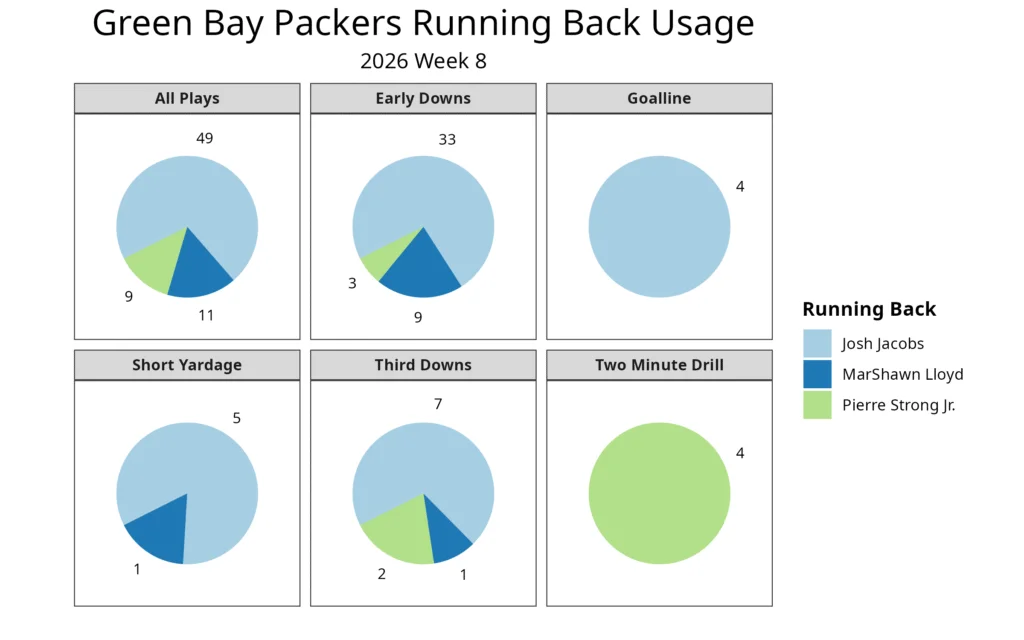
The clearest fantasy signal from Carolina’s visit to Green Bay was Josh Jacobs’ expanded role. The Packers have struggled to establish an effective run game this season, but Jacobs took a larger share of the work in his second game and scored twice. His workload gives fantasy managers more reason to keep him in starting lineups.
Jacobs spent the season’s first six weeks on the Commissioner’s Exempt List. In his first game back, he played 52.2% of Green Bay’s offensive snaps, sharing early-down work and some third-down and short-yardage opportunities. MarShawn Lloyd handled most of the rotation alongside him, while Pierre Strong Jr. also saw a handful of snaps. That limited deployment resembled Jacobs’ late-season workload last year, when he was playing through injury.
This time, Green Bay gave Jacobs a more prominent place in the offense. He played every snap on the Packers’ first, second, fourth and fifth drives. Lloyd handled the third possession, and Strong took the field for the two-minute drill at the end of the first half. Green Bay’s multi-score lead in the second half brought more rotation, but Jacobs’ early workload was still a meaningful step up.
For fantasy purposes, Jacobs’ larger role makes his place in lineups feel safer. Lloyd’s reduced share makes him difficult to start, though he remains worth holding in most leagues. The league is still investigating Jacobs, and a suspension remains possible. If Jacobs is unavailable, Lloyd could return to Green Bay’s starting role.
Watson’s return matters more than a clear replacement
Christian Watson’s night included a hospital evaluation for a chest injury, but he returned to the stadium and re-entered the game. He left late in the second quarter, cleared his tests according to reports early in the third, and came back later in that quarter. Watson finished with more than 100 yards despite missing a portion of the game.
His return is the immediate development for fantasy managers, though Green Bay did rotate him more than usual after he came back. The Packers listed him as questionable during the game and left open the possibility of a return. Given that he rejoined the lineup, the outlook for the team’s next game appears encouraging, particularly with extra time before it after this Thursday night matchup.
The broader receiver picture offers a less tidy fantasy takeaway. Watson and Matthew Golden have been Green Bay’s primary wideouts. Jayden Reed and Skyy Moore, who had handled significant slot work, are both on injured reserve. Savion Williams has taken over the slot role in recent games, and that assignment stayed the same after Watson’s injury.
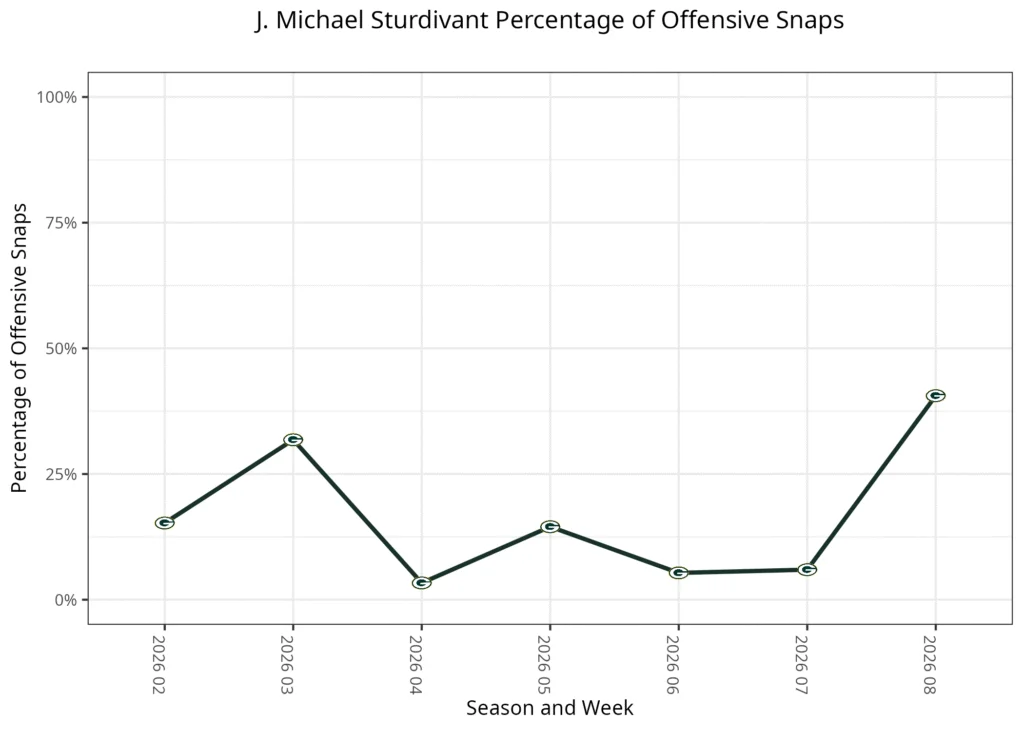
Green Bay didn’t install one obvious replacement for Watson on the outside. Bo Melton and J. Michael Sturdivant rotated there, while Golden occasionally took plays off after catches, leaving both in the lineup. If Watson or Golden misses time later in the season, this usage suggests an outside receiver committee rather than a straightforward waiver pickup. Sturdivant looks like the group’s most appealing option for upside, but the rotation limits certainty.
Carolina’s tight ends still lack a dependable fantasy role
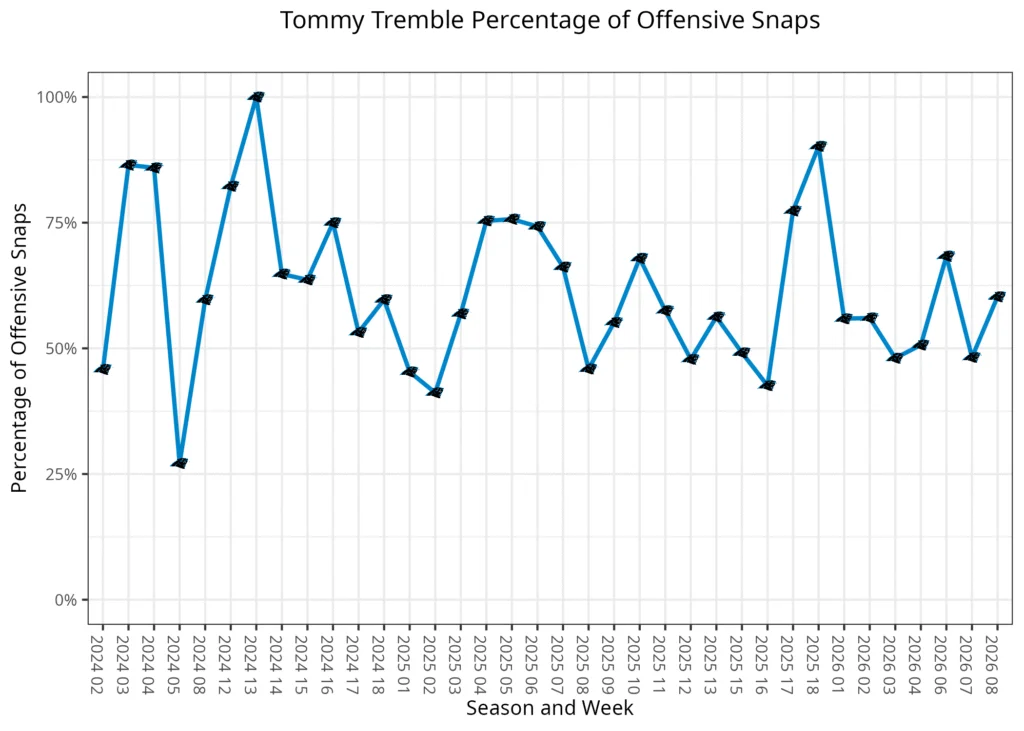
Tommy Tremble played more often than usual, but the increase didn’t translate into a clear route advantage. Carolina has divided tight end snaps among Tremble, Mitchell Evans and Darren Waller. Before this game, Tremble had averaged 54.9% of snaps, compared with 48.2% for Evans and 45.8% for Waller. Their roles have differed by personnel grouping: Tremble and Evans typically feature in 12 personnel, while Waller has more third-down work. On early downs in 11 personnel, the team has rotated among all three.
That distinction matters because Waller has generally run more routes and scored more touchdowns, giving him the stronger fantasy profile. Tremble’s Week 5 line—four catches for 46 yards and two touchdowns—offered a reminder of his scoring potential, but he played less than usual the following week.
Against Green Bay, Tremble returned to a larger share of 12-personnel snaps and saw more early-down work in 11 personnel than in any other game this season. But he still wasn’t on the field for third downs, where Waller continued to run more routes. Waller has caught only one pass across the past three games after a promising first month. Tremble may earn more work as the season continues, but neither player has a stable enough role to trust as a fantasy starter right now.
Carolina’s offense runs through Chuba Hubbard
Chuba Hubbard dominated the Panthers’ snaps and touches, yet Carolina couldn’t keep pace with Green Bay. That concentration makes Hubbard the team’s most prominent fantasy contributor from this matchup, while the offense’s other usage patterns offer narrower clues about the receiving corps.
Tetairoa McMillan and Jalen Coker continue to play as every-down receivers. John Metchie III has been used in 11 personnel, while Brycen Tremayne has seen work in 13 personnel and a smaller number of 11-personnel snaps. Xavier Legette is eligible to return from injured reserve, though there’s been no report on when he might come back. AJ Dillon was a healthy scratch for the third straight game.
Roster notes that could shape future usage
Kaleb Johnson was inactive for the second consecutive game despite being healthy. He may remain out while Green Bay’s other running backs are available; the source notes that his roster spot could be at risk if the Packers need room for players at other positions.
Golden missed practice on Monday and Tuesday with shoulder and foot injuries, then was limited on Wednesday. He was listed as questionable but played close to his usual snap workload. Watson’s injury was more dramatic, but Golden’s practice status is another detail to monitor for the Packers’ receiving group.
Backup tight end Josh Whyle left early with a concussion. Mark Redman took on more work after that, playing every 12-personnel snap and also stepping in on some 11-personnel plays when Tucker Kraft needed a break. Jonnu Smith was a healthy scratch for the first time this season. After six targets in the opening three weeks, he has been targeted only twice over the past four games.
On defense, Carolina remains without Jaycee Horn and Mike Jackson, both on injured reserve, while Akayleb Evans missed this game with triceps and knee injuries. The Panthers opened with rookie Will Lee III and practice squad call-up Marco Wilson outside, with Tre’von Moehrig in the slot. Lee injured his hamstring late in the second quarter, and Chau Smith-Wade moved from the slot to an outside cornerback spot for the rest of the game.
Devin Lloyd returned to playing every defensive snap for Carolina after seeing a smaller role the previous week amid a large second-half deficit. For Green Bay, Isaiah McDuffie and Ty’Ron Hopper each played more than 90% of defensive snaps as the team’s two linebackers for a second week in a row.
Reading the usage data
The snap counts include plays erased by penalties, including offensive holding and defensive pass interference. The other three statistics exclude those plays. Target totals may differ from official NFL figures, particularly on clear throwaways: official scoring may assign the target to the nearest receiver, while this data does not. Carries count designed runs only, so quarterback scrambles aren’t included.
For fantasy managers, the matchup leaves a few actionable usage signals: Jacobs’ workload rose, Watson returned after evaluation, and Carolina continues to funnel opportunity toward Hubbard. The Packers’ reserve receivers and the Panthers’ tight ends remain unsettled enough that their snap patterns deserve attention before anyone treats them as dependable weekly options.


