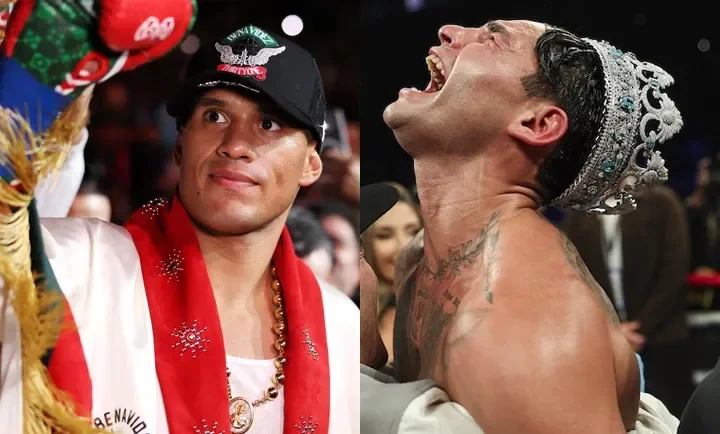
Promoters compete for the fights
Free agency has made David Benavidez and Ryan Garcia tempting targets for rival boxing promoters. But comments at a Wednesday press conference in Hollywood suggest both stars may see more value in staying close to the people and platforms that can arrange their next major fights. In boxing, a fighter’s options depend not only on who can offer a contract, but also on whether the relevant promoters can agree to make the bout.
That distinction gives the current speculation its real weight. Benavidez and Garcia have drawn interest from Zuffa Boxing, while their existing connections point toward PBC, Golden Boy Promotions and DAZN. Public remarks don’t settle where either fighter will compete long term, but they show that access to high-profile opponents is central to the discussion. A change in promotional home would matter only if it improved those chances.
Benavidez’s route to bigger fights
Benavidez, 32-0 with 26 knockouts, said he wants to remain with Premier Boxing Champions (PBC), where advisor Al Haymon and promoter Sampson Lewkowicz have guided his career. The 29-year-old holds the WBO and WBA cruiserweight titles and is scheduled to headline a Dec. 5 three-belt unification against new WBC champion Michal Cieslak, 28-2 with 22 knockouts, at Desert Diamond Arena in Glendale, Arizona. That bout gives him a chance to add the WBC belt, while also putting a concrete test ahead of his larger ambitions.
The December bout is one step in a broader plan. Benavidez has named former IBF champion Jai Opetaia, ex-undisputed light heavyweight champion Artur Beterbiev and former undisputed cruiserweight and heavyweight champion Oleksandr Usyk as the fights he wants next. Those names span different divisions and career histories, so a wish list alone doesn’t establish that any matchup is close. It does, however, make the promoter question practical: Benavidez needs a route to opponents whose schedules and promotional arrangements may not be controlled by his own team.
Opetaia’s connection to Zuffa Boxing, along with Zuffa chief Dana White’s interest in Benavidez, has fueled speculation that the company could pursue the champion. Yet Benavidez said his aim is to work across promoters to land the matchups he wants. PBC previously allowed him to face Anthony Yarde on a Riyadh Season card backed by Turki Alalshikh, an example of how a fighter can appear on an event outside his usual promotional setting without necessarily changing teams. The precedent supports Benavidez’s argument, though it can’t guarantee that future negotiations will work as smoothly.
“We’re able to move around, and the promotional companies, at the end of the day, they work for us,” Benavidez said. He added that his proposed fights serve both the fans and the sport. “I’ve got my wish list … it don’t get better than that.” The point is clear: he wants the freedom to pursue valuable fights without treating promotional affiliation as a boundary. Whether the companies involved can make that approach work will be measured in signed bouts, not press conference assurances.
Golden Boy Promotions chief Oscar De La Hoya also dismissed the prospect of Benavidez leaving PBC. He described the fighter as loyal to Haymon and Lewkowicz, and argued that the strongest roster of opponents and champions is currently available through DAZN. That is a promoter’s assessment, and it serves Golden Boy’s interest in keeping major fights on its platform. Still, the broader claim reflects how a platform’s value is judged in boxing: by the opponents it can bring together, rather than by its name alone.
“Zuffa Boxing is not what David Benavidez represents,” De La Hoya said, adding that Benavidez has no interest in competing for what he called the “Zuffa unicorn belt.” The comment draws a line between the kind of title and promotion De La Hoya believes suits Benavidez and the one associated with Zuffa. It also shows how these recruitment conversations double as arguments over credibility and status. This is more significant than it looks: the choice of opponent and event can shape how a fighter’s achievements are understood by fans.
Garcia’s schedule points toward DAZN
Garcia’s position is less settled publicly, but his immediate plans also keep him close to Golden Boy and DAZN. De La Hoya said he is working on a February welterweight unification between Garcia and WBA titleholder Teofimo Lopez Jr., who has a multi-fight agreement with DAZN. A unification would give the proposed matchup a clear sporting purpose, though De La Hoya’s comments describe a fight he is working on, not one that has been confirmed.
Garcia’s September knockout of Zuffa fighter Conor Benn had prompted questions about whether White might try to recruit him. De La Hoya said he sees little reason for Garcia to make that move, with a potential Lopez fight ahead and a possible rematch with Devin Haney later in 2027. Those possibilities give Garcia a plausible near-term path within the existing network, but each depends on the parties making the fight. For now, the schedule is a case for staying put, not proof that every bout is settled.
“You never know what’s going to happen,” De La Hoya said, while stressing that Garcia wants to build a lasting legacy. He pointed to Haney’s DAZN deal and his own pursuit of a welterweight unification against Liam Paro as further signs that major matchups could converge on the platform. The thread connecting those plans is access: Golden Boy is presenting DAZN as a place where several relevant welterweight fights may be assembled. That’s a persuasive pitch, but the promised value rests on those matchups becoming real.
Recent moves have complicated Zuffa’s recruitment picture. Unbeaten four-division champion Shakur Stevenson left the promotion after efforts to arrange fights with Manny Pacquiao and Haney failed; he is now in talks with DAZN. Haney, meanwhile, turned down Zuffa’s approach and signed a multi-fight deal with DAZN. These decisions suggest that a promotion’s ability to deliver specific opponents can weigh heavily when fighters assess their options. They don’t establish a permanent trend, but they make the outcome of negotiations more revealing than the recruitment talk itself.
What the next fights will show
For Benavidez, the practical measure is whether promoters can deliver the opponents he has called for. His December homecoming gives him a title unification first; the Opetaia, Beterbiev and Usyk ambitions will test how well his current arrangement can turn that wish list into actual fights. If you’re working in this space, the key question isn’t which promoter makes the strongest claim at a press conference. It’s who can coordinate the people, titles and schedules required to put the bout on.
Garcia’s proposed route offers a similar test, with the Lopez unification and possible Haney rematch serving as the clearest indicators of what Golden Boy and DAZN can arrange. Here’s the thing: fighters can speak confidently about legacy, and promoters can point to a deep pool of opponents, but neither statement substitutes for a completed deal. And yet, these public positions still matter because they show which relationships each side is willing to defend while negotiations continue.
The numbers here are underwhelming as evidence of where either fighter will end up: interest and proposed matchups aren’t commitments. The next announced bouts will tell readers more about the strength of these ties than declarations of loyalty can. For now, Benavidez has a title fight on his schedule, and Garcia has a unification being pursued. The rest remains a test of whether the people around them can make the desired fights happen. The promise is clear. The proof is still to come.


