Why the trade market could move quickly
Milwaukee is celebrating, and the offseason is underway. Free agency won’t officially open for five days: until then, clubs can settle option decisions and negotiate exclusively with their own free agents. Trades are already back on the table. Teams can resume talks for the first time since August 3. That timing matters. Several players who surfaced in deadline rumors remain candidates, while others have only recently become plausible trade targets. Some carry rising salaries that could strain their current clubs’ budgets. Others may be available after a disappointing finish or a change in the front office. The market could be unusually active. Only a couple of teams are in full rebuild mode, which may push clubs toward the kind of player-for-player “baseball trades” that are less common in a typical offseason. A weak free-agent class, especially among position players, gives teams looking for offense fewer alternatives. And the expected December 1 lockout could put a five-week clock on front offices hoping to finish deals before baseball’s business pauses. MLBTR’s list balances two hard-to-measure questions: how valuable each player is in a trade and how likely his team is to move him. It isn’t a strict ranking on either measure. Several players farther down the list could rise into the top 5–10 if reporting made their availability more certain. Arbitration salary estimates come from MLBTR contributor Matt Swartz, and projected years of team control assume the next collective bargaining agreement leaves service-time rules unchanged.1. Reid Detmers, Angels, LHP
Arbitration eligible through 2028; projected 2027 salary: $7.5 million. The Angels’ deadline discussions about Detmers and José Soriano marked a shift toward thinking about the club’s longer-term future. Only Soriano was dealt in August, but Detmers should draw another round of calls this winter. He has two arbitration years left and is coming off the best season of his career. At 27, the former top-10 draft pick made 32 starts and threw 185 innings with a 3.36 ERA. He struck out 28.5% of hitters and walked 6.5%, while tamping down the home-run trouble that had dogged him earlier. His finish was especially sharp: a 1.89 ERA across 13 starts after the All-Star break. That’s the profile of a strong No. 2 or a high-end No. 3 starter. Detmers’ fastball sits around 94 mph, and two breaking pitches miss bats. He showed his best command yet, handled hitters from both sides of the plate and kept working through opposing lineups. His projected $7.5 million salary next year is manageable; his total arbitration earnings over the next two seasons should land around $20 million. Whether the Angels are ready for an aggressive rebuild remains unclear. But competing within Detmers’ remaining control window looks like a difficult proposition. Los Angeles acquired top shortstop prospect Arjun Nimmala from Toronto for Soriano, and could seek a comparable headliner for Detmers, backed by an even stronger supporting package. A contender could fit him into its rotation and budget, so interest may come from more than two-thirds of the league.2. Drew Rasmussen, Rays, RHP
The Rays hold a $20 million club option for 2027. Rasmussen has put together two elite seasons in a row. After finishing ninth in 2025 AL Cy Young voting, he looks likely to place in the top five this year, following 172 innings with a 2.67 ERA. He struck out 26% of batters and walked just 5%, and carried that form into the postseason. Over the past two seasons, only 11 pitchers have thrown at least 250 innings with an ERA below 3.00. Rasmussen is in that company. The risk has always been his arm. A first-round talent at Oregon State, he fell to the sixth round after two Tommy John surgeries. An internal brace procedure on his UCL limited him to 73⅓ innings across 2023 and 2024. Outside a 12-game rookie season, though, he has posted a sub-3.00 ERA in every major-league campaign. The Rays extended Rasmussen before 2025, buying out his last arbitration years and adding a 2027 option. The deal started at $8 million, with escalators that could raise the option to $20 million if he stayed healthy. He did, reaching the maximum. That $20 million still looks like a bargain for the pitcher he has become. The Rays are expected to exercise the option, but keeping him may be another matter: the club has never carried a player at that salary and is likely to run a payroll in the low nine figures, even after its pennant run. Tampa Bay could trade one year of control to a higher-spending contender and seek affordable rotation help in return.3. Zach Neto, Angels, SS
Arbitration eligible through 2029; projected 2027 salary: $9.8 million. Neto is less likely to move than Detmers. He has three years of team control instead of two, and doesn’t carry the same injury uncertainty as a pitcher. But if the Angels choose a full rebuild, he’d be one of the biggest names available. The 2022 first-round pick has become a franchise shortstop. Baseball Reference has credited him with about five wins above replacement in each of the past three seasons; FanGraphs puts him in the 3–4 WAR range. His defense draws mixed reviews, but his combination of power and speed is unusual for a middle infielder. He has reached 20 home runs and 20 steals in each of the past three seasons, including 27 homers and 24 steals in 2026—though it took him 36 attempts to get those steals. He hit .239/.330/.436 in 704 plate appearances.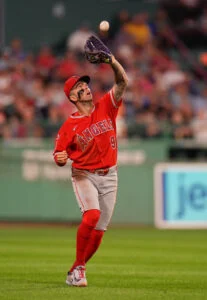 There are real flaws. Neto strikes out often, isn’t an efficient base stealer and can make defensive mistakes. He’s a tier or two below shortstops such as Bobby Witt Jr. and Elly De La Cruz. Still, three controllable seasons from an above-average shortstop carry substantial value, particularly in an offseason with virtually no free-agent options at the position.
The Angels reportedly asked about Boston prospect Franklin Arias, one of baseball’s top three prospects, during deadline talks over Neto. That would be an ambitious return, but Los Angeles can reasonably ask for multiple Top 100 prospects, including a headliner in the top 25–50. Nimmala hit well in Double-A after the Soriano deal and could eventually take over at shortstop. The Angels would still need a veteran bridge for what may be another rebuilding season. The reported Arias inquiry gives a sense of the scale of return the club has considered.
4. George Kirby, Mariners, RHP
Arbitration eligible through 2028; projected 2027 salary: $9.8 million.5. Emerson Hancock, Mariners, RHP
Pre-arbitration; controllable through 2030. Seattle finally traded a starting pitcher this summer, sending Luis Castillo to the White Sox. But the Mariners haven’t yet reshaped their homegrown rotation, and another move now looks plausible. Seattle is unlikely to trade touted rookie Kade Anderson. The rest of the staff could enter trade discussions. Logan Gilbert has one arbitration year remaining; Kirby has two, Bryce Miller and Bryan Woo have three, and Hancock has four. All five should attract calls. Anderson will probably get a few, too, though those conversations are likely to end quickly. Kirby and Hancock drew the most public attention at the deadline: Seattle appeared to test Hancock’s value after a strong stretch, while doing more background work on Kirby. Hancock, the sixth overall pick, posted a 3.57 ERA in 25 starts and struck out 22.3% of hitters, up six percentage points from his previous career high. He changed his pitch mix, throwing more four-seam fastballs and fewer sinkers. A new cutter became his best weapon against left-handed hitters, who had hit his changeup hard in 2025. This version could fit as a solid No. 3 starter. A left abductor strain ended his season in the final month, but he should have a normal offseason. Kirby’s case is more complicated. He has flashed an All-Star ceiling, but his recent results have been closer to league average. He finished 2026 with a 4.33 ERA and a career-low 20% strikeout rate in 30 starts. His exceptional command has slipped to merely very good, and he struggled away from pitcher-friendly T-Mobile Park. Even so, the market for controllable starters should give Kirby a long list of suitors. His average fastball velocity climbed from around 96 mph to nearly 97 this year, and he still has a strong strikeout and walk profile against right-handed hitters. He isn’t far removed from looking like a No. 2 starter with much the same arsenal. A buyer may believe a small adjustment can bring that form back. Seattle would likely trade from its rotation to add offense now. The Mariners ranked 28th in scoring and could lose their best hitter, Randy Arozarena, in free agency. A corner-outfield bat is a priority, and the club could also seek an upgrade at shortstop.The Nationals’ decision on CJ Abrams is a test of their timeline. He has two years of arbitration control left and appears headed for an eight-figure salary. Washington has enough offense to chase a playoff spot, but its pitching staff needs a major overhaul. If the club expects to contend in 2027, keeping Abrams—or trying to extend him—makes sense. If not, trading him could be the defining move in a rebuild that has already run longer than planned.
Houston has more infielders than places to play them
8. Isaac Paredes, Astros, 3B ($13.35MM club option for ’27; projected for $15MM in arbitration if the option is declined)
9. Christian Walker, Astros, 1B ($20MM salary in ’27)
Houston’s infield crunch looks like a trade opportunity, but last year showed why the Astros might hesitate. Paredes was a frequent subject of trade speculation as Houston sought a left-handed bat. Then he suffered a potentially season-ending injury before the 2025 deadline, prompting the Astros to make a major deal for Carlos Correa to play third base.
The resulting roster left little obvious room for a healthy Paredes. Correa had third, Jeremy Peña was at short, and Jose Altuve had returned to second after a brief move to left field. Christian Walker was signed through the season on a three-year, $60MM deal, while Yordan Alvarez occupied most of the designated hitter role. Houston kept Paredes, who had two years of control remaining, and injuries to Peña and Correa soon made that apparent surplus useful.
The same names return this winter, with Alvarez still at DH. There are more established infielders than daily jobs. Injuries may again settle the lineup, but Walker is easier to move with only one contract year left. Paredes costs more, which could make Houston more motivated to deal him. Both players are set to reach free agency after the season.
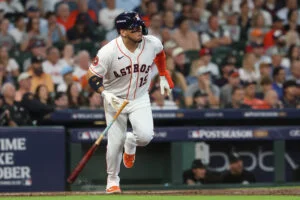
Paredes gives a buyer a clearer case. He hit .262/.360/.447 with 25 home runs in 2026. His defense at third was below average, though he handled first adequately in 15 games and made occasional appearances at second, where he’s an emergency option rather than a regular solution. His projected arbitration salary is higher than the $13.35MM option, so Houston—or an acquiring team—would be expected to exercise the option. His pull-heavy, fly-ball swing also suits Daikin Park’s short left-field porch. That’s real value for the Astros, which makes a trade less automatic than the roster math suggests.
Walker’s value is harder to sell. He started well, then faded, finishing with 29 homers and strong first-base defense but a .226/.299/.427 line at age 35. Houston might need to cover a substantial share of his $20MM salary to move him. A buyer could still take on roughly 40% of the remaining deal, giving the Astros some payroll relief and a way to simplify the infield. Walker also publicly criticized Houston fans after the team was booed during a Wild Card loss to the White Sox, a controversy that may make a reset appealing to both sides. He spoke out about the fans’ reaction.
St. Louis has a choice on Alec Burleson’s timing
10. Alec Burleson, Cardinals, 1B (arbitration eligible through ’28; projected $8.3MM salary)
St. Louis spent much of the first half around the playoff picture, then sold at the deadline when its pitching failed to hold up. The offense exceeded expectations, in large part because of Burleson. At 27—he turns 28 in late November—he hit a career-high 26 home runs and posted a .279/.343/.473 line while earning $3.3MM.
Burleson has been an above-average hitter for three straight seasons and a plus bat over the last two. Since 2024, he’s hit .279/.324/.451; since 2025, .284/.343/.466. His projected raise to $8.3MM is manageable. The harder question is whether the Cardinals expect to contend in 2027. If president of baseball operations Chaim Bloom sees another year of transition, Burleson’s value may be near its peak with two years of control left.
There’s no need to rush a deal. St. Louis could wait until summer or even next offseason and still find a market; if the club is competitive in 2028, Burleson could be part of that team. But a prime-aged power hitter who has struck out in just 16% of his plate appearances over the past two seasons should draw interest. Free agency offers first-base alternatives including Jake Bauers, Ty France and Alec Bohm, alongside other trade candidates. That competition could limit the bids. Still, a club willing to offer pitching should be able to get the Cardinals’ attention.
Steven Kwan’s rebound changes the trade question
11. Steven Kwan, Guardians, CF/LF (arbitration eligible through ’27; projected $11.3MM salary)
Kwan’s poor first half had put his Cleveland future in doubt. He carried a .212/.318/.257 line into July after an ugly finish to 2025, and a non-tender once looked plausible. Then he flipped the story: from July onward, he led the majors in batting average and on-base percentage, hitting .352/.445/.441.
He finished at .282/.382/.349, with a career-best 13.3% walk rate and a strikeout rate below 10%. The power remains slight—three homers and a .067 isolated power—but Kwan ranked among the top 10 qualified hitters in on-base percentage. That’s a useful reminder that his value doesn’t depend on slugging.
His defense also held up across positions. A four-time Gold Glove left fielder, Kwan started nearly half of Cleveland’s games in center and graded well over 637 innings, with six Defensive Runs Saved and six Outs Above Average. His usual left-field defense remained strong too.
Guardians president of baseball operations Chris Antonetti played down the trade possibility at his season-ending press conference: “As we sit here today, we’re expecting Steven Kwan to be a big part of a contending team next year.” Cleveland needs outfielders and has little payroll committed for 2027, so an arbitration salary above $11MM is within reach. An extension seems less likely; after 2027, the club could issue him a qualifying offer and potentially receive compensation if he leaves.
Still, Cleveland’s pattern is to trade stars approaching free agency, with José Ramírez the notable exception. The Padres, Phillies, Cubs, Giants, Yankees, Astros, Blue Jays and Reds are among the clubs that could call. Whether Cleveland listens is less clear than whether Kwan would have a market.
Jarren Duran’s price has to match the risk
12. Jarren Duran, Red Sox, LF (arbitration eligible through ’28; projected $11.1MM salary)
Duran’s 2026 was a brutal version of a 20-20 season: he barely reached 20 in both homers and strikeouts, while his rate numbers cratered. Across 608 plate appearances, he hit .207/.266/.361, career lows for a full season. Among 135 qualified hitters, only Ezequiel Tovar had a lower on-base percentage. Duran walked less, struck out more and hit the ball with less authority.
Boston reportedly made him available at the deadline. The timing came shortly after Duran seemed to criticize third-base coach Chad Epperson for holding him at third rather than sending him home on a play Duran thought could become a sacrifice fly. Nothing came together. The Red Sox then struggled through September and scored only two runs across two lopsided Wild Card games against the Yankees. They may want a stronger bat to share left field and DH with Roman Anthony.
An $11.1MM arbitration projection creates some non-tender risk, but another team could see Duran as a change-of-scenery bet. From 2023 through 2025, he hit .276/.339/.471 in nearly 1,800 plate appearances. He runs well and is a strong left fielder; he could probably play center for a club without a Gold Glove regular such as Ceddanne Rafaela. With two years of control left, the Giants, Cardinals, Rangers, Angels and Phillies could make sense as landing spots.
Texas could test two full no-trade clauses
13. Jacob deGrom, Rangers, RHP ($37MM salary; ’28 club option starts at $20MM)*
DeGrom has the power to shut down any trade discussion. His five-year, $185MM Rangers contract includes a full no-trade clause, which he used to block talks with Atlanta before the deadline. The proposed deal may have sent him to the Braves and could have involved Spencer Strider going to Texas. DeGrom may simply prefer to stay put. It’s also possible he was willing to revisit a move in the offseason.
The Rangers have a difficult roster and payroll problem. They’ve missed the playoffs three years running despite playing in a division where no team consistently took control, and ownership has constrained spending both in the offseason and at the deadline. Texas hasn’t signaled a full teardown, but moving some expensive commitments to players in their mid-to-late 30s would help.
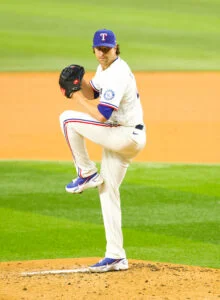
DeGrom is the biggest 2027 salary on the books: $37MM in the final guaranteed year of his deal. The Rangers’ $20MM option for 2028 was added after he underwent Tommy John surgery; it rises to $30MM if he finishes in the top five of Cy Young voting in 2027.
If he won’t waive his clause, Texas has no path to a trade. If he does, contenders with money should be interested even after a 4.20 ERA season. DeGrom struck out 30% of opponents and still worked in the upper 90s. At 39, he’d remain a potential frontline addition. Atlanta could return to the conversation, with the Dodgers, Padres and Red Sox also plausible fits.
14. Corey Seager, Rangers, SS ($31MM annually from ’27-’31)*
If deGrom won’t move, Texas could ask Seager. He has full no-trade rights as a 10-and-5 player, and his contract is an obstacle: $155MM across his age-33-to-37 seasons, or $31MM a year through 2031.
His 2026 season adds uncertainty. Seager went on the injured list three times, twice with lower-back problems, and hit .227/.312/.424 in 436 plate appearances. The overall line makes a trade hard to picture. But the ending was better: after returning from his final IL stint on July 31, he hit .269/.332/.472 with 10 homers in 51 games. Teams needing a shortstop or third baseman won’t find many easy answers in free agency, and Seager can still play short before shifting to the hot corner. If Texas covered enough salary to bring his cost down to roughly $22MM to $25MM annually, Atlanta or the Yankees might at least ask whether he’d approve a deal.
Minnesota has already seen a Larnach deal fall apart
15. Trevor Larnach, Twins, LF (arbitration eligible through ’27; projected $6.3MM salary)
Minnesota believed it had traded Larnach at the deadline, agreeing to send him to Houston for rental reliever Bryan Abreu. Astros owner Jim Crane vetoed the swap, an apparent sign that he had lost confidence in general manager Dana Brown, whom he dismissed three weeks later. Larnach finished the season with the Twins. The failed deal still leaves the impression that Minnesota is ready to move on.
The case for moving Trevor Larnach is mostly about Minnesota’s depth. He had a productive season, hitting .269/.352/.436 with 13 home runs in 433 plate appearances, and was 31 percent better than average against right-handed pitching. The Twins shielded him from most lefties, though, and have a growing queue of left-handed outfielders: top prospects Walker Jenkins and Emmanuel Rodriguez debuted late in the season, while Alan Roden and Hendry Mendez are in the upper minors. Larnach’s projected $6.3MM salary could probably do more for Minnesota elsewhere. A trade would likely bring a modest return, with the Padres or Diamondbacks among the plausible fits.
16. Teoscar Hernández, Dodgers, LF
Teoscar Hernández is due $14.5MM in 2027, including $8MM deferred, and then has a $15MM club option or $6.5MM buyout for 2028. The Dodgers have no pressing need to reduce payroll. Still, they have a crowded outfield and a top prospect ready for a larger role, which makes Hernández a candidate to move if another club helps cover the cost. That prospect is Josue De Paula. The 21-year-old debuted late in the year after excelling in the upper minors and made a strong impression at the plate. He’s ranked among the top five prospects in baseball. Even if he needs more time, Los Angeles has plenty of cover: Kyle Tucker is committed to right field on the major deal he signed last winter, and Andy Pages is coming off a breakout in center. The farm also includes two more outfielders in Baseball America’s top 20, Eduardo Quintero and Mike Sirota, plus No. 80 Charles Davalan. If none is ready, versatile veterans can fill gaps; Tommy Edman is the clearest option.
Hernández, 34, hit .267/.334/.425 with 16 homers and a 110 wRC+. The overall line looks useful, but the split matters: most of his damage came against left-handed pitching, while he was slightly below average against righties. His defense has also slipped to well below average, with minus-5 DRS and minus-5 OAA across 999 innings in the corner outfield. That’s a limited package for an expensive veteran, even if his bat can still help in the right matchup.
A lower-spending club that can’t or won’t pursue Seiya Suzuki or Randy Arozarena might see Hernández as a cheaper source of corner-outfield power. The Dodgers may need to absorb a few million dollars to make the numbers work. Potential fits include the Reds, Royals and Marlins, clubs seeking corner help; the Blue Jays, who struggled against lefties; and the Twins or Rangers, which could have openings at designated hitter. The amount Los Angeles is willing to pay down may decide where he lands.
17. MacKenzie Gore, Rangers, LHP
MacKenzie Gore is arbitration-eligible through 2027 and projected to earn $8.7MM. Texas spent a five-player package to acquire him from Washington last winter, led by infielders Gavin Fien and Devin Fitz-Gerald. The bet was on upside: Gore was the No. 3 overall pick and once baseball’s top pitching prospect. But injuries and mechanical trouble have interrupted his progress. San Diego, his first organization, even sent him to extended spring training to reset his delivery.
Gore appeared in only 16 big-league games for the Padres before going to Washington in the Juan Soto blockbuster. He never reached the stardom of James Wood or CJ Abrams, but his time in Washington offered real signs of progress. In the summer of 2025, he had a 3.02 ERA, a 30.5% strikeout rate, a 7.7% walk rate and a 36% ground-ball rate through 110 1/3 innings over 19 starts. Then came a disastrous four-start run: 23 runs allowed in 15 2/3 innings. He recovered and finished well, but his ERA settled at 4.17.
Texas wanted something closer to the promising version over two seasons. Instead, Gore spent much of 2026 with an ERA in the low-to-mid 4.00s. His average fastball barely changed, from 95.3 mph in 2025 to 95.1 mph in 2026, but his strikeout rate fell from 27.2% to 23.2%, and his swinging-strike rate from 13.3% to 11.2%. Those remain respectable figures, and he allowed less hard contact than the year before. The bigger problem was traffic: with runners on second or third, opponents hit .294/.395/.500 against him.
At $8.7MM, Gore is a fairly expensive one-year bet on a rebound, with just one year of team control left. The Rangers could still move him for a prospect or two and shave payroll, a priority for ownership for more than two years. But the price should reflect Texas’ thin rotation depth: replacing his innings would mean bringing in another starter, and Gore still has enough upside to be worth keeping. He’s 28, throws left-handed at 95 mph and can miss bats above average. If he breaks through in Texas, he could become a qualifying-offer candidate if that system remains in place, or raise his trade value by the 2027 deadline. The White Sox, Mets, Blue Jays, Orioles, Braves, Giants, Cubs, Reds and Padres are reasonable destinations.
18. Jeremy Peña, Astros, SS
Jeremy Peña is arbitration-eligible through 2027, with a projected salary of $13.1MM.


