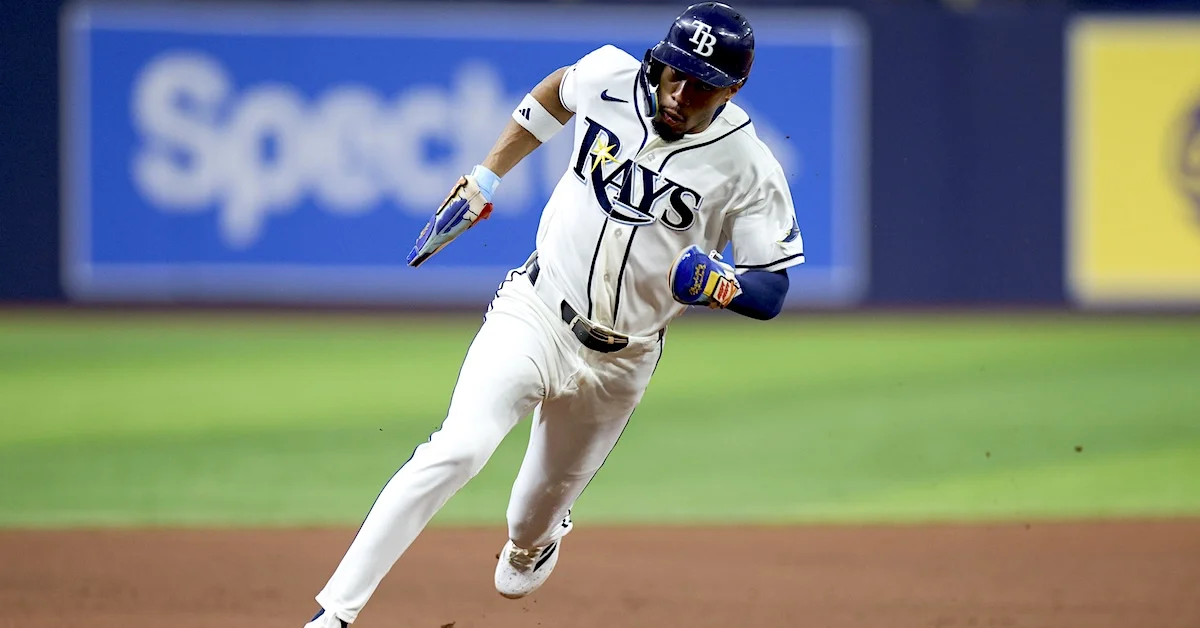
Chandler Simpson already owns one of baseball’s most distinctive offensive profiles. This season, the Tampa Bay outfielder led the majors with 359 competitive runs, even though his 612 plate appearances trailed the totals of every other player in the top 10 for the category. That gap points to a bigger possibility: if Simpson earns a full season near the top of the lineup, Amed Rosario’s single-season record of 369 could be vulnerable.
A stat that captures how a player runs
Competitive runs are the plays Statcast uses to measure sprint speed when a hitter is likely to be running at full effort. The category includes a batter racing to first after a topped or weakly hit ball, and a runner advancing at least two bases. It excludes routine trips down the line and scoring from second on an extra-base hit, situations that don’t offer the same read on a player’s top speed.
The number was developed as a way to select useful opportunities for measuring sprint speed, but it also says something about how a player creates offense. A high total generally requires frequent contact, balls hit on the ground or weakly, and enough times on base to attempt extra advances. That combination makes the statistic an unusually vivid snapshot of a speed-first approach.
Rosario set the high-water mark in 2022 with 369 competitive runs, nearly 70 more than any other player that season. He had 670 plate appearances, hit .104 above league average by wRC+ with a 104 mark, and recorded nine triples, the most in the majors. Simpson’s 359 is the fourth-highest total on record, and he reached it in fewer trips to the plate.
Simpson’s swing creates the chances
Simpson’s approach is built to put the ball in play and give his legs a chance to matter. His swing is unusually slow and flat, with little of his body committed to generating power. That limits his ability to drive the ball in the air, but it leaves the bat on plane with pitches for a long time and gives him room to adjust. The result is one of the highest contact rates in baseball and a steady stream of low line drives and hard grounders.
He also has baseball’s fastest home-to-first time. The combination is easy to see in the ways he pressures defenses: bunts that force quick decisions, stolen bases, and ground balls that turn ordinary fielding plays into races. In the playoffs, those skills have been on display for a broad audience. Simpson led the American League in steals and came close to winning a batting title.
That run of production fits the competitive-runs measure almost too neatly. Simpson’s game gives him frequent opportunities to sprint, while his speed helps turn contact into baserunners and additional bases. He averaged 0.59 competitive runs per plate appearance this season, meaning nearly six out of every 10 plate appearances involved a play that qualified for the metric.
Lineup position limits the counting total
Competitive runs are a counting statistic, so playing time and batting order matter. Rosario’s record, and the other totals at the top of the leaderboard, came with more plate appearances and more time in the first or second spot. Simpson spent a plurality of his plate appearances batting fifth, and nearly as many batting sixth as leading off. That placement took away opportunities to accumulate runs.
The season leaderboard makes the distinction clear:
| Year | Player | Competitive Runs | PA | AVG Batting Position |
|---|---|---|---|---|
| 2022 | Amed Rosario | 369 | 670 | 2.5 |
| 2017 | Dee Strange-Gordon | 369 | 695 | 1.3 |
| 2015 | Ben Revere | 368 | 634 | 2.3 |
| 2026 | Chandler Simpson | 359 | 612 | 4.2 |
| 2017 | Elvis Andrus | 348 | 689 | 2.8 |
| 2016 | Mookie Betts | 344 | 730 | 1.8 |
| 2017 | Jose Altuve | 343 | 662 | 2.7 |
| 2016 | Jean Segura | 342 | 694 | 1.1 |
| 2016 | Adam Eaton | 342 | 706 | 1.3 |
| 2017 | DJ LeMahieu | 341 | 682 | 2.0 |
Every player above Simpson spent at least a plurality of his time batting first or second. The average batting-position figure in the table reflects the same pattern: most of the leaders were substantially closer to the top of the order. A leadoff hitter simply gets more chances over a season than a player batting fifth or sixth. The difference can be large enough that a hitter lower in the order needs many more games to reach the same plate-appearance total.
There’s a performance reason Simpson hasn’t occupied the leadoff spot every day. The Rays sometimes sit him against left-handed pitching, against which he has a 76 wRC+ across his two major-league seasons. His 93 wRC+ this season also gives the club less reason to lock him into the top spot than Rosario’s 104 wRC+ did in 2022. With a stronger offensive line, Simpson might have played more often, hit leadoff more consistently, and approached 700 plate appearances.
The record depends on what comes next
Simpson is only in his second major-league season and is 25, so there’s room for his offense to develop. His speed already adds value to his profile; he may not need a major transformation at the plate to become a credible everyday leadoff option for Tampa Bay. Still, his production against lefties and his 93 wRC+ are real constraints, and the path to a record season depends partly on improving enough to stay in the lineup and near the top of it.
As Baseball America’s JJ Cooper has noted, Simpson was pursuing an unusual batting-title milestone this year: becoming the first player to win a batting title in college, the minors, and the majors. That ambition underscores how much contact and batting average shape his game. The next test is whether he can keep that contact-driven style while raising his value enough to earn more consistent opportunities.
On a rate basis, Simpson already leads this group. On a full-season total, he sits fourth, despite fewer plate appearances than the other names on the list. If his role grows and his bat holds up, the competitive-runs record is within reach. For now, 359 is a remarkable measure of how often Simpson turns contact into a sprint—and a preview of what a season at the top of the order might produce.


