Ireland have cleared the first hurdle in their World Cup qualifying play-offs. The harder test comes in December, and Poland’s comeback against Belgium has made the route there more interesting. Carla Ward’s side can take confidence from two decisive wins; they’ll also know that a past record against Poland won’t settle a two-legged final.
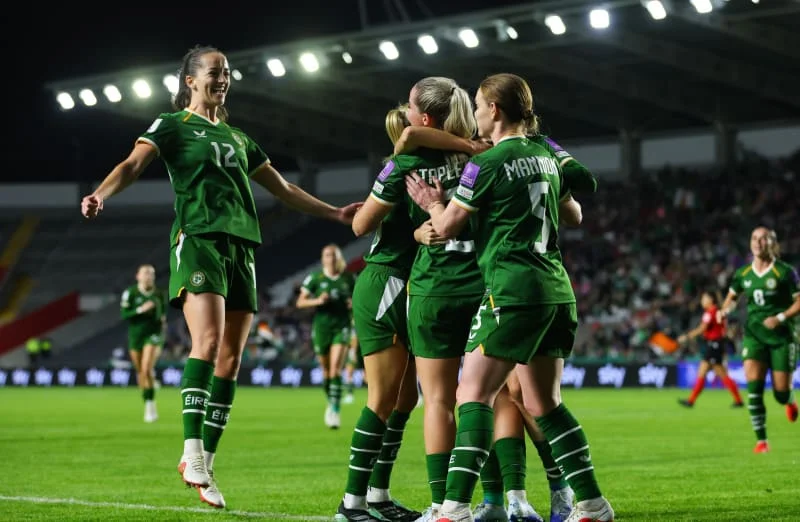
Ireland celebrate after Jessie Stapleton broke the deadlock in Cork. Ryan Byrne/INPHO
Ireland take care of business
Ward’s message after the semi-final win over Kazakhstan was simple: six weeks, two more cup finals. Ireland’s players marked the occasion with “Put ‘em Under Pressure” and Kabin Crew’s “The Spark” as they went around Páirc Uí Chaoimh. The celebration was real, but so was the focus on what comes next.
Kazakhstan sit 78 places below Ireland in the world rankings, so these two matches were always expected to be a formality. The play-off format can be questioned; Ireland’s task was to beat the team in front of them, and they did it professionally. An 8-0 win in Astana last Friday was followed by a 4-0 result in Cork.
The two games also gave Ward useful depth to assess. Ten players scored: Kyra Carusa and Jessie Stapleton twice each, alongside Chloe Mustaki, Abbie Larkin, Emily Murphy, Jamie Finn, Shanade Hopcroft, Katie McCabe, Denise O’Sullivan and Lucy Quinn. Twenty players featured across the tie. Jess Ziu and Mustaki picked up knocks, but early indications were positive; no major injury concerns or suspension risks emerged from yellow cards.
Stapleton and Larkin stood out as competition for places grows. Ireland look well placed for December, though the semi-final alone says little about how they’ll handle a closer contest.
Poland change the picture
Poland’s penalty shoot-out win over Belgium means Ireland will face a side they’ve beaten twice in the past year. Ireland edged Belgium 5-4 on aggregate in the Nations League promotion and relegation play-off to secure a League A place for World Cup qualifying, then beat Poland 3-2 away and 1-0 at Aviva Stadium. That history may reassure Irish supporters, but Belgium are a less predictable opponent—and Poland have just shown they can overturn a difficult tie.
Belgium took a 1-0 lead from the first leg in Leuven. Elena Dhont scored in first-half injury time after both teams’ leading forwards, Tessa Wullaert and Ewa Pajor, had penalties saved. Belgium led the main attacking figures: 17 shots, 11 on target, 30 touches in the opposition box and 52.1% possession, compared with Poland’s 11 shots, six on target, 26 box touches and 47.9% possession. They could reasonably have carried a larger advantage into the return leg in Gdańsk.
Instead, Poland won 4-3 on penalties after a 3-2 match brought the aggregate score level. Pajor, the Barcelona striker, equalised in the 42nd minute. Amy Littel put Belgium back in front soon after coming on at half-time, and Paulina Tomasiak’s 67th-minute goal sent the tie to extra time. Jarne Teulings appeared to have won it for Belgium, but Pajor scored again in the 116th minute. She then missed Poland’s opening penalty; it hardly mattered, as second-choice goalkeeper Kinga Seweryn saved two. Poland had taken charge of the attacking contest and kept their nerve when it counted.
Poland are chasing their first World Cup appearance. They qualified for Euro 2025, their first major tournament, after losing twice to Austria in the group stage and then beating them in the play-off final. Ireland will be aware of the parallel: Poland have already shown they can reverse a previous defeat when the stakes rise.
Ireland know the cost of a play-off
Ireland’s 1-0 win over Scotland at Hampden Park in October 2022—four years ago last Sunday—sent the team to its first World Cup. Amber Barrett’s toe poke and Courtney Brosnan’s penalty save will be familiar reference points as this next campaign unfolds.
The more recent memory is harder. Ireland lost to Wales in the Euro 2025 play-offs, including a painful second-leg defeat at Aviva Stadium. Ward, who took over from Eileen Gleeson shortly afterwards, has urged the squad to put that result behind them: “Forget Wales. Honestly, forget Wales. We have come a long way since then.”
That’s the challenge now: carry forward the confidence from a comfortable win without assuming December will be comfortable too.
4. A full Aviva would match the moment
Ireland have earned a shot at another World Cup, but their path through the play-offs has exposed how much the team still has to learn. They swept Georgia aside 9-0 on aggregate, then drew 1-1 away to Wales before losing 2-1 in Dublin. Ireland struggled with the pressure of being favourites and didn’t make enough of the first leg. The progress is real; so are the lessons from that defeat.
This is the Girls in Green’s fourth play-off campaign. Their first ended with a 4-1 aggregate loss to Iceland in the Euro 2009 qualifiers. Now the goal is to make it two World Cup appearances in a row.
The next step comes at the Aviva Stadium on 5 December, with a 5pm kick-off. Ireland travel to Gdańsk for the first leg earlier that week, then return home for the decider thanks to their seeded status. Qualifying in front of their own supporters would be a fitting way to finish the campaign.
Carla Ward has asked for Ireland’s biggest Aviva crowd yet, and Katie McCabe has urged fans to fill the ground. A sellout would be a first. The case for it is straightforward: the team is within touching distance of Brazil 2027, and this is the match that could take them there.
The attendance record stands at 35,944, set against Northern Ireland in Ireland’s first Aviva appearance after the 2023 World Cup. Their April meeting with Poland drew 18,000 on a Saturday afternoon. Recent crowds have ranged from 14,000 against Belgium to 32,000 against England, so there’s room to grow.
There’s also a reasonable argument for Cork. Ireland have split recent home games between the Aviva, Tallaght Stadium and Páirc Uí Chaoimh; recently retired Julie-Ann Russell was among those who thought the Poland match belonged in Cork. Ireland have won every game there, produced notable upsets and averaged 12,500 spectators. Still, the return to Dublin gives supporters a clear chance to set a new record—and gives Ireland a home crowd behind them when the stakes are highest.


