The scoreline helps, but Poland will decide what it means
Ireland’s 12-0 aggregate defeat of Kazakhstan is a confidence boost, not a serious measure of how ready Carla Ward’s team is for a World Cup play-off final. They won 8-0 in Astana and 4-0 in Cork, taking them to within two matches of a second straight World Cup appearance. The next test is Poland, over two legs on 1 and 5 December. The return is at Aviva Stadium, and the prize is a place at next summer’s tournament in Brazil. Poland arrive with a very different kind of momentum: they beat Belgium on penalties and are chasing their first major tournament qualification. Ireland’s rout matters, but the contrast in routes to the final makes the coming tie a better measure of both sides. There’s a reasonable debate about whether facing such low-ranked opposition is ideal preparation. Still, ten different Irish players scored across the two games: Kyra Carusa and Jessie Stapleton got two apiece, while Chloe Mustaki, Abbie Larkin, Emily Murphy, Jamie Finn, Shanade Hopcroft, Katie McCabe, Denise O’Sullivan and Lucy Quinn also found the net. That spread should help Ward’s side carry confidence into the next camp, even though the slate resets when the teams meet in six weeks. The front three of Carusa, Larkin and Murphy caused particular trouble in Astana, and Murphy and Larkin combined again in Cork. The goals came from across the squad; the attack was plainly in good shape. “It is huge and it does give them confidence,” Ward said. She explained that Ireland kept the same broad approach for the second match because the team needed to build confidence across different combinations ahead of the next camp. “The one thing we set out to do is be better every camp and improve all the time, and I think we’ve done that. I think we’ll continue to do that.”A deeper attack, with more than two names to rely on
The Kazakhstan games also put Ireland’s changing attack in view. Before Carusa became the central striker in the build-up to the 2023 World Cup, Heather Payne—now back in the squad as a full-back, though unused in these matches—often had to lead the line alone. Ireland later moved towards a front two; under Ward, a three-player attack has become more common. Murphy and Larkin are part of that shift. Both have progressed under Ward, the former Aston Villa manager, and the goals against Kazakhstan offered another sign of their growing influence. Ireland also rely less heavily on McCabe and O’Sullivan for goals and attacking output than they once did. Carusa has reached double figures, while Murphy and Larkin are scoring and assisting more often.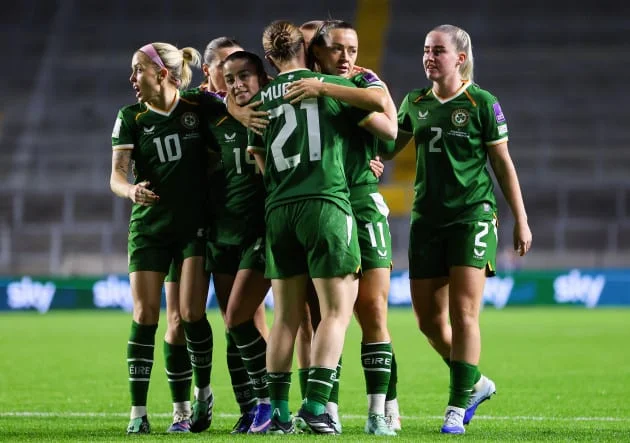 Katie McCabe celebrates her goal with Murphy. Source: Ryan Byrne/INPHO
The two younger forwards are now important players for Ireland and will keep developing at WSL clubs Brighton & Hove Albion and Crystal Palace. Whether both can start against Poland is less certain. Their understanding was clear in Cork, though.
“Larko and I get on very well,” Murphy said. “We’re similar in age, which helps. We look to each other for being very similar personnel in terms of looking for the ball in behind or maybe coming to feet, and I feel as though we work quite well together.”
She added that Larkin’s unpredictability is a strength: “With Abbie, you never know what you’re gonna get in terms of she can take a player on, she can cut back, and I think that’s a really exciting thing about her. She’s the ability to change a game and make a game.”
Murphy’s assessment of Ireland’s attack was simple: she has plenty of options. She singled out the hold-up work of Kyra Carusa and Amber Barrett, and said she couldn’t complain about the depth available across the forward line.
A painful reset, then a new shape
The change in attack is part of a broader rebuild under Carla Ward, which The 42 has tracked over the past 14 months. Ward also discussed that work in an exclusive interview last December.
She took charge in January 2025, after Ireland’s Euro play-off failure. Several senior players then retired, leaving a squad already short on confidence in the middle of a transition. Ward’s first attempt to change the team’s style went badly: Ireland lost 4-0 away to Slovenia.
That defeat still shapes how Ward views the progress since. Speaking in the bowels of Páirc Uí Chaoimh on Tuesday, with two matches left before the World Cup, she called the Koper loss a wake-up call. The result exposed how much needed fixing, she said, and helped the group confront the hurt left by the previous campaign.
Ward began with the 4-3-3 she had used throughout her club career: aggressive pressing, a high line and an attempt to play on the front foot. But the system left too much space between players and didn’t fit the squad she had inherited. The lesson was practical. A team can’t play a preferred style simply because its coach believes in it.
Last summer, Ireland settled on a more adaptable balance: defend with familiar Irish grit, while keeping Ward’s emphasis on playing with the ball. The shift to a fluid 5-3-2 began with the Nations League promotion/relegation play-off win over Belgium. Since then, Ireland’s only defeats have come narrowly against France and the Netherlands.
Ward said the players had embraced the change, though it took a year of work and collective effort. That matters as much as the formation itself. Ireland’s attacking progress appears to have come from giving players a structure they can trust, rather than asking them to force a system that leaves the team exposed.
If you're following Ireland’s World Cup push, that’s the most telling sign: the team has changed how it plays and seems to have bought into why. The results against stronger opponents are encouraging, but the next two games will show how well that progress holds under pressure.
- Listen to the latest episode of The 42’s Football Family podcast.


