Mitch Garver’s career was defined by a rare mix for a catcher: a powerful bat that could change a game, paired with injuries and defensive questions that shaped his role. After parts of 10 major league seasons with Minnesota, Texas and Seattle, Garver has retired, Ted Schwerzler of minnesotasportsfan.com reports. His career never followed a straight line from prospect to dependable regular. Instead, it turned on short stretches when his bat was unusually productive, separated by injuries and uncertainty about where he could contribute defensively.
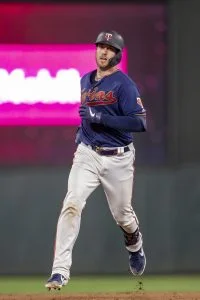 Minnesota drafted Garver in the ninth round in 2013, out of the University of New Mexico. His minor league hitting stood out, but questions about his defense behind the plate persisted. That split between offensive promise and defensive concerns followed him into the majors, where a catcher’s value is judged across more than what he does at the plate. The Twins added him to their 40-man roster after the 2016 season, protecting him from the Rule 5 draft.
A power surge in Minnesota
Garver’s 2017 debut offered little indication of what was coming: he hit .196/.288/.348 in 52 plate appearances, without a home run. He improved the next year, batting .268/.335/.414 with seven homers. The progression mattered, but the sample remained modest; what followed made his offensive ceiling much clearer. In 2019, he put together the best season of his career.
In just 93 games and 359 plate appearances, Garver hit 31 home runs for Minnesota’s “Bomba Squad.” That season’s league-wide home run surge came amid widely discussed changes to the baseball, a context that complicates comparisons with other offensive peaks. Still, Garver’s .273/.365/.630 line amounted to a 55% advantage over league average by wRC+. His defense drew less praise than his offense, yet the bat was especially valuable at a position where hitting is often harder to find. The result was a sharp example of how a catcher can become a major offensive asset even when defense limits the shape of his role.
Injuries interrupted that momentum. An intercostal strain limited Garver to 23 games in the shortened 2020 season, and he struggled at the plate. He was again hampered in 2021, but produced when available: 13 homers in 243 plate appearances, with a .256/.358/.517 line and a 139 wRC+. Availability became part of the evaluation. A hitter can retain his upside while still leaving a club with difficult lineup and roster decisions when he can’t stay on the field.
From a Texas title to a difficult Seattle stint
The rise of Ryan Jeffers gave Minnesota room to trade Garver before the 2022 season. The Twins sent him to Texas for Isiah Kiner-Falefa and Ronny Henriquez. The following day, Kiner-Falefa moved to the Yankees in a separate deal that also involved Josh Donaldson and Ben Rortvedt going to New York, with Gary Sánchez and Gio Urshela headed to Minnesota. The transactions show how Garver’s changing place in Minnesota’s catching plans created room for a new roster arrangement.
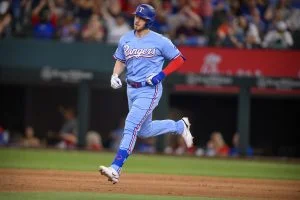
Garver’s first year with the Rangers was disrupted by injuries. He played 54 games before undergoing flexor tendon surgery in July. In 2023, despite missing significant time with a knee sprain, he returned to form at a pivotal moment: 19 home runs, a 12.8% walk rate and a .270/.370/.500 line across 344 plate appearances. Texas won its first championship in franchise history, with Garver adding three more home runs in the postseason. That is the career’s clearest counterpoint to the injury story: when he was available and producing, his contribution could extend into October and onto a championship team.
Seattle signed him to a two-year, $24 million contract after that title run, planning to use him as a bat-first backup to Cal Raleigh and part-time designated hitter. Garver hit .187/.290/.341 over the two seasons, and his limited defensive value made the decline at the plate more costly. The role depended on his offense carrying enough weight to justify the roster spot; when that bat didn’t arrive, there was less room for the rest of his profile to compensate.
Seattle brought him back on a minor league deal; he made the 2026 Opening Day roster, then was released in August after batting .175/.302/.294 in 149 plate appearances. He later signed another minor league deal, this time with the Yankees. Those moves kept the possibility of a rebound open, but the results in Seattle made the path back to a regular major league role increasingly narrow.
A career built around the long ball
Garver finishes with 702 games and 2,498 plate appearances. He recorded 497 hits, including 110 home runs, scored 301 runs and drove in 324. His career line was .229/.325/.432. FanGraphs credited him with eight wins above replacement; Baseball Reference calculated 10.1. The site estimates his career earnings at just under $35 million. The different WAR totals reflect how major public metrics can assess a player’s overall contribution differently, particularly when offense, defense and playing time all shape the picture.
His 2019 peak and his role in Texas’s title run offer a fitting measure of what Garver could provide when healthy and productive. The numbers here are underwhelming at the career level beside those standout seasons, but they don’t erase how sharply his bat could change a lineup. He leaves the game with a career shaped by both that impact and the injuries that limited it.
What Garver’s career says about role and availability
Garver’s arc illustrates a familiar tension for teams: a specialist’s value can be substantial, but it depends on the skill that makes the role worthwhile showing up consistently. For a catcher with questions behind the plate, a powerful bat offers a clear path to playing time; injuries and a prolonged slump can narrow that path quickly. (And this is the part most people overlook.) His best seasons weren’t simply good stretches of hitting; they were evidence that he could make a roster’s offensive balance look different.
If you’re working in this space, Garver’s career is a reminder that peak production and dependable availability answer different questions. The championship season in Texas remains a meaningful part of his record, while the Seattle decline explains why the later stages of his career became harder to sustain. A brief, forceful peak. That tension is what makes his retirement notable: he leaves behind a career whose most memorable moments were real, even as the full body of work was constrained by missed time and uneven results.
Photos courtesy of Jordan Johnson, Jesse Johnson, Jerome Miron, Imagn Images


