SunSong makes a strong case for letting a surfer’s joy set the tone. Spearhead Unlimited’s latest film, produced by Mikey February, centers on 17-year-old Fijian surfer James Kusitino at Cloudbreak, then gives a deep crew room to make the most of the waves around him. That structure matters: the film has a clear lead, but it doesn’t ask the rest of the lineup to fade into the background. Its appeal comes from watching one surfer’s personality anchor a group session without turning it into a one-person showcase.
Directed and edited by Sam Smith, with filming by Wade Carroll, Dave Fox, and Ian Thurtell, the film also features Tosh Tudor, Kobe Hughes, Frankie Harrer, and Indigenous Australian surfer Lungi Slabb. The ensemble is accomplished, and the range of surfers gives the footage more than one visual rhythm. Still, Kusitino supplies the film’s clearest through line: a young surfer whose grin seems to grow with the swell. That presence gives the edit an emotional center, something a sequence of technically impressive waves can’t provide on its own.
Cloudbreak, seen through Kusitino’s eyes
Kusitino’s rise over the past year helped inspire the project, and the film makes that starting point legible without turning his biography into a formal introduction. At Cloudbreak, his home break, he approaches serious surf with unusual lightness. He fades and carves back toward the foam, then slips beneath the lip; in heavier conditions, he lays back deep in the wave. Those movements show control, but the film’s emphasis stays on how he seems to enjoy being there.
The technical moments land, yet the pleasure he takes in them is what makes you want to watch. Surf films often ask viewers to admire difficulty at a distance; Kusitino’s expression gives the action a more immediate human measure. You can read the energy in his surfing even when the wave itself is doing most of the talking. This is more significant than it looks: joy becomes a point of view, not just a mood pasted over the footage.
His profile has also brought fresh attention to Fijian surfing. Kusitino once bused tables to earn gas money for trips to Cloudbreak; now he’s traveling internationally as one of the sport’s most closely watched young talents. That shift gives the film’s location a personal dimension, since the break is both a world-class surf setting and part of his own path into the sport. He’s not alone. Other Fijian surfers are working toward the same stage, and the film hints at a broader local wave of talent still to come.
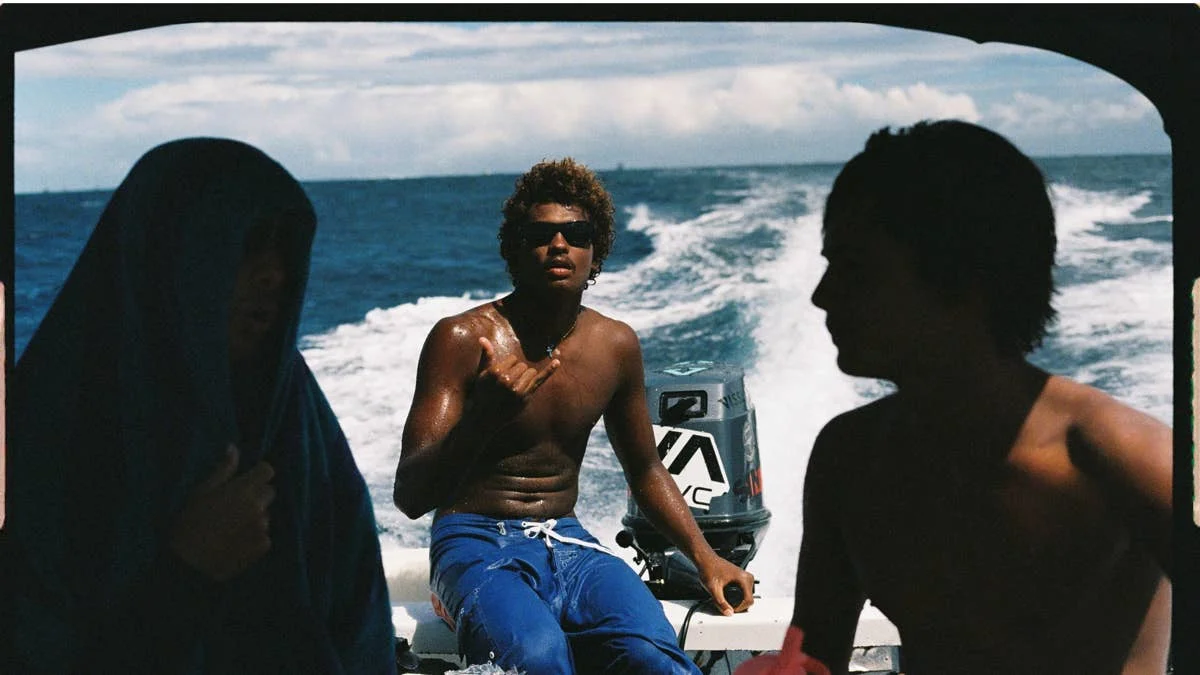
Wade Carroll
A crew that makes the most of what arrives
Cloudbreak gives the whole group a compelling stage, but the film’s interest lies in how each surfer uses it. Kusitino may have the advantage of local knowledge, yet the other surfers bring their own styles and strengths. The differences matter because they keep the footage from settling into one repeated approach to the wave. A familiar break can still look varied when the surfers make different choices within it.
A travel snag adds an unexpected thread: much of the crew’s board quiver went missing en route and arrived days late. The few boards that made it on time circulated among the surfers, who adapted and drew different lines on the same equipment. That’s a practical complication, but it also gives the sessions an unplanned constraint. Instead of treating equipment as a display of individual preference, the film shows a group sharing what’s available.
That constraint suits a film more interested in feel than in a polished gear showcase. You can see the surfers responding to the waves and to one another, with the shared boards lending the sessions a sense of improvisation. Similar travel problems can force a crew to work with fewer options, and the result here is a useful reminder that performance isn’t only about having a tailored setup. Sometimes the more revealing footage comes from watching people adjust. And that makes the board mix part of the story, rather than a sidebar.
A soundtrack built to stay with you
The music gives SunSong another point of connection. Hugh Masekela and Letta Mbulu, both legendary South African artists, sit alongside American saxophonist Azar Lawrence and field recordings gathered during the trip. The mix links Fiji and Africa through its rhythms, while giving the surf footage a mood that holds up on repeat. It’s an editorial choice with a clear effect: the music sets a pace that lets the sessions breathe instead of pushing every wave toward a climax.
Field recordings add texture to that combination, grounding the soundtrack in the trip’s surroundings while the established artists bring a distinct musical identity. The film doesn’t need to explain the relationship between its locations and its music; the pairing does that work through sound. That said, a soundtrack can carry a surf edit only so far. Here, it works because it sits alongside footage with enough variation and personality to sustain attention.
What the film leaves in view
February’s taste runs through the film’s choices, from the boards to the soundtrack and the surfers’ lines. SunSong avoids the familiar feel of a highlight reel: it invites you into a session, then builds its best moments around Kusitino’s playfulness and a crew that looks like it’s having a great time. The approach gives the film a point of view without requiring a heavy narrative frame. A strong edit can make the audience feel the character of a session, and this one understands that distinction.
If you’re working in this space, the useful lesson is how much an edit can gain by letting a surfer’s personality guide the footage. Kusitino’s rise gives the film context, while the crew, shared boards, and music keep it from reading as a profile assembled around a single young talent. The wider implication is modest but meaningful: attention on one surfer can make room for a scene around him, especially when the film keeps the group visible. The next step isn’t promised here. The possibility is.
Press play, turn it up, and expect to run it back. A good surf film should leave you remembering more than the hardest turn. SunSong leaves the pleasure of the session in your head. And that’s the part most people overlook.
Related: Style is Everything in Craig Anderson and James Kusitino’s Latest Drop


