Eddie Aikau’s final paddle is part of surfing’s shared memory. The voyage of the canoe he left behind has had a longer reach: for five decades, Hōkūleʻa has helped revive Polynesian navigation and culture. Now, as weather reshapes its Pacific circumnavigation, navigator Nainoa Thompson is treating the pause as part of the work.
Aikau was among 16 people aboard the 62-foot Hōkūleʻa when it capsized in the Kaiwi Channel on a voyage toward Tahiti. The crew held onto the overturned canoe through the night. At first light, Aikau twice asked to paddle for help on his surfboard. The others joined hands in prayer, and he set off toward Molokaʻi. The Coast Guard rescued the crew; Aikau was never seen again.
His courage became central to surfing culture in part through the Eddie Aikau Invitational, which began in 1984. Images of Flea Virostko dropping into a 20-foot wave, Bruce Irons taking on a 10-foot shorebreak and North Shore lifeguard Luke Shepardson winning in enormous Waimea surf have kept Aikau’s name in view. “Eddie Would Go” became the event’s enduring shorthand for his bravery.
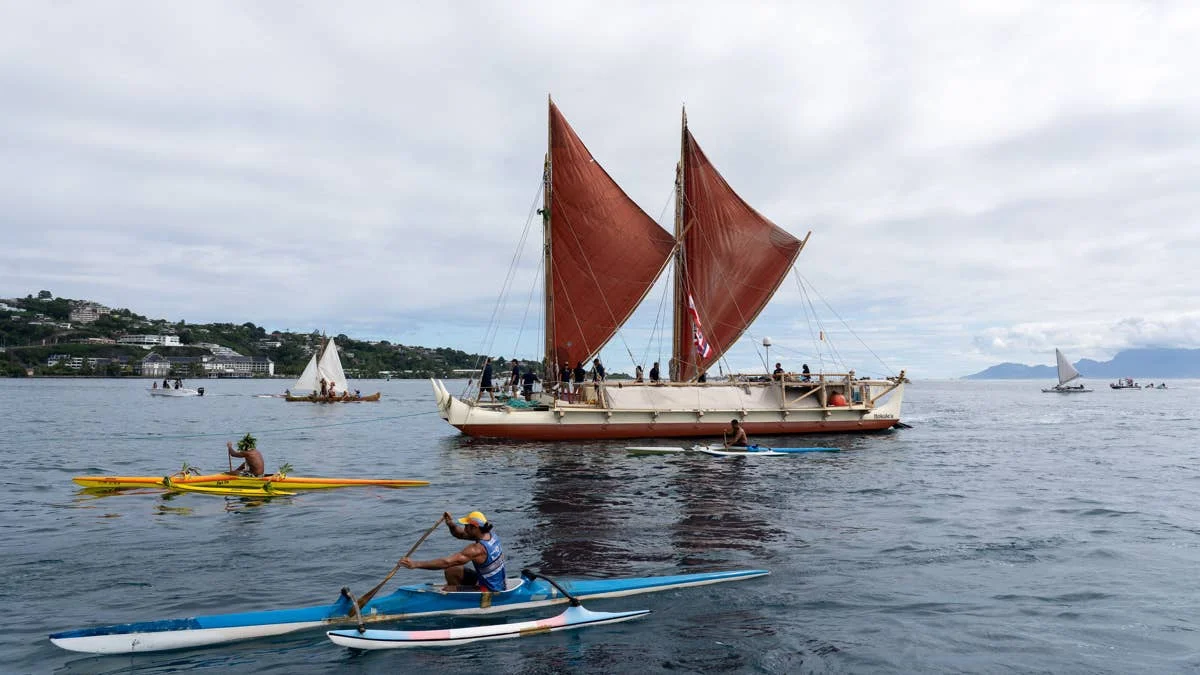
A voyage that revived traditional navigation
Thompson, then 25 and still learning to navigate, watched Aikau paddle away. The loss could have ended the effort to sail by ancestral methods. Instead, Thompson said, the crew carried on because Aikau had dreamed of finding islands as their ancestors had.
Thompson sought training from Mau Piailug, a master navigator from the Micronesian island of Satawal. Piailug had guided Hōkūleʻa to Tahiti in 1976 without instruments, reading stars, swells, birds and wind. Teaching an outsider broke tradition, but Piailug agreed. “I will train you to find Tahiti, because I don’t want you to die,” he told Thompson.
In 1980, Thompson navigated Hōkūleʻa from Hawaiʻi to Tahiti and back. He was the first Hawaiian in roughly 600 years to make the crossing using traditional navigation. The voyage helped spark a wider revival of Hawaiian and Polynesian language, canoe-building and navigation across Oceania.
The canoe’s later voyages carried that revival across the Pacific. In 1987, it completed a two-year, 16,000-nautical-mile circuit through Tahiti, the Cook Islands, Aotearoa, Tonga and Samoa. It reached Rapa Nui in 1999. From 2014 to 2017, Hōkūleʻa visited more than 150 ports and covered 40,000 nautical miles, carrying a message of care for the Earth.
Weather sets the pace
Thompson turned 73 in March. He and the crew have spent the past year in Auckland, roughly halfway through a clockwise Pacific circumnavigation that began in 2023. The voyage has slowed amid El Niño conditions, which have also drawn attention from surfers watching the Pacific—and could bring record waves to the Eddie this winter.
In a video message in June, Thompson said the sail plan would be “adjusted to what nature allows us to do.” The crew had expected to reach Fiji around mid-October for the Pre-COP climate meetings, then continue to Tuvalu. Gales and cold fronts kept them in Auckland in late September, postponing both visits, potentially until May 2027. The revised schedule pushes the circumnavigation into 2028.
Thompson describes the change as a chance to learn. “This is not a delay. It’s not a setback. To me, it’s a stepping stone of learning,” he said. The crew is weighing a 6,400-mile passage toward Hokkaido, which would mark Hōkūleʻa’s first visit to Japan in about 20 years, against a return to Aotearoa. Thompson’s research points to Aotearoa as the safest place in Polynesia during a strong El Niño.
The route remains subject to weather and stars, with an open boat and no instruments. Thompson’s long-term aim is to train and build a community of 10 million navigators. The current voyage shows what that teaching demands: judgment, patience and respect for conditions. Aikau left to seek help; the canoe he left behind continues the search for islands, knowledge and the people who will carry that knowledge forward.


