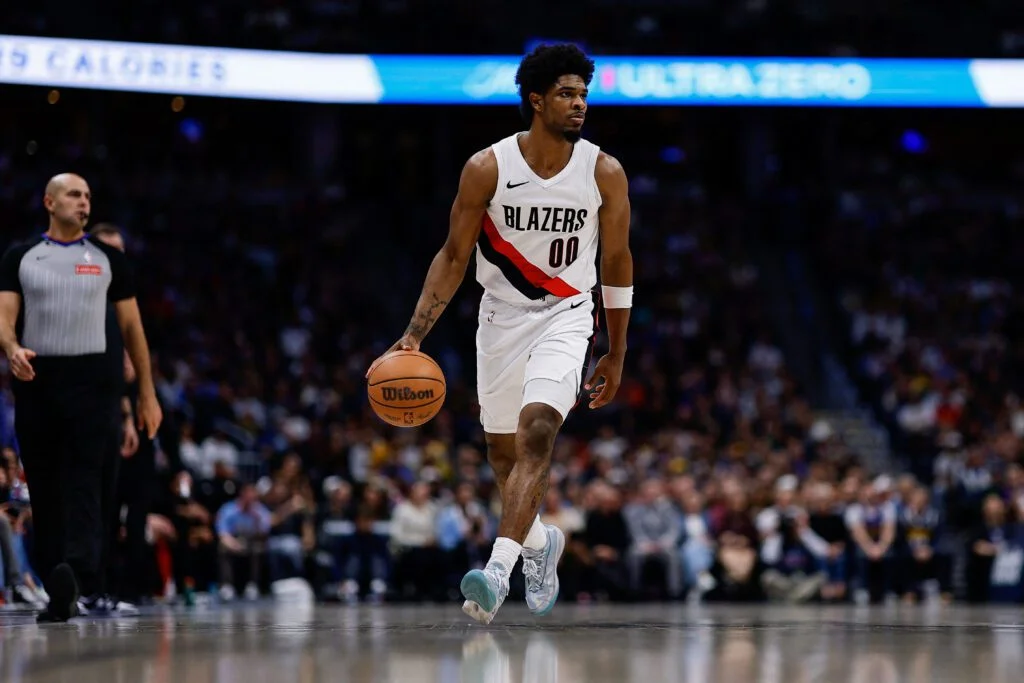
Eight players enter a season of uncertainty
Eight young players now face a season of uncertainty after passing the Oct. 19 deadline without rookie-scale extensions. Scoot Henderson headlines the group, but the reasons teams held back range from crowded rotations and injury concerns to tight cap sheets. Those differences matter: a player who needs to prove he can stay healthy faces a different test from one whose team may simply need to manage its payroll.
The deadline closed the window for teams to extend players on rookie contracts before they can test the market. NBA insider Jake Weinbach identified these notable names:
- Scoot Henderson, Portland Trail Blazers
- Anthony Black, Orlando Magic
- Jaime Jaquez Jr., Milwaukee Bucks
- Bilal Coulibaly, Washington Wizards
- Jarace Walker, Indiana Pacers
- Brice Sensabaugh, Utah Jazz
- Julian Strawther, Denver Nuggets
- Dereck Lively II, Dallas Mavericks
Other players could also enter restricted free agency, but this group stands out for its potential to become reliable rotation contributors, with some carrying higher ceilings. For teams, waiting can preserve flexibility and provide another season of evidence; for players, it leaves performance and availability under closer scrutiny. Recent cases such as Jalen Duren and Peyton Watson show how complicated restricted free agency can become for young players, especially when a team’s view of a player’s value differs from his own.
Roster and health concerns shape key decisions
Portland’s hesitation with Henderson appears tied to its crowded backcourt. He improved last season, averaging 14.2 points, 2.7 rebounds and 3.7 assists per game, and the Trail Blazers see him as part of their rotation. That’s a useful foundation, but it doesn’t by itself answer how large a role the team expects him to hold as its guards compete for minutes. With several players occupying similar space in the rotation, Portland has reason to wait before making a major financial commitment.
Dallas faces a different calculation with Lively. The 22-year-old has a place in the Mavericks’ big-man rotation, but recurring injuries have limited his availability. He played just seven games last season, averaging 4.3 points, 5.3 rebounds and 1.6 blocks, and was still out through training camp and preseason. Dallas has enough frontcourt depth to wait and see whether he can stay healthy, because a player’s value to a team depends on being available as well as productive. That’s the central question his season needs to answer.
For Anthony Black, the obstacle is Orlando’s payroll. He had a breakout season at 15.0 points, 3.8 rebounds and 3.7 assists per game, but the Magic are roughly $600,000 below the second apron after committing significant money to their starters. The team reportedly doesn’t want to trade him, and next summer could bring more room: Orlando is projected to have nearly $30 million below the $213 million tax line. The tension is familiar for teams managing a costly core: a young player can show real progress while the timing and size of a new deal remain difficult to resolve.
That financial squeeze also helps explain the extension outlook for Denver’s Julian Strawther and Indiana’s Jarace Walker. Their situations resemble Black’s more than the prove-it cases facing some of the other players on the list. A delay, in these cases, can reflect the constraints around building a roster as much as a judgment about a player’s individual ability. For the players, the practical challenge is that a strong season may help their case without removing the team’s budget pressures.
Three players need to strengthen their cases
Brice Sensabaugh, Bilal Coulibaly and Jaime Jaquez Jr. may need stronger seasons to make an extension compelling. Sensabaugh gave Utah 14.9 points, 3.1 rebounds and 1.9 assists per game last year, but roster additions could leave fewer minutes available. He’ll need to distinguish himself in a more crowded rotation, where opportunities may depend on showing that his scoring can translate into a dependable role. The numbers here are encouraging, but the question is whether they hold up when his path to minutes gets harder.
Coulibaly has shown two-way value in Washington, averaging 11.7 points, 4.3 rebounds, 2.6 assists, 1.3 steals and 1.0 blocks. The arrival of AJ Dybantsa has raised questions about how well Coulibaly fits the Wizards’ plans, with trade speculation following. Speculation alone doesn’t settle his future, but it does underline the uncertainty around how Washington sees its roster taking shape. If you’re working in this space, the key distinction is between a player’s demonstrated contributions and the team’s confidence in his long-term role.
Jaquez joins Milwaukee after being traded this summer in the deal that sent Giannis Antetokounmpo to Miami. He averaged 15.4 points, 5.0 rebounds and 4.7 assists last season, showing he can score at multiple levels. His next challenge is proving he can become a meaningful part of the Bucks’ rebuilding effort, where a new team context may change what’s expected of him. Production is part of the case; fit and responsibility will shape the rest.
The regular season becomes the next test
Preseason performances from the group offered little to settle these questions. The regular season now gives each player a chance to clarify his value—and gives teams more evidence before restricted free agency begins. That evidence can take different forms: sustained production, a stable role, or simply a healthier run of games. No single stretch is guaranteed to resolve a negotiation, but a full season gives both sides more to judge than projections alone.
And this is the part most people overlook: the same season can strengthen a player’s bargaining position while making a team more cautious about the cost of keeping him. A crowded rotation can limit a player’s numbers, while a constrained payroll can limit what a team is able to offer. Those pressures don’t cancel each other out. They make the months before free agency a test of how closely a player’s contribution, role and expected price align.
Here’s the thing: missing the extension deadline doesn’t tell us which of these players will earn a new deal or where he’ll play next. It sets up a season in which each case can become clearer, though the reasons for uncertainty differ. Some need to establish durability or a larger role; others may have to wait for their teams’ finances and roster plans to come into focus. A longer evaluation window. For players and teams alike, that’s the immediate consequence of passing on an extension.


