Nick Martinez’s case as Tampa Bay’s Game 4 starter rests on a skill that can look like a weakness: hitters make contact against him constantly. That puts pressure on the quality and direction of that contact, because a pitcher who rarely gets swings and misses has fewer chances to escape a mistake. The Rays will need Martinez to keep producing the kind of fly balls that rarely threaten the wall when they visit Cleveland on October 16.
Martinez wins by shaping contact
Tampa Bay Rays (1) at Cleveland Guardians (2), 6:00 PM ET
TB: Nick Martinez (15-6, 3.10 ERA, 116 DRA-)
CLE: Johnny Wholestaff (36-26, 3.54 ERA, 94 DRA-)
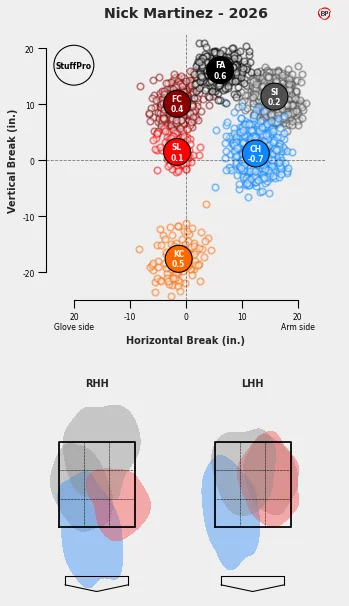
Martinez allowed two runs across 3⅔ innings in Game 3 of the ALDS against the Yankees. That outing fits a profile that can make conventional measures uneasy: he had the lowest strikeout rate among qualified starters by a wide margin, one of the four lowest ground-ball rates, and a fastball that sits around 92 mph in a league where 96 is common. He throws that fastball roughly two-thirds of the time, pairing it with a changeup meant to disrupt timing. Batters rarely chase, and no full-time starter allowed more contact.
Those numbers describe a pitcher with little margin for the usual escape routes. Martinez can’t count on a steady stream of strikeouts, and his low ground-ball rate means he isn’t routinely inducing easy rollers either. That makes the location and shape of the ball in play central to his performance. A hitter can make contact and still fail to do much damage; for Martinez, that gap between contact and useful contact is the point.
Those traits help explain the gap between his 3.10 ERA and 116 DRA-. But Martinez’s results aren’t a brief anomaly. Since coming back from Japan, he has worked more than 700 innings with a 3.53 ERA, often without a settled schedule or role. His success comes from locating pitches at the edges with unusual precision. He leads starters in the share of pitches thrown in the shadow zone near the plate, while also ranking sixth in overall zone rate. He gets close enough to the border to frustrate hitters, then lands enough pitches inside it to avoid giving away free passes.
That combination demands control of the strike zone in both directions. Living near the edge can make a pitch difficult to square up, but falling behind too often would invite hitters to wait him out. Martinez’s ability to work near the boundary while still reaching the zone helps explain why the contact-heavy approach has held up over a long stretch. It's a narrow path, and his results suggest he knows how to stay on it.
Fly balls that stay in the park
Martinez can also challenge hitters with his fastball, even down the middle. Given his high arm slot and reliance on the pitch, that might seem like a recipe for home runs. But his approach differs from pitchers who use a high fastball to climb above the barrel and collect swings and misses. Martinez tends to work across the plate: his cutter moves in on left-handed batters, while his sinker runs toward right-handers.
That movement changes the question from whether hitters can make contact to what kind of contact they can produce. A pitch crossing the plate with lateral action can be difficult to meet squarely, even when its location looks inviting. Martinez doesn’t need every fastball to miss a bat. He needs hitters to connect beneath the ball or send it skyward without enough force to carry it.
Hitters often recognize the pitches and put them in play. The backspin, however, can leave them hitting underneath the ball. That distinction matters. A few months ago, I argued for distinguishing dangerous fly balls with launch angles of 26 to 35 degrees from high flies at 36 degrees or more, which often fall short of the fence regardless of how hard they’re struck.
That split offers a more useful way to think about Martinez than simply counting fly balls. A ball in the air can be a warning, but its angle helps determine whether it has a plausible path to extra bases or a home run. (And this is the part most people overlook.) Contact isn’t one outcome; it covers everything from a harmless pop to a drive that changes an inning.
Martinez allowed 226 fly balls this season, and about two-thirds were high flies in that less threatening range. Among 155 starters who threw at least 1,500 pitches, only four had a lower wOBA allowed on fly-ball contact than Martinez’s .189. For a pitcher, a high fly that stays in the park is an unusually favorable result—and his approach appears built to produce them.
This is more significant than it looks. Martinez’s profile doesn’t merely tolerate contact; it appears to steer a substantial share of that contact toward a low-value result. Still, that outcome depends on repeating the locations and pitch movement that create it. If hitters begin squaring up the ball, the lack of strikeouts leaves less room to recover. The numbers here are persuasive, but they describe a tendency, not a guarantee.
The postseason test
There’s still a question about how well that formula carries into October, when playoff lineups don’t represent the same broad sample as regular-season opponents. A short series gives a pitcher fewer chances to let results average out, and hitters can focus on the pitches they’ve seen. That can make each well-located fastball more important, while also increasing the cost of one that catches too much of the plate.
The challenge applies to every pitcher, though, and Martinez will have the Rays’ elite outfield defense behind him, as he did in May. That support matters for a contact-first pitcher: a ball that stays in the park still has to be fielded, and the defense can help turn a playable fly into an out. It gives his approach a useful margin for error, without removing the risk that a hitter finds the right pitch and drives it.
If you're working in this space, Martinez is a reminder that strikeouts aren’t the only route to controlling an at-bat. His method asks for precision, favorable contact, and capable fielding behind him. A delicate balance.
Cleveland’s starter is listed as “Johnny Wholestaff,” with an 8.0-inning workload shared across 36 appearances. That label points to a different kind of uncertainty: Tampa Bay may not be preparing for one conventional starter’s rhythm and repertoire. For Game 4, the matchup turns on whether Tampa Bay can keep Martinez’s carefully managed contact in the air—and keep those flies in front of the wall.
What Game 4 will reveal
The central question is whether Martinez can make his regular-season method work under the tighter conditions of a postseason game. His season-long record gives the Rays a reason to trust the approach, while the contact rate and limited strikeouts leave little ambiguity about its risk. Cleveland doesn’t need to miss the pitch entirely to challenge him; a better swing could be enough to turn a routine-looking fly into a dangerous one.
For the Rays, the practical test is visible pitch by pitch: can Martinez keep locating near the edges, keep hitters from getting beneath the ball in a damaging way, and give his outfield a chance to finish the play? What this means for you as a viewer is that a ball put in play won’t tell the whole story. The flight and location of that ball will.


