Quarterback rankings: early signs, not settled verdicts
Patrick Mahomes is still on top, Jared Goff is making a quiet case for the top five, and Justin Herbert’s latest game has pushed him farther down the board. Those are the clearest signals in this week’s rankings. But five games leave plenty of room for a hot stretch—or a rough Sunday—to distort the picture.
These rankings include prior expectations, so they aren’t simply a list of this season’s highest PFF grades. By Week 5, current performance carries more weight, and the list is starting to move. The sample is still small, though, which calls for some restraint. Quarterbacks expected to miss significant time because of injury are left out; their backups take their places.
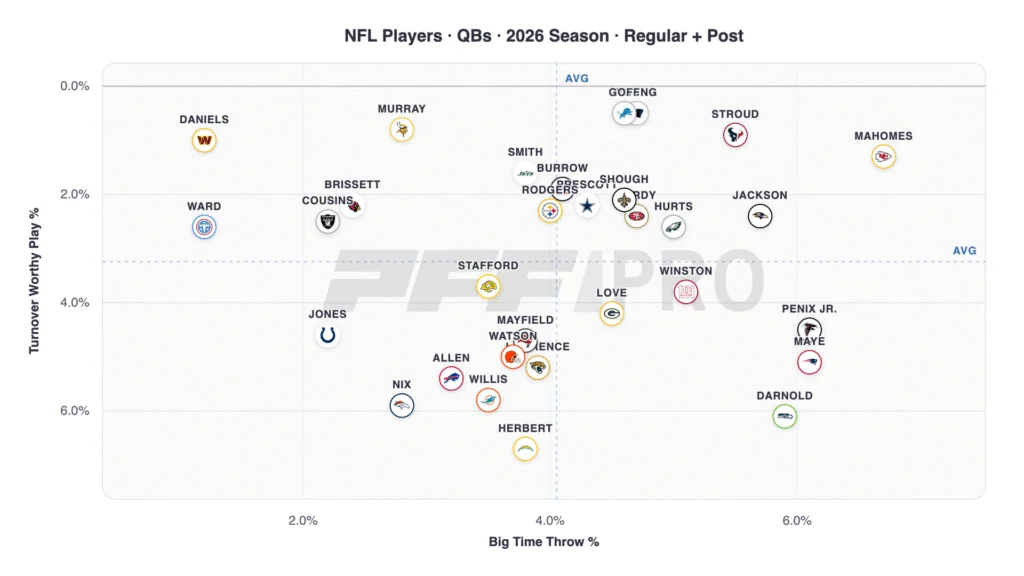
Mahomes held first place through Kansas City’s bye. His 6.7% big-time throw rate leads the NFL, while his 1.3% turnover-worthy play rate is the sixth-lowest among quarterbacks with at least 60 dropbacks. Lamar Jackson stays second despite missing Baltimore’s win over Atlanta; there’s optimism he’ll return against Cleveland. His 91.4 PFF grade leads quarterbacks with 60 or more dropbacks, and his 20.6% positively graded play rate ranks second.
Joe Burrow and Josh Allen remain third and fourth. Burrow’s 86.8 grade ranks fourth, and he’s limited turnover-worthy plays to 1.9%, the league’s eighth-best rate. Allen leads the position in rushing grade (91.9) and positively graded play rate (23.2%), but his 5.4% turnover-worthy play rate ranks fifth-worst. Brock Purdy completes the unchanged top five: he’s among the leaders in overall grade and positively graded plays, while his 0.390 EPA per play and 5.2% negatively graded play rate lead the position. He’s tracking toward the best-graded season of his career.
Goff rises as the middle of the board shifts
Goff is up three places to seventh, just outside the top five. His 86.1 passing grade leads the league, and his 0.5% turnover-worthy play rate is tied for best. That combination matters: he’s producing at a high level while largely avoiding the mistakes that can quickly undo it.
Matthew Stafford slips one spot to eighth. His 2025 MVP-level season still supports his position, but this year he has produced more turnover-worthy plays than big-time throws. If that continues, the ranking will be hard to defend. Bryce Young holds ninth after a Week 4 bye; his 88.6 grade trails only Jackson’s through five weeks, putting him on pace for the best season of his career.
Trevor Lawrence falls two places to 10th after posting a season-low 60.6 grade in Jacksonville’s win over Philadelphia. His 76.5 passing grade ranks ninth, and his 16.6% positively graded play rate is tied for 13th. He’s still playing well; the question is whether he can match the form he showed late in 2025.
Dak Prescott stays sixth after earning at least a 72.0 grade in each of his five games. His 57.1% completion rate against Tampa Bay was a season low, but three drops pulled it down; without them, it would have been 64.3%. His 19.4% positively graded play rate ranks fourth in the NFL in 2026.
Jordan Love moves up one to 11th after leading all quarterbacks with a 95.1 grade in Week 5 and throwing six big-time passes against Chicago. Better pass protection over the past two weeks has helped him look like the top-10 quarterback he’s been in recent years. Drake Maye rises one place to 12th after a 93.2 grade; only Love scored higher in Week 5. Both quarterbacks struggled early after entering the season with high expectations, then rebounded.
C.J. Stroud climbs three places to 13th. He was the NFL’s third-highest-graded quarterback this week and sits in the top 10 in both overall and passing grade through five weeks, despite Houston’s broader problems. He’s on course for career highs in both measures.
Caleb Williams enters at 14th, with optimism that he’ll return to Chicago’s lineup after the Bears benched backup Tyson Bagent during their loss to Green Bay. Across 70 dropbacks, Williams has a 14.4% positively graded play rate and a 5.8% negatively graded play rate. That latter mark is tied for third-best among quarterbacks with at least 60 dropbacks, though his sample is smaller than most. Jayden Daniels drops one place to 15th. His 77.3 grade over 98 dropbacks and 5.8% negatively graded play rate are encouraging; his Week 5 will also be remembered for late-game clock management that cost Washington a chance to attempt a game-winning field goal.
Sam Darnold falls five spots to 16th after an uneven win over the Chargers: 13 completions on 22 attempts, 168 yards, a 4.5% big-time throw rate and a 7.7% turnover-worthy play rate. His season is hard to judge on such limited evidence. He left the opener early, leaving one excellent performance and one poor one.
What the lower half is telling us
Tyler Shough slips one place to 17th after a 61.5 grade against Minnesota, his lowest of the season. That defense has troubled plenty of quarterbacks. Through five weeks, Shough has twice as many big-time throws as turnover-worthy plays, a ratio tied for sixth-best.
Jacoby Brissett rises to 18th. His 81.2 grade ranks ninth among quarterbacks with 60 or more dropbacks. He isn’t generating many big plays—his 2.4% big-time throw rate is seventh-lowest—but his 2.2% turnover-worthy play rate is tied for 10th-best. Michael Penix Jr. drops two places to 19th after his worst graded game of the season. The split under pressure is the concern: his passing grade is 90.8 when kept clean, sixth-best, and 33.9 when pressured, 10th-worst. A dip under pressure is normal; this one is unusually large.
Jalen Hurts falls two to 20th. He improved from two straight weeks below a 45.0 passing grade, but his 60.7 grade in the loss to Jacksonville was still modest. His season passing grade of 60.6 ranks 25th. Geno Smith holds at 21st. Expectations were low after his season with Las Vegas, but he’s been more careful with the ball: no interceptions and a 1.6% turnover-worthy play rate, seventh-best among quarterbacks.
Kirk Cousins drops two places to 22nd after his second-lowest graded outing of the season in a loss to New England. The blowout also gave us a first look at Fernando Mendoza. Cousins has otherwise been solid, though his four-to-five ratio of touchdowns to interceptions looks stronger than his four-to-five ratio of big-time throws to turnover-worthy plays.
Aaron Rodgers stays 23rd. His 2.3% turnover-worthy play rate ranks 12th-best, but the passing production has been middling: his three PFF passing grades, big-time throw rate and positively graded play rate all sit between 16th and 26th. Kyler Murray moves up one to 24th. He was injured early in Week 1 and struggled against Tampa Bay in Week 3, but the past two weeks have offered better signs. His 0.8% turnover-worthy play rate ranks third-best. With Minnesota’s defense behind him, a low-mistake approach may be enough.
Herbert’s further slide and Goff’s steady climb point to the same tension in these rankings: early-season performance is beginning to count, but the evidence remains uneven. Goff’s ball security is backed by five games; Darnold’s evaluation rests on roughly two. The ranking captures both the play and the limits of what we know so far.
Growth and decline in the bottom half
25. Cam Ward, Tennessee Titans (up 1)
Ward’s rise by one spot reflects a real, if still early, improvement. His turnover-worthy play rate fell from 3.8% in Weeks 1–3 to 1.1% across the past two games. The Titans may be picking near the top of the 2027 draft, but that recent progress gives them a reason to keep developing Ward and build around him instead of searching for a replacement.
26. Daniel Jones, Indianapolis Colts (up 2)
The two-place bump doesn’t change the underlying numbers: Jones has a 57.4 PFF grade through five weeks, seventh-worst among quarterbacks. His 2.2% big-time throw rate is tied for fifth-lowest, while his 4.6% turnover-worthy play rate ranks 10th-highest.
27. Bo Nix, Denver Broncos (down 3)
Nix has been below a 60.0 PFF grade in four of his five starts. His 5.9% turnover-worthy play rate is third-highest among quarterbacks with at least 60 dropbacks; his 12.3% positively graded play rate is fifth-lowest. The slide is backed by both mistakes and too few strong plays.
28. Deshaun Watson, Cleveland Browns (down 1)
Watson’s seven touchdown passes and two interceptions look serviceable at a glance. The grading tells a harsher story: his 52.7 PFF grade is fifth-lowest among quarterbacks with 60 or more dropbacks, and his 5.0% turnover-worthy play rate ranks eighth-worst.
29. Malik Willis, Miami Dolphins (no change)
Willis has struggled to pair danger with upside. His 5.8% turnover-worthy play rate is fourth-worst, while his 3.5% big-time throw rate is tied for 12th-lowest. The result is a 43.8 PFF grade, second-lowest among qualified quarterbacks.
30. Justin Herbert, Los Angeles Chargers (down 8)
Herbert’s eight-place drop has obvious context: the Chargers’ offensive line ranks 32nd, and the situation around him has been poor. Still, the line doesn’t account for all of it. His 41.7 PFF passing grade is the NFL’s lowest, and his 13 turnover-worthy plays are two more than any other quarterback. Those numbers make this more than a ranking driven by circumstance.
The backups
31. Jameis Winston, New York Giants (no change)
Winston showed more encouraging flashes in the Giants’ tie with the Washington Commanders. His 16.7% positively graded play rate in that game was 6.8 percentage points above his 9.9% mark entering the week. It’s a modest sign of progress, though one game can only say so much.
32. Jalon Daniels, Tampa Bay Buccaneers (no change)
Daniels’ 57.3 PFF grade over his first two NFL starts is modest. But his profile fits a useful backup: among 34 quarterbacks with at least 60 dropbacks this season, his 6.5% negatively graded play rate ranks eighth-best. For a reserve, avoiding damaging plays can matter as much as producing highlight throws.


